
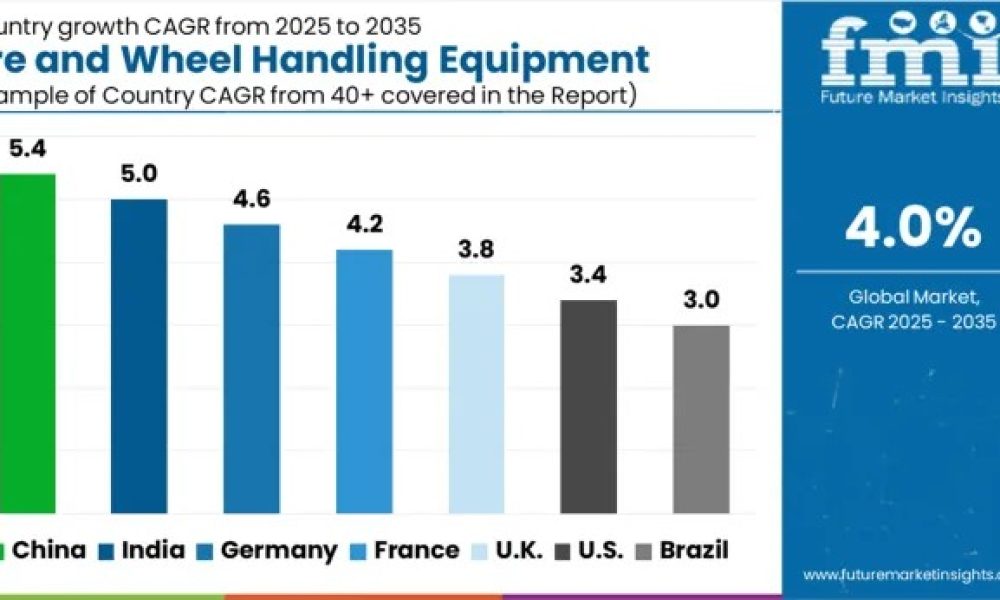
The global tire and wheel handling equipment market is transitioning into a phase of stable, long-term expansion, with market value projected to grow from USD 3.6 billion in 2025 to USD 5.3 billion by 2035, registering a compound annual growth rate (CAGR) of 4.0% over the forecast period. This growth reflects rising vehicle fleets, increasing replacement and maintenance cycles, and a structural shift toward automation, safety, and operational efficiency across automotive service environments.
Tire and wheel handling equipment—including wheel balancers, tire changers, alignment systems, inflators, and lifting solutions—plays a critical role in modern vehicle servicing. As workshops, fleets, and manufacturing facilities seek higher throughput and safer operations, demand for standardized, reliable handling solutions continues to strengthen across developed and emerging markets.
Market Evolution: From Adoption to Consolidation
Between 2020 and 2024, the market experienced an early adoption phase, led primarily by automotive repair shops, tire service centers, and fleet maintenance operators testing efficiency gains, safety improvements, and labor reduction benefits. During this period, purchasing decisions were largely driven by operational trials, return-on-investment assessments, and regulatory compliance requirements.
Entering 2025, the market has moved into a scaling phase characterized by broader adoption across commercial garages, large fleet operators, and tire manufacturing units. Manufacturers are increasing production capacity, expanding dealer and distributor networks, and investing in operator training programs to support market expansion. Rising vehicle parc levels and predictable tire replacement cycles are contributing to consistent revenue growth, reinforcing wider market acceptance.
From 2030 to 2035, the market is expected to reach USD 5.3 billion, maintaining a steady 4.0% CAGR. This period marks a consolidation phase, where leading suppliers strengthen their positions through long-term partnerships, expanded service coverage, and bulk procurement contracts with automotive service chains. Smaller players increasingly focus on niche applications or exit the market, while competitive dynamics stabilize around quality, reliability, and after-sales support.
Get access to comprehensive data tables and detailed market insights — request your sample report today!
https://www.futuremarketinsights.com/reports/sample/rep-gb-25691
Demand Structure and End-Use Dynamics
Market demand is shaped by a diverse range of end users. Automotive repair and service centers represent approximately 35% of total market demand, driven by the need for fast, accurate, and safe tire servicing. Commercial fleet operators contribute 20%, supported by logistics, delivery, and transportation fleets that require frequent tire rotation and replacement to minimize downtime.
Tire manufacturing units account for 15%, utilizing handling equipment for assembly line operations and quality inspection processes. Automotive dealerships represent 10%, integrating equipment into service bays to support aftersales operations. Additional demand comes from warehousing and distribution centers (7%), construction and off-highway operators (5%), public transport operators (4%), and motorsports and specialty garages (4%). Together, these segments reflect a market that is increasingly diversified yet anchored by high-volume service operations.
Segment-Level Performance
By equipment type, wheel balancers lead the market, accounting for 42.7% of total revenue in 2025. Their dominance reflects their essential role in ensuring vehicle stability, reducing uneven tire wear, and improving fuel efficiency. Increasing wheel complexity—particularly in passenger, premium, and performance vehicles—has elevated the need for precise balancing systems with digital measurement and automated calibration features.
From a vehicle type perspective, two-wheelers represent the largest segment, holding 38.9% of market revenue. High ownership levels in emerging economies, combined with frequent maintenance cycles for motorcycles and scooters, continue to drive demand. Specialized equipment designed for smaller wheels has enabled faster turnaround times and improved service quality, reinforcing adoption in high-volume urban workshops.
By end user, automotive repair shops dominate with 44.3% of market revenue, supported by the widespread preference for independent and franchise service centers over dealerships. Investments in modern equipment that enhances speed, precision, and customer experience are becoming a key competitive differentiator in this segment.
Regional Growth Outlook
Geographically, North America, Asia-Pacific, and Europe remain the primary growth regions. China leads global expansion with a projected CAGR of 5.4%, driven by rising vehicle production, expanding service infrastructure, and increased focus on workshop safety and productivity. India follows at 5.0% CAGR, supported by rapid growth in automotive service centers, fleet operations, and workshop modernization initiatives.
In Europe, Germany records a CAGR of 4.6%, reflecting strong adoption in automotive service centers and industrial maintenance facilities under stringent safety and ergonomic standards. The United Kingdom (3.8%) and France (4.2%) show steady growth linked to workshop automation and vehicle parc stability. The United States, growing at 3.4% CAGR, benefits from consistent demand across maintenance, fleet servicing, and compliance-driven equipment upgrades.
Drive Your Business Growth Strategy: Checkout the Report for Key Insights
https://www.futuremarketinsights.com/checkout/25691
Competitive Landscape and Industry Positioning
The tire and wheel handling equipment market is shaped by global manufacturers, regional distributors, and specialized solution providers. Industry leaders such as Hunter Engineering Company, Bosch Automotive Service Solutions, Corghi, Ravaglioli, Rotary Lift, Hofmann, Coats (a Fortive brand), and Mahle Service Solutions maintain strong positions through comprehensive product portfolios, advanced automation capabilities, and robust after-sales networks.
Competitive differentiation increasingly centers on equipment precision, durability, ergonomic design, automation readiness, and lifecycle support. Strategic collaborations with OEMs, automotive service chains, and fleet operators are strengthening market access, while innovation in robot-assisted handling systems, digital diagnostics, and IoT-enabled monitoring is shaping next-generation offerings.
Market Outlook
By 2035, the tire and wheel handling equipment market is expected to exhibit mature competitive dynamics, predictable growth patterns, and well-established service and quality standards. As workshops and fleets prioritize efficiency, safety, and reliability, investment in advanced handling equipment will remain a strategic necessity. Companies that combine technological innovation with scalable distribution, training support, and regulatory compliance are positioned to capture sustained value in this stable and well-structured global industry.
Why Choose FMI: Empowering Decisions that Drive Real-World Outcomes: https://www.futuremarketinsights.com/why-fmi
About Future Market Insights (FMI)
Future Market Insights, Inc. (FMI) is an ESOMAR-certified, ISO 9001:2015 market research and consulting organization, trusted by Fortune 500 clients and global enterprises. With operations in the U.S., UK, India, and Dubai, FMI provides data-backed insights and strategic intelligence across 30+ industries and 1200 markets worldwide.



