
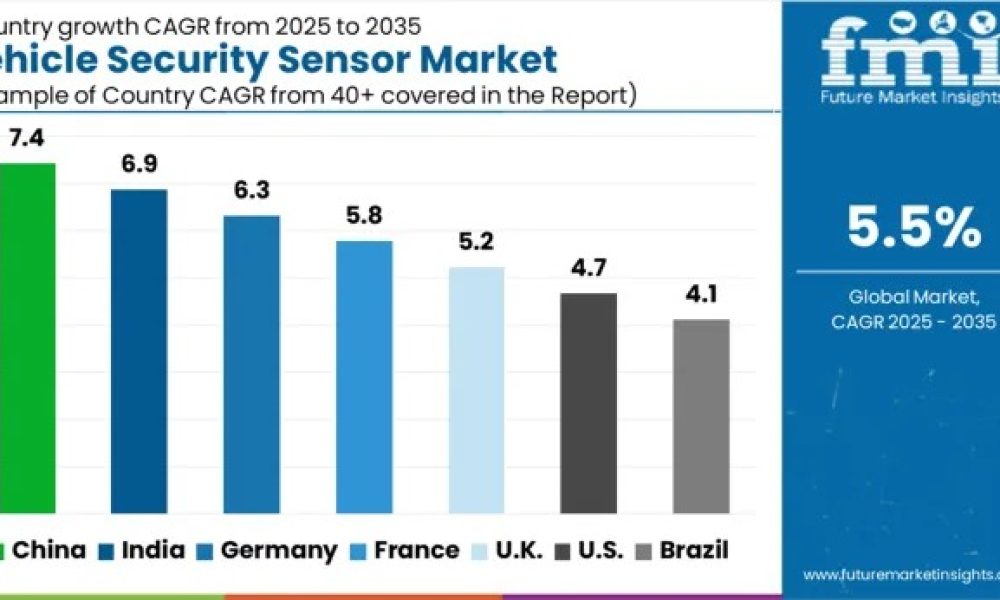
The global Vehicle Security Sensor Market is witnessing steady and structurally supported growth as automotive manufacturers, fleet operators, and consumers increasingly prioritize theft prevention, real-time monitoring, and intelligent vehicle protection systems. Valued at USD 721.1 million in 2025, the market is projected to reach USD 1,231.8 million by 2035, expanding at a compound annual growth rate (CAGR) of 5.5% over the forecast period.
This growth trajectory highlights the market’s evolution from conventional alarm-based solutions toward multi-layered, sensor-driven security architectures integrated with connected car ecosystems. Rather than being driven by a single technology, expansion is shaped by the combined and incremental adoption of motion sensors, proximity sensors, biometric access systems, and camera-based monitoring, reinforcing reliability and long-term demand.
Sensor Diversification Strengthens Market Foundations
The vehicle security sensor market demonstrates a diversified technology mix that collectively supports sustained expansion. Motion sensors remain foundational, accounting for a significant share of installations due to their widespread use in intrusion detection and anti-theft alarm systems. Their ability to provide real-time alerts and detect unauthorized movement makes them a standard component in both passenger and commercial vehicles. Market progression from USD 721.1 million in 2025 to USD 893.4 million by 2029 underscores the continued relevance of motion sensing within baseline vehicle security architectures.
Proximity sensors represent another critical growth contributor, enabling keyless entry, automated locking, and perimeter protection. Their integration across mid-range and premium vehicles supports incremental market value creation, with market expansion accelerating between 2030 and 2034, when values rise from USD 942.5 million to USD 1,106.7 million. These systems are increasingly aligned with smart access control and convenience-driven security features.
Meanwhile, biometric security technologies, including fingerprint and facial recognition sensors, are gaining traction in luxury and premium vehicle segments. While still representing a smaller portion of overall revenue, biometric systems are among the fastest-growing technologies, offering enhanced personalization, access control, and differentiation. Their gradual incorporation reflects the market’s shift toward identity-based security frameworks.
Get access to comprehensive data tables and detailed market insights — request your sample report today!
https://www.futuremarketinsights.com/reports/sample/rep-gb-25388
Camera-Based Sensors Lead Segment Adoption
Among individual sensor types, camera-based sensors emerged as the leading segment in 2025, accounting for 27.6% of market share. Their versatility across interior and exterior monitoring applications, combined with advancements in image processing, low-light performance, and AI-enabled analytics, has positioned them as a core pillar of modern vehicle security systems.
Camera-based solutions support facial recognition, gesture detection, object identification, and 360-degree perimeter monitoring, enabling automakers to deliver comprehensive security packages across multiple vehicle classes. As costs decline and scalability improves, camera-based sensors are increasingly deployed beyond premium vehicles into mid-range segments.
Interior and Exterior Monitoring Drive Balanced Growth
From a functional perspective, interior and exterior monitoring sensors each account for approximately 27.6% of market revenue, reflecting balanced demand across in-cabin safety and perimeter protection. Interior monitoring sensors play a vital role in detecting unauthorized access, monitoring occupant movement, and enhancing passenger safety—particularly in connected vehicles, ride-sharing fleets, and commercial transport applications.
Exterior monitoring sensors, including motion and camera-based systems, address rising concerns over vehicle theft, vandalism, and parking security. Their ability to deliver early warnings and continuous environmental awareness is strengthening adoption across urban and high-risk regions.
Connected Vehicles and Regulation Accelerate Adoption
The vehicle security sensor market represents approximately 5.4% of the broader automotive electronics market, underscoring its growing strategic importance. Increasing adoption of connected cars, telematics platforms, and IoT-enabled monitoring systems is enabling real-time threat detection, remote immobilization, and cloud-based alerts, transforming security sensors into intelligent, data-driven solutions.
Regulatory emphasis on vehicle safety and theft prevention, combined with insurance incentives for sensor-equipped vehicles, is further reinforcing market demand. Automakers are integrating security sensors as standard or optional features, while aftermarket installations remain strong for fleet upgrades and retrofitting older vehicles.
Asia-Pacific Leads Growth Momentum
Regionally, Asia-Pacific is emerging as the fastest-growing market, supported by rising vehicle production, urbanization, and rapid adoption of smart vehicle technologies. China leads with a CAGR of 7.4%, driven by large-scale automotive manufacturing, strong investments in sensor technology, and widespread electrification. India follows closely at 6.9% CAGR, supported by expanding passenger vehicle ownership, fleet digitization, and growing awareness of anti-theft solutions.
Europe remains a technology-driven market, with Germany growing at 6.3% CAGR, fueled by premium vehicle production and advanced sensor integration. North America, led by the United States at 4.7% CAGR, continues to demonstrate stable growth supported by regulatory compliance, connected vehicle adoption, and a robust aftermarket ecosystem.
Drive Your Business Growth Strategy: Checkout the Report for Key Insights
https://www.futuremarketinsights.com/checkout/25388
Competitive Landscape Focused on Integration and Innovation
The vehicle security sensor market is highly competitive, with leading players including NXP Semiconductors N.V., Infineon Technologies AG, Allegro MicroSystems, Analog Devices, TDK Corporation, and Amphenol Corporation driving innovation in high-precision sensing and secure connectivity. Specialized providers such as Avital, Clifford, Firstech (Compustar), and Fortin Electronic Systems compete through tailored solutions for OEMs, fleets, and aftermarket channels.
Competition is increasingly centered on sensor fusion, AI-enabled threat detection, cybersecurity, and seamless integration with vehicle electronics, rather than standalone hardware differentiation. Strategic collaborations with automakers, telematics providers, and IoT platforms are shaping next-generation security offerings.
Market Outlook
The Vehicle Security Sensor Market’s progression from USD 721.1 million in 2025 to USD 1,231.8 million by 2035 reflects the automotive industry’s shift toward intelligent, connected, and secure mobility. Growth is reinforced by technological diversification, regulatory support, and rising consumer expectations for advanced vehicle protection.
As vehicles become more connected and electronically complex, security sensors are evolving from optional add-ons into essential components of automotive safety and digital infrastructure. This transformation positions the market for sustained, long-term expansion, driven by continuous innovation, expanding applications, and global adoption across passenger and commercial vehicle segments.
Why Choose FMI: Empowering Decisions that Drive Real-World Outcomes: https://www.futuremarketinsights.com/why-fmi
About Future Market Insights (FMI)
Future Market Insights, Inc. (FMI) is an ESOMAR-certified, ISO 9001:2015 market research and consulting organization, trusted by Fortune 500 clients and global enterprises. With operations in the U.S., UK, India, and Dubai, FMI provides data-backed insights and strategic intelligence across 30+ industries and 1200 markets worldwide.



