
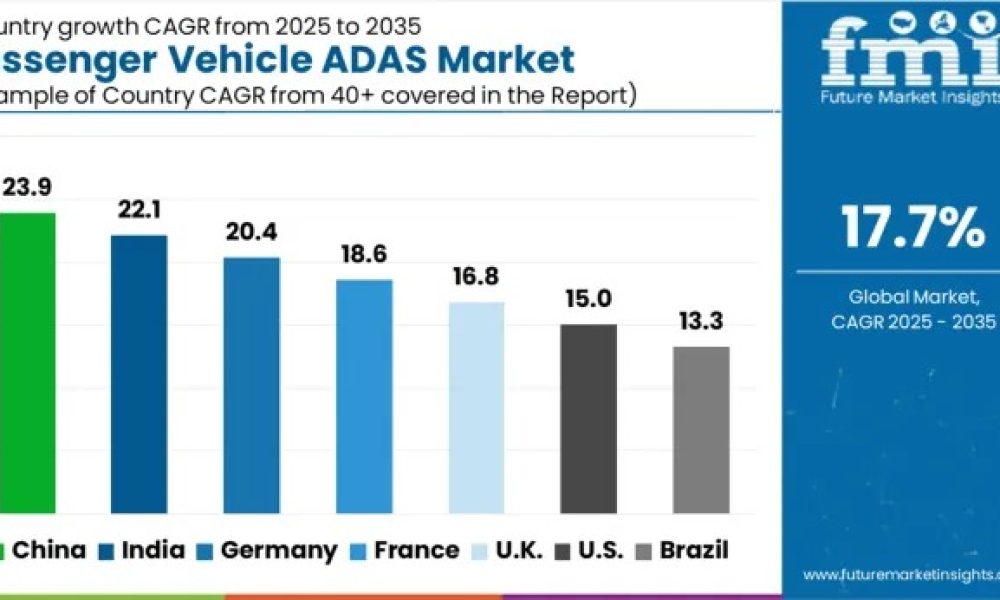
The global passenger vehicle advanced driver assistance systems (ADAS) market is entering a period of rapid and transformative growth, driven by regulatory mandates, accelerating technological maturity, and rising consumer expectations for safer and more intelligent vehicles. In 2025, the market is estimated to be valued at USD 33.7 billion and is projected to surge to USD 171.8 billion by 2035, expanding at a robust compound annual growth rate (CAGR) of 17.7% over the forecast period. This trajectory positions ADAS as one of the fastest-growing segments within the broader automotive electronics and intelligent mobility ecosystem.
At the core of current market revenues are safety-focused ADAS technologies, including adaptive cruise control, automatic emergency braking (AEB), and lane keeping assistance. These systems benefit from strong regulatory encouragement and, in several regions, mandatory integration into new passenger vehicles. As a result, they form the foundational layer of ADAS adoption and are expected to retain a significant share of market contribution throughout the forecast horizon.
Technology Evolution Driving Market Scale
The passenger vehicle ADAS ecosystem is underpinned by a sophisticated mix of sensing hardware, software intelligence, and electronic integration platforms. Radar and camera-based systems currently dominate sensor deployment due to their cost efficiency, proven reliability, and ease of integration across vehicle platforms. Radar, in particular, accounts for a leading share of sensor adoption, supported by its all-weather performance and suitability for critical applications such as collision avoidance, adaptive cruise control, and blind spot detection.
Camera systems continue to gain traction in applications such as lane departure warning, traffic sign recognition, and driver monitoring. Meanwhile, lidar, although more expensive, is expected to expand its role steadily as automakers pursue higher precision and redundancy for advanced automation. By the early 2030s, lidar adoption is anticipated to increase notably in vehicles targeting Level 3 and Level 4 automation, where enhanced environmental perception becomes essential.
Beyond hardware, integration platforms are emerging as a key value driver. Centralized electronic control units (ECUs), AI-based perception software, and multi-sensor fusion architectures are expected to account for a rising share of market value from 2028 onward. These platforms enable real-time decision-making, predictive driver assistance, and seamless coordination across multiple ADAS functions, signaling a shift from feature-based systems to holistic intelligence frameworks.
Get access to comprehensive data tables and detailed market insights — request your sample report today!
https://www.futuremarketinsights.com/reports/sample/rep-gb-26094
ADAS as a Strategic Pillar of Automotive Markets
Within the global passenger vehicle market, ADAS technologies currently account for approximately 6.8%, reflecting their growing penetration beyond luxury vehicles into mid-range models. In the automotive electronics sector, passenger vehicle ADAS contributes nearly 8.1%, highlighting the increasing semiconductor and sensor content per vehicle. Its influence is even more pronounced in the automotive sensors market, where ADAS represents around 9.0%, underlining reliance on radar, lidar, and camera technologies.
Across the advanced driver assistance and autonomous driving ecosystem, passenger vehicle ADAS holds roughly 10.2%, reinforcing its role as a critical enabler of gradual vehicle automation. This positioning underscores ADAS not only as a safety enhancement but as a foundational technology shaping the future of mobility.
Segment Leadership Anchored in Adaptive Cruise Control and Sedans
By system type, adaptive cruise control leads the market with an estimated 12.6% share in 2025. Its appeal lies in the combination of safety and driving comfort, achieved through real-time speed adjustment and distance management using sensor-based inputs. As automakers increasingly standardize adaptive cruise control in mid-tier vehicles, supported by declining component costs, the segment is expected to maintain strong momentum.
From a vehicle perspective, sedans account for approximately 41.7% of ADAS adoption, driven by high global sales volumes and early integration of advanced safety technologies. Sedan platforms often serve as testing grounds for new ADAS functionalities before broader rollout across SUVs and hatchbacks, reinforcing their strategic importance within the market.
Regulatory Pressure and Consumer Demand Accelerate Adoption
Regulatory influence remains one of the most powerful growth drivers for the passenger vehicle ADAS market. Governments across North America and Europe have introduced mandates requiring features such as autonomous emergency braking and lane-keeping assistance in new vehicles. Safety ratings and insurance incentives further reinforce adoption by linking ADAS integration to tangible economic benefits for vehicle owners.
At the same time, consumer demand for safety and convenience is reshaping purchasing behavior. Features such as blind spot detection, automated parking, and driver monitoring are increasingly perceived as essential rather than optional. As these technologies become more accessible in mid-range vehicles, market penetration continues to accelerate, supported by rising awareness of vehicle safety ratings and growing acceptance of semi-autonomous functions.
Asia-Pacific Emerges as the Growth Engine
Regionally, Asia-Pacific stands out as the fastest-growing market, led by China and India. China is projected to expand at a 23.9% CAGR, driven by strong regulatory mandates, rapid integration of ADAS across vehicle categories, and government support for intelligent mobility. India follows with a 22.1% CAGR, supported by rising vehicle sales, increasing road safety awareness, and cost-optimized ADAS deployment through local manufacturing and global partnerships.
In Europe, Germany records a 20.4% CAGR, reflecting strong demand for premium vehicles equipped with advanced safety systems and ongoing innovation in sensor fusion and AI-based perception. The United Kingdom and United States show steady, albeit comparatively moderate, growth, supported by regulatory frameworks, insurance incentives, and gradual mainstream adoption.
Drive Your Business Growth Strategy: Checkout the Report for Key Insights
https://www.futuremarketinsights.com/checkout/26094
Competitive Landscape Defined by Integration and Intelligence
The passenger vehicle ADAS market is highly competitive, shaped by global leaders such as Bosch, Continental, Denso, Aptiv, Valeo, Mobileye, Ambarella, Aisin, and Autoliv. Competition centers on system reliability, processing speed, scalability, and real-world performance. While traditional Tier 1 suppliers emphasize full-stack safety integration, technology specialists differentiate through advanced vision systems, AI-driven perception, and low-power semiconductor platforms.
Outlook
As vehicles transition toward higher levels of automation, ADAS is evolving from a collection of discrete safety features into an integrated intelligence layer central to vehicle value. The convergence of regulation, technology, and consumer demand positions the passenger vehicle ADAS market for sustained, high-growth expansion through 2035. Detailed analysis of system-level trends, regional opportunities, and competitive strategies highlights the depth of opportunity embedded within the full market report, reflecting ADAS’s role as a defining feature of next-generation passenger vehicles.
Why Choose FMI: Empowering Decisions that Drive Real-World Outcomes: https://www.futuremarketinsights.com/why-fmi
About Future Market Insights (FMI)
Future Market Insights, Inc. (FMI) is an ESOMAR-certified, ISO 9001:2015 market research and consulting organization, trusted by Fortune 500 clients and global enterprises. With operations in the U.S., UK, India, and Dubai, FMI provides data-backed insights and strategic intelligence across 30+ industries and 1200 markets worldwide.



