
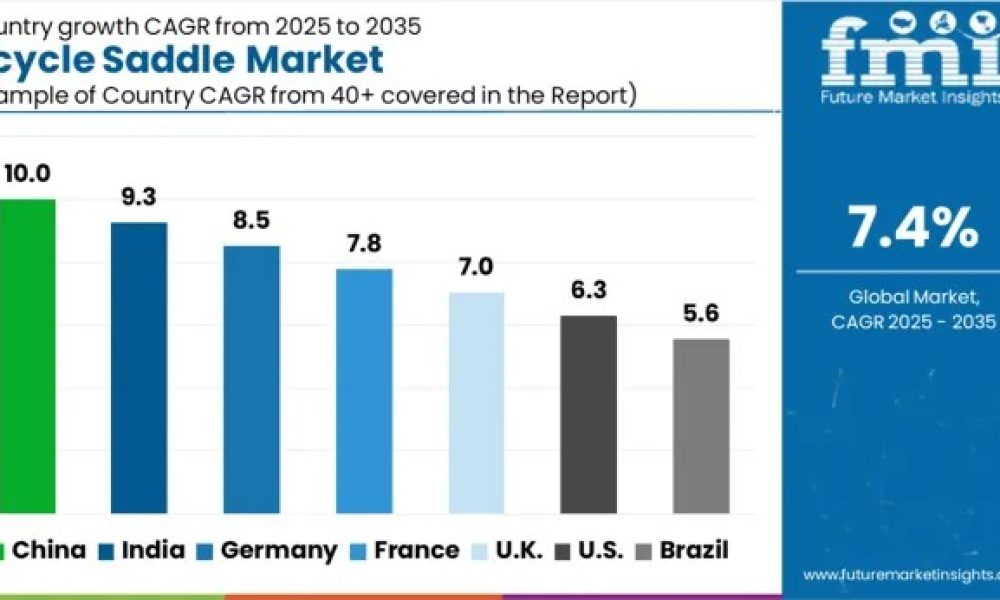
The global bicycle saddle market is undergoing a steady transformation as cycling evolves from a recreational activity into a mainstream mode of transport, fitness, and competitive sport. Valued at USD 2.8 billion in 2025, the market is projected to reach USD 5.8 billion by 2035, expanding at a compound annual growth rate (CAGR) of 7.4% over the forecast period. This growth reflects rising consumer expectations around comfort, ergonomics, and performance, alongside increasing adoption of bicycles across urban commuting, recreational riding, professional sports, and electric mobility.
Early market momentum has been shaped by demand from cycling enthusiasts and professional riders, who have significantly influenced saddle design, materials, and performance standards. These early adopters accelerated innovation in lightweight constructions, advanced cushioning systems, pressure-relief geometries, and aerodynamically optimized designs, setting the foundation for broader market adoption.
Market Evolution Reflects a Structured Adoption Curve
From 2025 to 2030, the market is expected to grow from USD 2.8 billion to USD 3.8 billion, signaling a shift from niche adoption toward mainstream usage. During this phase, growing awareness among casual cyclists, fitness riders, and urban commuters expands the addressable customer base. Manufacturers benefit from economies of scale in production and logistics, while competitive intensity increases as brands differentiate through comfort, durability, aesthetics, and pricing strategies.
By 2035, the market’s expansion to USD 5.8 billion indicates a transition into late-stage adoption, where advanced saddle technologies are widely recognized and incremental innovation—rather than disruptive product categories—drives replacement demand. Regional penetration in emerging markets continues to support volume growth, although affordability and consumer familiarity remain moderating factors.
Get access to comprehensive data tables and detailed market insights — request your sample report today!
https://www.futuremarketinsights.com/reports/sample/rep-gb-26086
Key Market Takeaways at a Glance
- Market Value (2025): USD 2.8 billion
- Forecast Value (2035): USD 5.8 billion
- Forecast CAGR (2025–2035): 7.4%
- Leading Material Segment (2025): Leather (21.6%)
- Key Growth Regions: North America, Asia-Pacific, Europe
Within the broader cycling components and sports equipment industry, bicycle saddles account for approximately 4.2% of total component value. Their share rises to 5.1% in premium and performance cycling, underlining the importance of comfort optimization, lightweight materials, and ergonomic engineering in high-end applications. In recreational and commuter cycling, saddles contribute around 3.8%, while in the rapidly growing e-bike segment, their share stands at 4.5%, driven by longer ride durations and increased comfort requirements.
Material and Activity Segments Shape Competitive Dynamics
By material, the market spans leather, synthetic, gel, and carbon fiber saddles. The leather segment, accounting for 21.6%, maintains strong relevance due to its durability, premium appeal, and ability to conform to rider anatomy over time. While higher maintenance and weather sensitivity limit mass adoption, strong brand heritage and customization options continue to sustain demand among touring and long-distance cyclists.
From an activity perspective, road biking dominates with a 27.4% share, reflecting the performance-driven nature of the segment. Road cyclists prioritize weight reduction, pressure relief, and efficiency, prompting continuous innovation in saddle geometry, padding density, and rail materials. Growth in organized cycling events, fitness cycling, and sports tourism continues to reinforce demand in this category.
Online Retail Emerges as the Preferred Distribution Channel
The online retail segment leads distribution, accounting for 33.2% of total market share. Digital platforms have reshaped purchasing behavior by offering extensive product comparison, access to niche brands, customer reviews, and competitive pricing. Virtual fitting tools, high-resolution product visuals, and flexible return policies have further reduced adoption barriers, while direct-to-consumer strategies allow manufacturers to expand reach beyond traditional retail limitations.
Technology, E-Bikes, and Sustainability Drive Market Momentum
Technological advancement remains a central growth pillar. Innovations such as multi-density foam cushioning, pressure-relief cutouts, carbon fiber and titanium rails, ventilated covers, and 3D-printed saddle structures have significantly improved rider comfort and performance. Emerging integration of smart sensors for posture monitoring and ride analytics highlights the market’s trajectory toward data-driven cycling accessories.
The rapid rise of e-bikes and urban mobility solutions has further expanded demand. E-bike riders typically cover longer distances, increasing reliance on ergonomic, shock-absorbing, and weather-resistant saddle designs. Bike-sharing programs and smart city initiatives are also driving demand for durable, low-maintenance, and theft-resistant saddles.
Sustainability is increasingly influencing purchasing decisions. Manufacturers are adopting recycled polymers, eco-friendly foams, vegan leather alternatives, water-based coatings, and solvent-free adhesives, aligning product development with environmental regulations and circular economy principles.
Asia-Pacific Leads Growth, While Europe and North America Focus on Premiumization
Country-level analysis highlights China (10.0% CAGR) and India (9.3%) as the fastest-growing markets, driven by expanding urban cycling infrastructure, e-bike adoption, and domestic manufacturing capabilities. Germany (8.5%), France (7.8%), and the UK (7.0%) emphasize premium, ergonomic, and sustainable saddle solutions, while the United States (6.3%) remains anchored in recreational cycling and e-bike growth.
Drive Your Business Growth Strategy: Checkout the Report for Key Insights
https://www.futuremarketinsights.com/checkout/26086
Competitive Landscape Anchored in Innovation and Ergonomic Expertise
The market is shaped by established and performance-focused brands, including ISM (Ideal Saddle Modification), SCOTT Sports SA, Selle Italia, Selle Royal, Shanghai Phoenix Bicycle Co. Ltd, SHIMANO INC., Specialized Bicycle Components, Inc., and Terry Bicycles. Competition centers on anatomical precision, pressure distribution, material durability, and performance optimization, with collaborations across sports science, frame manufacturing, and material technology accelerating innovation cycles.
Outlook:
With cycling participation rising globally and comfort becoming a non-negotiable performance factor, the bicycle saddle market is positioned for sustained, innovation-led growth through 2035. Strategic pricing, continuous product enhancement, and regional expansion will be critical for stakeholders seeking to capitalize on evolving consumer expectations across both premium and mass-market segments.
Why Choose FMI: Empowering Decisions that Drive Real-World Outcomes: https://www.futuremarketinsights.com/why-fmi
About Future Market Insights (FMI)
Future Market Insights, Inc. (FMI) is an ESOMAR-certified, ISO 9001:2015 market research and consulting organization, trusted by Fortune 500 clients and global enterprises. With operations in the U.S., UK, India, and Dubai, FMI provides data-backed insights and strategic intelligence across 30+ industries and 1200 markets worldwide.



