
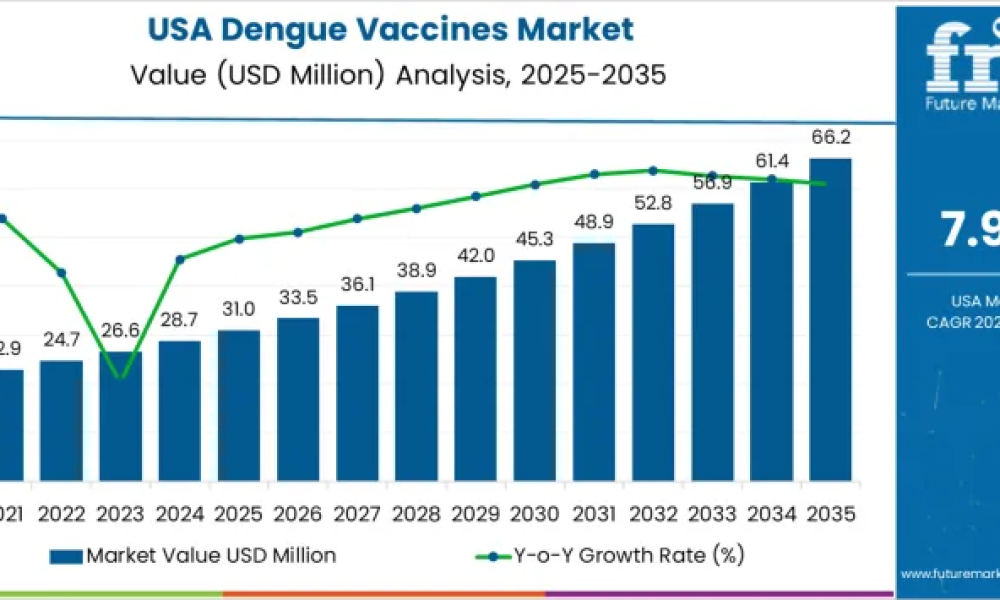
Future Market Insights (FMI), a leading global market research firm, today released its comprehensive analysis of the Demand for dengue vaccines in the USA is valued at USD 31.0 million in 2025 and is projected to reach USD 66.2 million by 2035, reflecting a CAGR of 7.9%. Growth is driven by the expanding risk of dengue transmission linked to increased travel to endemic regions and climate-related spread of Aedes mosquitoes. Public health preparedness, vaccination for high-risk populations, and heightened awareness of severe dengue complications support stronger uptake.
Dengue fever, once considered primarily a tropical concern, is increasingly relevant to the United States due to international travel, climate change, and localized outbreaks in territories like Puerto Rico and the U.S. Virgin Islands. With millions of Americans traveling annually to endemic regions and warming temperatures expanding the habitat of Aedes mosquitoes, public health leaders are prioritizing vaccination as a critical line of defense. This FMI report provides decision-makers—pharmaceutical executives, policymakers, and healthcare providers—with actionable, evidence-based insights to navigate this evolving landscape.
“The U.S. dengue vaccines market reflects a deliberate, targeted approach to public health preparedness,” said Sabyasachi Ghosh, Associate Vice President at Future Market Insights. “While dengue incidence remains low in the continental U.S., the combination of travel-related importation, climate-linked mosquito proliferation in southern states, and heightened awareness of severe complications is driving meaningful demand. This is not a mass-market opportunity yet, but a strategic one focused on high-risk populations—travelers, humanitarian workers, and residents of endemic territories.”
Key highlights from the report reveal a market shaped by innovation and caution. Takeda’s Qdenga currently commands 52.0% market share, benefiting from broader eligibility criteria that include both seropositive and seronegative individuals. In contrast, Sanofi Pasteur’s Dengvaxia holds 48.0%, limited to those aged 9–16 with laboratory-confirmed prior infection in endemic areas. This segmentation highlights the ongoing challenge of balancing efficacy with safety, particularly for seronegative recipients.
Pediatric vaccination leads demand at 65.0% share, driven by adolescent travel to high-risk destinations. Adult immunization, comprising 35.0%, focuses on frequent travelers, government personnel, and aid workers. Distribution channels emphasize structured programs: direct government and international organization procurement accounts for 40.0%, followed by hospitals (30.0%), specialized travel medicine clinics (20.0%), and NGOs (10.0%).
Regionally, the West leads with a 9.1% CAGR, fueled by high outbound travel volumes from states like California and Washington, coupled with outdoor recreation and warming climates. The South follows at 8.1% CAGR, reflecting subtropical conditions in Florida, Texas, and Gulf Coast areas where persistent mosquito populations raise seasonal concerns. The Northeast (7.3% CAGR) benefits from international hubs in New York and New Jersey, while the Midwest shows measured growth at 6.3% CAGR through primary-care travel consultations.
Leading the competitive landscape is Sanofi Pasteur with an estimated 28.8% share, supported by its established Dengvaxia platform. Emerging players like GSK Vaccines, Merck & Co., Emergent BioSolutions, and Codagenix Inc. are advancing next-generation candidates, including viral vector technologies and synthetic biology approaches that promise broader age coverage and improved safety profiles for seronegative individuals.
Subscribe for Year-Round Insights → Stay ahead with quarterly and annual data updates: https://www.futuremarketinsights.com/reports/brochure/rep-gb-29742
Request for Discount: https://www.futuremarketinsights.com/reports/sample/rep-gb-29742
Despite these advances, challenges persist. Current approvals remain narrow, complicating screening requirements and limiting perceived benefits in low-incidence continental states. Manufacturer decisions to phase out certain products due to global demand fluctuations introduce supply uncertainty. Yet opportunities abound: renewed R&D momentum, WHO prequalification of newer vaccines, and enhanced surveillance could prompt U.S. regulators to expand indications, potentially unlocking significant growth for travelers and broader populations.
“As climate patterns shift and global connectivity increases, the U.S. cannot afford complacency on vector-borne diseases,” added Ghosh. “This market’s trajectory signals a maturing preventive framework—one where collaboration between regulators, manufacturers, and public health agencies will determine how effectively we protect vulnerable groups. Forward-thinking stakeholders who align with CDC guidance and invest in next-generation solutions stand to lead this space.”
Future Market Insights’ report equips industry leaders with granular data on trends, competitive dynamics, and regulatory pathways, enabling informed strategic decisions in a market poised for thoughtful, sustained expansion.
About Future Market Insights (FMI)
Future Market Insights, Inc. (FMI) is an ESOMAR-certified, ISO 9001:2015 market research and consulting organization, trusted by Fortune 500 clients and global enterprises. With operations in the U.S., UK, India, and Dubai, FMI provides data-backed insights and strategic intelligence across 30+ industries and 1200 markets worldwide.
Why FMI: Decisions that Change Outcomes- https://www.futuremarketinsights.com/why-fmi
Contact Us:
Future Market Insights Inc.
Christiana Corporate, 200 Continental Drive,
Suite 401, Newark, Delaware – 19713, USA
T: +1-347-918-3531
Website: https://www.futuremarketinsights.com
LinkedIn| Twitter| Blogs | YouTube
Have a specific Requirements and Need Assistant on Report Pricing or Limited Budget please contact us – [email protected]



