
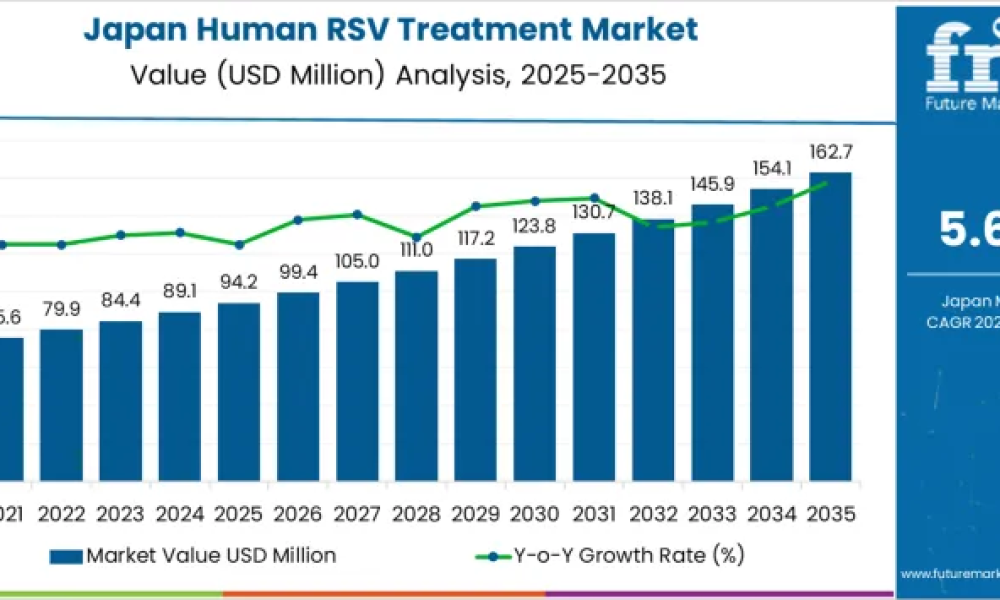
Future Market Insights (FMI), a leading market research firm, today released its comprehensive report, Clinical demand for human RSV treatment in Japan is valued at USD 94.2 million in 2025 and is projected to reach USD 162.7 million by 2035, reflecting a CAGR of 5.6%. Supportive care and hospital-based treatment each hold nearly equal treatment shares, showing balanced reliance on oxygen therapy, antiviral support, and inpatient monitoring. Pediatric and geriatric populations remain the core patient segments, with seasonal spikes during winter driving short-term admission surges. Large hospitals with over 500 beds dominate treatment delivery due to ICU availability and respiratory specialists, while mid-sized hospitals, ambulatory surgical centers, and clinics address early-stage cases. Regional demand is concentrated across Kanto, Kansai, and Chubu due to dense urban populations and higher testing intensity. Treatment pricing remains regulated under national reimbursement systems, limiting volatility across providers.
RSV remains a silent seasonal threat in Japan, triggering winter surges that strain hospital resources and touch countless families. From dense urban childcare centers in Kanto to aging communities in Tohoku, the virus exploits high-risk groups, often leading to prolonged hospitalizations and supportive interventions. Yet, amid these challenges, the market narrative is one of opportunity and adaptation. Japan’s universal health coverage, rigorous surveillance systems, and cultural emphasis on early intervention are fueling a shift from reactive, hospital-centric care to more preventive, year-round strategies.
At the heart of this evolution is a broadening clinical focus. Historically dominated by pediatric cases—driven by high childcare attendance, early school enrollment, and NICU prophylaxis protocols—RSV demand is increasingly extending to geriatric populations. Japan’s rapidly aging society, with rising cardiopulmonary risks among older adults, is expanding the patient base. Supportive care, including oxygen therapy and infection control, commands a 50% market share, reflecting the current reliance on managing symptoms rather than curing the virus outright. Hospital-based treatment mirrors this, holding another 50% share, with large facilities (over 500 beds) leading due to specialized respiratory units.
Regional dynamics add depth to the story. Urban powerhouses like Kanto (6.5% CAGR) and Kansai (5.7% CAGR) benefit from dense neonatal networks and rapid diagnostics, while Kyushu & Okinawa leads growth at 7.0% CAGR, bolstered by higher seasonal incidence and robust public hospital coverage. In contrast, demographic declines in Tohoku (4.4% CAGR) and other regions temper expansion, highlighting the need for targeted resource allocation.
Key players are navigating this landscape with precision. Domestic leaders like Meiji Seika Pharma, with its strong antiviral and pediatric portfolios, and Shionogi, through respiratory anti-infective programs, anchor hospital supply chains. Chugai Pharmaceutical drives biologic adoption via established networks, while AstraZeneca Japan plays a pivotal role in long-acting antibody prevention for high-risk infants and elderly. International benchmarks from institutions such as Children’s National Hospital, Cleveland Clinic, and Boston Children’s Hospital inform Japanese protocols, fostering evidence-based advancements.
Market drivers paint a picture of structural strength: rising awareness of RSV’s impact on immunocompromised patients, stricter infection-control in neonatal and geriatric units, and expanded outpatient antiviral access. However, challenges persist—limited curative therapies, seasonal bed shortages during winter peaks, and variability in regional advanced care access. Lower birth rates and fewer high-capacity neonatal units further moderate growth in some areas.
Looking ahead, opportunities abound for industry leaders. The anticipated rollout of adult RSV vaccines promises to reshape dynamics, shifting toward managing breakthrough infections and reinforcing post-vaccination care. Integration of early diagnostics, preventive immunizations, and outpatient management could broaden access, easing hospital burdens and enabling year-round respiratory frameworks. Trends point to gradual adoption of preventive biologics, standardized pathways, and volume-driven growth as RSV burden overlaps with influenza and aging-related fragility.
Subscribe for Year-Round Insights → Stay ahead with quarterly and annual data updates: https://www.futuremarketinsights.com/reports/brochure/rep-gb-29811
Request for Discount: https://www.futuremarketinsights.com/reports/sample/rep-gb-29811
For pharmaceutical executives, healthcare providers, and policymakers, this report offers decision-grade insights. With USD 23.0 million in value addition projected from 2025 to 2030, accelerating to USD 45.5 million through 2035, strategic investments in preventive agents, regional infrastructure, and geriatric-focused therapies could yield significant returns. Japan’s model—blending centralized institution-led distribution, regulated pricing under national reimbursement, and guidance from the Japanese Pediatric Society—provides a blueprint for resilient RSV management.
“As Japan confronts dual demographic pressures—fewer births and more elderly vulnerable to respiratory threats—the RSV treatment market is maturing into a sophisticated ecosystem,” said a senior analyst at Future Market Insights. “Leaders who prioritize preventive innovation and equitable regional access will not only drive growth but also improve outcomes for generations of patients.”
The 250-page report delves into historical trends from 2020 (USD 71.6 million valuation), scenario forecasts, supply chain analysis, and competition benchmarking. It equips stakeholders with the tools to navigate this vital sector.
About Future Market Insights (FMI)
Future Market Insights, Inc. (FMI) is an ESOMAR-certified, ISO 9001:2015 market research and consulting organization, trusted by Fortune 500 clients and global enterprises. With operations in the U.S., UK, India, and Dubai, FMI provides data-backed insights and strategic intelligence across 30+ industries and 1200 markets worldwide.
Why FMI: Decisions that Change Outcomes- https://www.futuremarketinsights.com/why-fmi
Contact Us:
Future Market Insights Inc.
Christiana Corporate, 200 Continental Drive,
Suite 401, Newark, Delaware – 19713, USA
T: +1-347-918-3531
Website: https://www.futuremarketinsights.com
LinkedIn| Twitter| Blogs | YouTube
Have a specific Requirements and Need Assistant on Report Pricing or Limited Budget please contact us – [email protected]



