
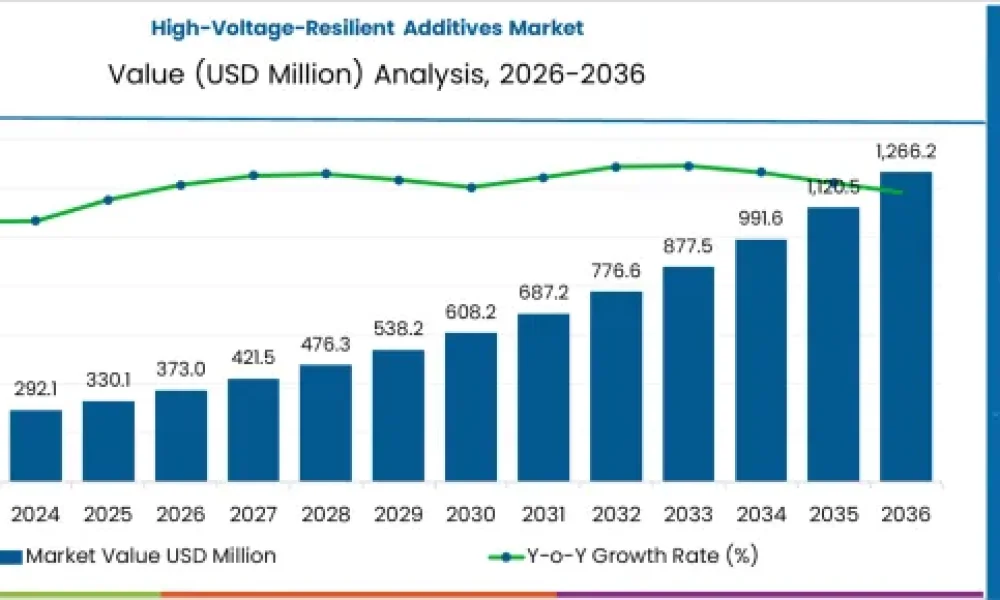
The global high-voltage resilient additives market is projected to expand from USD 373 million in 2026 to USD 1,266.2 million by 2036, advancing at a strong compound annual growth rate of about 13 % over the forecast period. This rapid growth is being driven by accelerating investments in power transmission infrastructure, rising adoption of renewable energy, and increasing demand for high-performance insulating materials capable of withstanding extreme electrical and thermal stress. As utilities and industrial operators transition toward higher-voltage systems, resilient additives have become critical for ensuring safety, efficiency, and long service life of electrical equipment.
High-voltage resilient additives are specialty chemical formulations designed to enhance the dielectric strength, thermal stability, and oxidation resistance of insulating fluids, polymers, and composite materials. These additives play a vital role in transformers, switchgear, high-voltage cables, and other power equipment, where even minor material degradation can lead to operational failures and costly downtime. The market’s expansion reflects a broader shift toward resilient, high-reliability electrical systems across both developed and emerging economies.
Key Market Insights at a Glance
Market growth is being supported by increasing voltage ratings in power networks and the need for advanced materials that can perform reliably under continuous stress. Oxidation inhibitors account for nearly one-third of overall demand, as they significantly slow degradation in insulating fluids exposed to heat and high voltage. From an application perspective, e-transmission fluids represent more than 40 % of market share, highlighting their central role in power transmission and distribution systems. Demand is further strengthened by the need for additives that improve breakdown resistance, control conductivity, and extend maintenance cycles.
Segment Overview
By functionality, the market spans oxidation inhibitors, corrosion inhibitors and metal deactivators, dielectric stabilizers, conductivity modifiers, and anti-foaming agents. Oxidation inhibitors remain the most widely used due to their proven effectiveness in maintaining fluid integrity over long operating periods. Corrosion inhibitors protect metallic components within electrical systems, while dielectric stabilizers and conductivity modifiers help manage charge distribution and suppress partial discharge. On the application side, e-transmission fluids dominate, followed by industrial insulating systems and specialty polymer applications used in high-voltage cables and components.
Regional Overview
Asia-Pacific stands out as the fastest-growing regional market, supported by large-scale grid expansion, rapid industrialization, and heavy investment in renewable energy projects. China leads regional growth with an estimated CAGR approaching the mid-teens through 2036, driven by ultra-high-voltage transmission projects and expanding power demand. North America and Europe continue to show steady momentum, underpinned by grid modernization programs, replacement of aging infrastructure, and stringent safety and performance standards. Emerging markets in Latin America also present attractive opportunities as electricity networks are upgraded to meet rising demand.
To access the complete data tables and in-depth insights — Request Your Sample Report Now
Competitive Landscape
The competitive environment is characterized by the presence of major global specialty chemical manufacturers and additive technology leaders. Companies are focusing on innovation, performance optimization, and compatibility with a wide range of base fluids and polymers. Strategic priorities include co-development with original equipment manufacturers, expansion of high-voltage testing capabilities, and development of formulations that balance performance with evolving environmental expectations.
Market Outlook: Powering the Next Decade
Over the next ten years, the high-voltage resilient additives market is expected to benefit from the global push toward electrification, including electric mobility, smart grids, and energy storage systems. As power densities increase and operating conditions become more demanding, the importance of advanced additive solutions will intensify. Utilities and industrial users are increasingly prioritizing materials that deliver long-term reliability, reduced maintenance, and improved safety margins, positioning resilient additives as a core enabler of next-generation power infrastructure.
Key Players of Sustainable Label Industry
Leading participants in the high-voltage resilient additives space include Lubrizol, Afton Chemical, Infineum, BASF, Evonik, Clariant, LANXESS, Solvay, Dow, and Sinopec. These companies are actively investing in research and development to deliver high-performance solutions aligned with sustainability and efficiency goals.
Recent Strategic Developments
Recent developments across the market include expanded R&D investments, new product launches targeting ultra-high-voltage applications, and strategic collaborations with power equipment manufacturers. Ongoing advancements in additive chemistry are expected to further enhance dielectric performance and operational resilience, supporting sustained market growth through 2036.
Have a specific Requirements and Need Assistant on Report Pricing or Limited Budget please contact us – [email protected]
About Future Market Insights (FMI)
Future Market Insights, Inc. (FMI) is an ESOMAR-certified, ISO 9001:2015 market research and consulting organization, trusted by Fortune 500 clients and global enterprises. With operations in the U.S., UK, India, and Dubai, FMI provides data-backed insights and strategic intelligence across 30+ industries and 1200 markets worldwide.
Why Choose FMI: https://www.futuremarketinsights.com/why-fmi



