
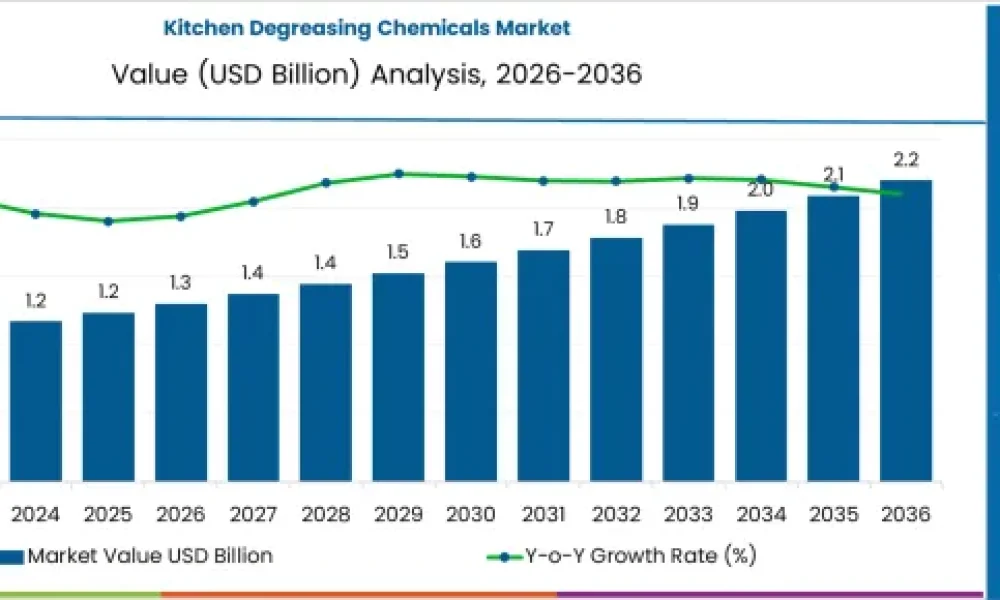
The global kitchen degreasing chemicals market is entering a strong growth phase, with market value projected to increase from USD 1.3 billion in 2026 to approximately USD 2.2 billion by 2036, expanding at a steady compound annual growth rate (CAGR) of 5.4%. This growth is being fueled by escalating hygiene regulations, the rapid expansion of commercial foodservice establishments, and increasing emphasis on operational cleanliness across restaurants, hotels, institutional kitchens, and food processing facilities worldwide.
As food safety standards become more stringent and inspection regimes intensify, degreasing chemicals have evolved from routine cleaning agents into mission-critical sanitation solutions. Their ability to remove stubborn grease, oils, and food residues efficiently is driving consistent demand, particularly in high-volume kitchens where compliance, productivity, and safety are non-negotiable.
Key Market Insights at a Glance
Between 2026 and 2031, the market is expected to experience accelerated adoption as restaurant chains, cloud kitchens, and hospitality operators upgrade cleaning protocols. By the early 2030s, the market is projected to surpass USD 1.7 billion, supported by repeat purchases, contract-based supply agreements, and increased use of standardized cleaning programs. Long-term growth through 2036 will be underpinned by product innovation, rising institutional demand, and integration of automated dosing and monitoring systems that optimize chemical usage and labor efficiency.
Segment Overview
From a formulation standpoint, alkaline-based degreasing chemicals dominate the market, accounting for roughly 44% of total demand due to their superior ability to break down heavy grease deposits commonly found in commercial kitchens. Solvent-based and bio-enzymatic formulations continue to gain traction, particularly in applications requiring surface compatibility or reduced chemical aggressiveness.
By form, concentrated degreasers lead with an estimated 52% market share, favored for their cost effectiveness, storage efficiency, and customizable dilution ratios. Ready-to-use sprays, foams, gels, and wipes complement the market by addressing convenience-driven and targeted cleaning needs. Applications span food-contact surfaces, exhaust hoods, floors, equipment exteriors, and back-of-house infrastructure, with restaurants and hospitality venues representing the largest end-use segment.
Regional Overview
Regional performance varies based on foodservice density, regulatory rigor, and economic development. Asia Pacific stands out as the fastest-growing region, recording growth rates exceeding 6% annually, driven by rapid urbanization, expansion of organized foodservice chains, and heightened awareness of kitchen hygiene. North America remains a mature yet resilient market, growing at around 5.2% CAGR, supported by structured sanitation standards and recurring procurement cycles. Europe continues to demonstrate stable growth near 4.9% CAGR, where compliance-driven cleaning practices are deeply embedded across commercial and institutional kitchens.
To access the complete data tables and in-depth insights — Request Your Sample Report Now
Emerging markets in Latin America and parts of the Middle East are also contributing to incremental growth as foodservice infrastructure modernizes and regulatory enforcement strengthens.
Competitive Landscape
The market features a competitive mix of multinational corporations and specialized regional players. Leading companies include Ecolab, Diversey, SC Johnson Professional, 3M, Zep, CloroxPro, P&G Professional, Spartan Chemical, Betco, and Unilever Professional. Competition is increasingly shaped by formulation performance, service reliability, sustainability credentials, and the ability to deliver integrated cleaning solutions rather than standalone products.
Manufacturers are differentiating through value-added services such as on-site training, digital dosing systems, and compliance support, helping customers reduce waste, improve safety, and achieve consistent cleaning outcomes.
Market Outlook: Powering the Next Decade
Looking ahead, the kitchen degreasing chemicals market is expected to maintain steady momentum through 2036. Growth opportunities will increasingly emerge from small and mid-sized foodservice operators, residential professional-grade products, and automated kitchen cleaning technologies. Innovation in low-VOC, enzyme-based, and environmentally responsible formulations will play a pivotal role in meeting evolving regulatory and sustainability expectations.
Companies that invest in scalable product portfolios, smart dispensing technologies, and sustainability-aligned innovation are well positioned to capture long-term value as the global foodservice industry continues to expand and professionalize.
Recent Strategic Developments
Recent market activity highlights a strong focus on reformulating products to balance high degreasing performance with improved environmental and worker safety profiles. Strategic partnerships with hospitality groups and institutional clients are enabling standardized cleaning protocols across multi-location operations. At the same time, investments in digital monitoring and automated dosing systems are enhancing efficiency, consistency, and customer retention, reinforcing the market’s long-term growth outlook.
Have a specific Requirements and Need Assistant on Report Pricing or Limited Budget please contact us – [email protected]
About Future Market Insights (FMI)
Future Market Insights, Inc. (FMI) is an ESOMAR-certified, ISO 9001:2015 market research and consulting organization, trusted by Fortune 500 clients and global enterprises. With operations in the U.S., UK, India, and Dubai, FMI provides data-backed insights and strategic intelligence across 30+ industries and 1200 markets worldwide.
Why Choose FMI: https://www.futuremarketinsights.com/why-fmi



