
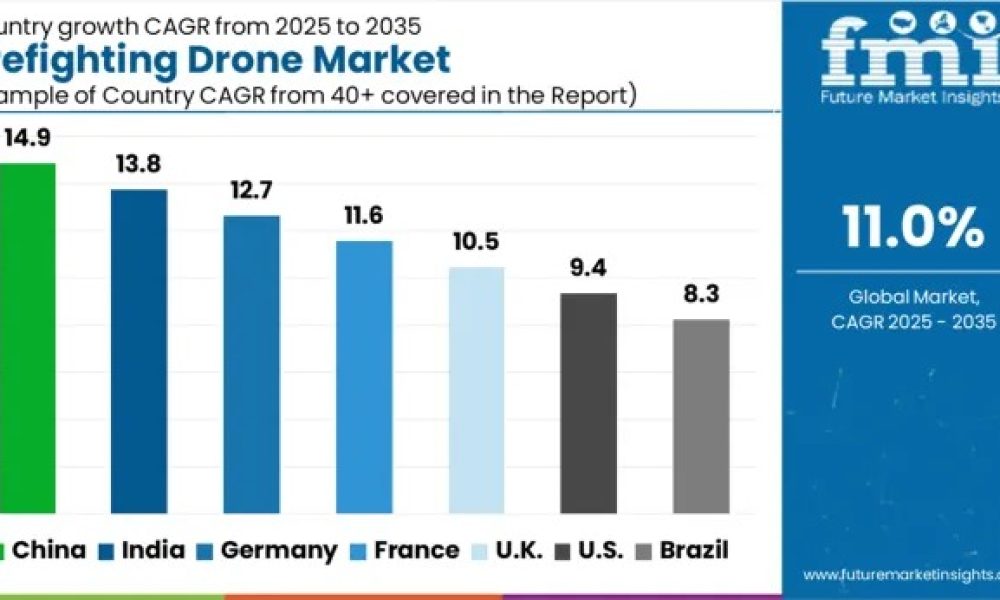
The global firefighting drone market is entering a phase of accelerated expansion, driven by the increasing complexity of fire incidents and the growing reliance on technology-enabled emergency response systems. The market is estimated to be valued at USD 2.2 billion in 2025 and is projected to reach USD 6.3 billion by 2035, registering a robust compound annual growth rate (CAGR) of 11.0% over the forecast period. This strong growth outlook reflects a structural shift toward smarter, faster, and safer firefighting solutions across both developed and emerging economies.
Firefighting drones are rapidly becoming a critical asset for modern fire management due to their ability to provide real-time situational awareness, rapid deployment, and risk reduction for human personnel. As wildfires intensify, urban density increases, and industrial fire risks rise, emergency agencies and public safety organizations are increasingly integrating unmanned aerial systems into their operational frameworks.
Technology-Driven Transformation in Firefighting Operations
The adoption of firefighting drones is being fueled by their capacity to operate in environments that are inaccessible or hazardous for ground crews. Equipped with thermal imaging cameras, infrared sensors, high-definition video systems, and payload deployment capabilities, drones enable faster fire detection, hotspot identification, and operational coordination. These capabilities are proving particularly valuable in large-scale wildfires, high-rise urban fires, and industrial incidents where visibility and access are limited.
Beyond suppression support, drones are increasingly used for fire monitoring, search and rescue, and post-incident assessment, strengthening their value proposition across the entire emergency response lifecycle. As a result, firefighting drones now account for an estimated 10–12% of the public safety drones market and approximately 4–5% of the overall drone market, highlighting their growing strategic importance within the broader unmanned systems ecosystem.
Get access to comprehensive data tables and detailed market insights — request your sample report today!
https://www.futuremarketinsights.com/reports/sample/rep-gb-25780
Rotary-Wing Drones Lead Market Adoption
By type, rotary-wing drones are expected to command 46.2% of total firefighting drone market revenue in 2025, making them the dominant segment. Their leadership is driven by superior maneuverability, vertical takeoff and landing capability, and the ability to hover steadily over active fire zones. These attributes allow precise close-range monitoring, targeted water or fire-retardant deployment, and continuous real-time data transmission to command centers.
Rotary-wing platforms are particularly well-suited for urban firefighting, forest fire containment, and search-and-rescue missions, where adaptability and control are critical. Ongoing advancements in rotor efficiency, battery endurance, and payload integration are further expanding their operational range and reliability in high-risk environments.
Mid-Capacity Payloads Strike the Optimal Balance
From a payload perspective, the 10–20 kg payload capacity segment is projected to hold 37.9% of market revenue in 2025, emerging as the leading payload class. Drones within this range offer an optimal balance between flight endurance, maneuverability, and functional capability. They can carry essential equipment such as thermal sensors, communication modules, and limited extinguishing agents without significantly compromising performance.
This segment is gaining traction due to its suitability for multi-mission deployment, including fire detection, live surveillance, and tactical response support. Its relatively lower operational cost and compatibility with modular payload systems are further driving adoption among government agencies, municipal fire departments, and private emergency service providers.
Hardware Investments Anchor Market Value
By component, hardware is anticipated to account for 58.3% of firefighting drone market revenue in 2025, reflecting the capital-intensive nature of drone procurement. Airframes, propulsion systems, sensors, and heat-resistant materials form the backbone of firefighting drone performance, particularly in extreme temperature and turbulence conditions.
Continuous innovation in lightweight composites, ruggedized structures, and modular hardware designs is enhancing durability and mission flexibility. As reliability and resilience remain top procurement priorities, hardware will continue to represent the largest share of market value.
Asia-Pacific Emerges as a High-Growth Region
Regionally, North America, Asia-Pacific, and Europe remain the key growth markets, supported by rising wildfire incidents and public sector investment in emergency response modernization. China leads global growth with a projected CAGR of 14.9%, driven by large-scale government initiatives to modernize firefighting infrastructure and manage urban and industrial fire risks. India follows with a 13.8% CAGR, supported by rapid urbanization, industrial expansion, and increased adoption of drone technology for disaster management.
In Europe, France is forecast to grow at 11.6% CAGR, fueled by wildfire risks in forested regions and strong public-sector support for advanced firefighting tools. The United Kingdom, growing at 10.5% CAGR, is increasingly integrating drones into broader emergency response and risk assessment strategies. The United States, while growing at a comparatively moderate 9.4% CAGR, continues to represent a significant market due to frequent wildfire events and sustained investment in advanced firefighting technologies.
Drive Your Business Growth Strategy: Checkout the Report for Key Insights
https://www.futuremarketinsights.com/checkout/25780
AI Integration and Automation Shape the Next Growth Phase
A defining trend in the firefighting drone market is the integration of artificial intelligence and automated analytics. AI-enabled drones can analyze fire behavior, predict spread patterns, and support data-driven decision-making in real time. Increasing automation is also enabling semi-autonomous and autonomous operations, reducing response times and dependence on manual control during critical situations.
While regulatory constraints and operational limitations such as battery life remain challenges, ongoing policy evolution and technological improvements are expected to mitigate these barriers over time, unlocking broader deployment opportunities.
Competitive Landscape and Strategic Focus
The market is characterized by the presence of leading drone manufacturers and defense technology providers, including DJI, Parrot SA, AeroVironment, Inc., Yuneec, Elbit Systems Ltd., Draganfly Inc., and Lockheed Martin Corporation. These players are competing on sensor integration, flight reliability, deployment speed, and mission-specific customization.
As fire risks intensify globally, firefighting drones are transitioning from supplemental tools to core components of modern emergency response strategies. With strong growth fundamentals, expanding use cases, and continuous technological innovation, the firefighting drone market presents a compelling opportunity for stakeholders seeking in-depth insights into its evolving competitive and regional dynamics.
Why Choose FMI: Empowering Decisions that Drive Real-World Outcomes: https://www.futuremarketinsights.com/why-fmi
About Future Market Insights (FMI)
Future Market Insights, Inc. (FMI) is an ESOMAR-certified, ISO 9001:2015 market research and consulting organization, trusted by Fortune 500 clients and global enterprises. With operations in the U.S., UK, India, and Dubai, FMI provides data-backed insights and strategic intelligence across 30+ industries and 1200 markets worldwide.



