
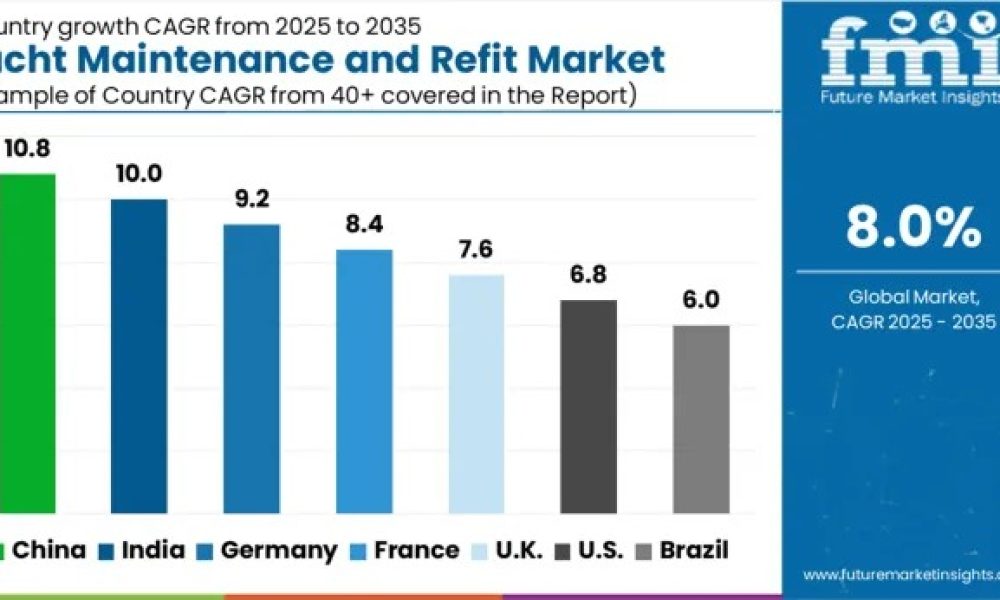
The global yacht maintenance and refit market is entering a phase of accelerated expansion, with market value projected to rise from USD 2.9 billion in 2025 to USD 6.3 billion by 2035, registering a robust compound annual growth rate (CAGR) of 8.0% over the forecast period. This growth reflects the increasing importance of maintenance and refit services as a core lifecycle investment for yacht owners, operators, and fleet managers amid rising vessel complexity, environmental regulations, and luxury expectations.
Yacht maintenance and refit activities have evolved from routine servicing into a strategic segment within the broader marine services ecosystem. Owners are increasingly prioritizing performance optimization, compliance upgrades, and aesthetic modernization to preserve asset value and enhance onboard experience, positioning maintenance and refit as a recurring and non-discretionary expenditure category.
Market Trajectory Signals Structural Demand Strength
Between 2021 and 2025, the market demonstrated consistent upward momentum, expanding from USD 2.0 billion to USD 2.9 billion. Annual gains through USD 2.1 billion, 2.3 billion, 2.5 billion, and 2.7 billion indicate a stable demand base, supported by routine servicing requirements and early adoption of technology upgrades. This phase reflects growing owner awareness around preventative maintenance and regulatory compliance.
The growth curve steepens during 2026–2030, as the market advances from USD 2.9 billion to USD 4.6 billion. Rising investment in high-quality refits, interior modernization, propulsion upgrades, and eco-friendly solutions accelerates market expansion. Demand for advanced materials, energy-efficient systems, and luxury customization intensifies as yachts are increasingly positioned as long-term lifestyle and charter assets.
From 2031 to 2035, the market further accelerates, reaching USD 6.3 billion, with intermediate milestones of USD 4.3 billion, 4.6 billion, 5.0 billion, 5.4 billion, and 5.8 billion. This phase reflects market maturity, driven by sustained demand for sophisticated refit services, particularly within the high-end and superyacht segments, alongside rising investment in marine technology integration.
Get access to comprehensive data tables and detailed market insights — request your sample report today!
https://www.futuremarketinsights.com/reports/sample/rep-gb-25752
Market Context Anchored in Interconnected Marine Industries
The yacht maintenance and refit market is closely linked to several parent industries. The marine services sector contributes approximately 30–35%, underscoring the essential role of maintenance and repair in vessel operability. The luxury goods market, accounting for 25–30%, highlights yachts as high-value lifestyle assets requiring premium upkeep to preserve exclusivity and performance.
The shipbuilding and ship repair sector contributes 15–20%, reflecting reliance on specialized yards for structural refits and engine overhauls. Meanwhile, the maritime equipment and parts market (10–12%) supports demand for advanced components, while the recreational boating market (8–10%) links growth to expanding global yacht fleets. Together, these segments illustrate the structurally embedded nature of yacht maintenance and refit services.
Maintenance Services Remain the Market Backbone
By service type, maintenance is projected to account for 57.3% of market revenue in 2025, establishing it as the dominant segment. Routine inspections, mechanical servicing, hull preservation, and compliance checks are mandatory for seaworthiness, insurance, and safety certification, ensuring predictable and recurring demand.
As global yacht fleets expand, cumulative servicing requirements are intensifying. Seasonal preparation, post-use inspections, and preventative maintenance are becoming more systematic, particularly in regions with defined yachting seasons. The growing availability of marina-based service centers and mobile maintenance units further enhances accessibility and responsiveness, reinforcing maintenance as the market’s most stable revenue stream.
Private Owners Drive High-Value Demand
By end user, private owners are expected to represent 52.4% of market revenue in 2025, making them the leading customer group. This dominance is driven by rising luxury yacht ownership across Europe, North America, and the Middle East. Private owners typically pursue bespoke interiors, advanced onboard systems, and performance upgrades, resulting in more comprehensive and higher-value refit projects.
Unlike commercial operators, private owners often prioritize customization and long-term asset preservation, adhering strictly to maintenance schedules to protect resale value and reliability. As yachts become more technologically advanced, private owners are expected to remain the primary drivers of premium maintenance and refit demand.
Sustainability and Technology Reshape Service Requirements
Environmental compliance and technological evolution are reshaping the market landscape. Yacht owners are increasingly seeking eco-friendly materials, energy-efficient propulsion systems, and low-emission retrofits to meet tightening regulations and sustainability goals. Smart yacht technologies, including advanced navigation, IoT-based monitoring, and automation systems, are becoming standard refit considerations rather than optional enhancements.
These trends are encouraging service providers to invest in skilled labor, advanced facilities, and specialized capabilities to handle complex, technology-intensive projects, raising entry barriers and strengthening competitive differentiation.
Drive Your Business Growth Strategy: Checkout the Report for Key Insights
https://www.futuremarketinsights.com/checkout/25752
Regional Growth Highlights Emerging and Mature Markets
The market exhibits strong regional momentum, led by China (10.8% CAGR) and India (10.0%), driven by rising high-net-worth populations, marina expansion, and growing interest in luxury yachting. Germany (9.2%) and France (8.4%) benefit from established maritime infrastructure and expanding superyacht activity, while the UK (7.6%) and USA (6.8%) reflect steady growth supported by mature yacht fleets and increasing sustainability-focused refits.
Competitive Landscape Defined by Craftsmanship and Capability
The market is characterized by specialized, high-skill competition, with leading players including Amico & Co, MB92 Group, Benetti Yachts, Lürssen Yachts, Monaco Marine, Derecktor Shipyards, Heesen Yachts, Oceanco, Northrop & Johnson, and Pendennis Shipyard. Competitive positioning centers on technical expertise, project scale capability, sustainability integration, and the ability to deliver bespoke, high-complexity refits.
Outlook
As global yacht ownership expands and vessels grow more sophisticated, the yacht maintenance and refit market is transitioning into a high-value, technology-driven growth phase. With strong structural demand, rising sustainability investment, and increasing customization requirements, maintenance and refit services are set to remain a critical pillar of the global yachting ecosystem through 2035.
Why Choose FMI: Empowering Decisions that Drive Real-World Outcomes: https://www.futuremarketinsights.com/why-fmi
About Future Market Insights (FMI)
Future Market Insights, Inc. (FMI) is an ESOMAR-certified, ISO 9001:2015 market research and consulting organization, trusted by Fortune 500 clients and global enterprises. With operations in the U.S., UK, India, and Dubai, FMI provides data-backed insights and strategic intelligence across 30+ industries and 1200 markets worldwide.



