
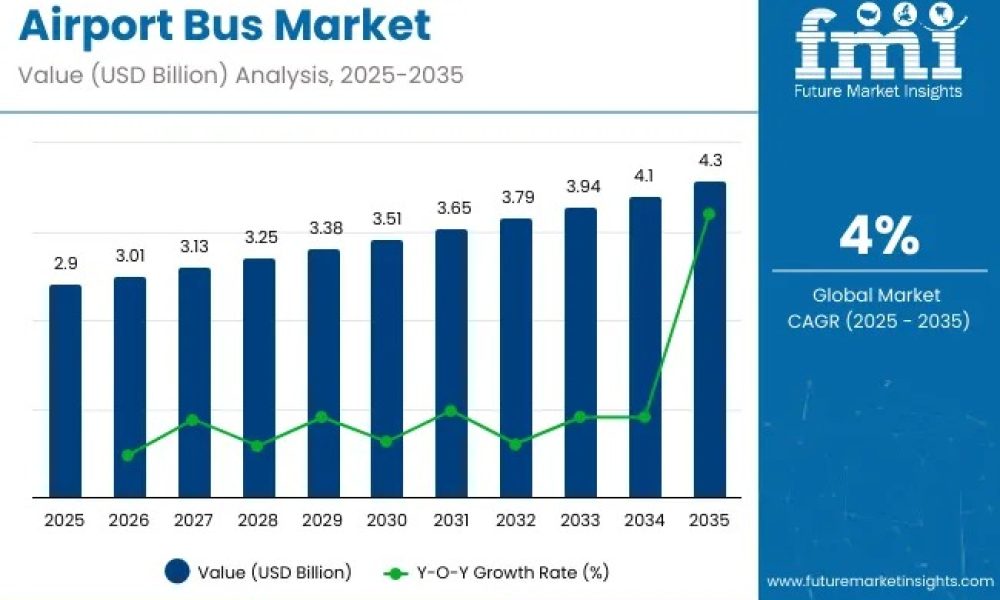
The global airport bus market is valued at USD 2.9 billion in 2025 and is projected to reach USD 4.3 billion by 2035, expanding at a compound annual growth rate (CAGR) of 4% over the forecast period. Market expansion is being driven by rising passenger traffic, sustained airport infrastructure investments, and accelerating adoption of low-emission ground mobility solutions across major aviation hubs worldwide.
Airport buses play a critical role in airside and landside passenger movement, supporting transfers between terminals, parking zones, remote aircraft stands, and ancillary facilities. As airports respond to higher throughput and operational efficiency targets, demand for reliable, high-capacity, and energy-efficient bus fleets continues to rise.
Market Dynamics Shaped by Technology and Regulation
Competitive dynamics within the airport bus market are increasingly influenced by technology adoption, environmental regulations, and airport modernization programs. Established manufacturers reliant on conventional diesel platforms are experiencing gradual market share pressure as procurement policies shift toward low-emission, energy-efficient fleets.
At the same time, manufacturers introducing battery-electric and hybrid airport buses, along with digital fleet management systems and flexible cabin configurations, are positioned to capture incremental share. Airports in Europe and Asia Pacific are transitioning more rapidly toward electric fleets, benefiting suppliers with advanced propulsion platforms, while regions with limited charging infrastructure continue to support conventional buses, providing temporary stability for incumbents.
Over the forecast period, companies focused on innovation, adaptability, and regulatory compliance are expected to realize market share gains, while suppliers resistant to technology transitions may experience gradual erosion despite overall market growth.
Get access to comprehensive data tables and detailed market insights — request your sample report today!
Airport Transfers Lead Application Demand
By application, airport transfers account for 45% of total market demand in 2025, reflecting the critical need for high-frequency, predictable shuttle services aligned with flight schedules. These services are essential to managing curbside congestion, reducing terminal dwell times, and ensuring smooth passenger flows during peak traffic periods.
Airport transfer buses typically operate at 8–10 loops per hour on dedicated routes, providing consistent capacity during flight banks. Hotel transfers represent approximately 25% of demand, while corporate shuttle services and tourism-oriented operations remain secondary contributors.
Standard and High-Capacity Buses Dominate Fleet Mix
By vehicle type, standard buses represent 40% of the market, reflecting their widespread deployment on terminal connections, parking loops, and remote stand access routes. These buses, commonly built on 12-meter platforms, can carry more than 80 passengers per trip, balancing luggage capacity, boarding efficiency, and durability for continuous operations.
By seating capacity, over 30-seat configurations account for 35% of market share, meeting the needs of high-traffic airports managing large passenger volumes. High-capacity buses reduce dispatch frequency, improve route efficiency, and help absorb seasonal traffic peaks. These vehicles are increasingly favored at large international hubs where throughput and turnaround time are critical performance indicators.
Diesel Remains Dominant as Electrification Gains Momentum
By propulsion type, diesel-powered buses retain a 40% market share in 2025, supported by established fueling infrastructure and their ability to operate long daily shifts of 300–350 kilometers with minimal downtime. Electric buses now account for 30% of the market, reflecting accelerated adoption through replacement cycles and new fleet tenders.
More than 25% of new apron bus deliveries in 2024 were battery-electric models, underscoring the industry’s transition toward sustainable ground operations. Hybrid buses continue to serve as transitional solutions, particularly in airports where charging infrastructure remains underdeveloped.
Electric and hybrid fleets are increasingly supported by retrofit programs, digital monitoring tools, and lifecycle optimization strategies aimed at reducing emissions and operating costs.
Drive Your Business Growth Strategy: Checkout the Report for Key Insights
Asia Pacific Leads Growth, Supported by Infrastructure Expansion
Regionally, Asia Pacific, Europe, and North America remain the primary growth markets. Asia Pacific leads global expansion, driven by large-scale airport development in China and India and rising passenger throughput. China records a CAGR of 6.2%, supported by new airport construction and domestic manufacturing capacity, while India follows at 5.9%, driven by airport privatization and terminal expansion projects.
The United States is projected to grow at 5.4%, supported by fleet electrification initiatives and accessibility upgrades at major hubs. In Europe, Germany is expected to expand at 5.0%, while the United Kingdom records 4.8%, reflecting steady modernization and low-emission fleet replacement programs.
Industry Ecosystem and Competitive Landscape
Airport authorities and operators account for approximately 39% of market demand, as procurement is closely linked to terminal expansion and passenger flow management. Bus and coach manufacturers contribute around 26%, supplying specialized low-floor, high-capacity, and electric variants. Ground handling service providers represent nearly 16%, while electric drivetrain and battery suppliers account for 11%. Maintenance and aftermarket services comprise the remaining 8%, supporting fleet reliability and lifecycle efficiency.
Leading companies operating in the airport bus market include Zhongtong Bus, Stagecoachbus, Veolia Transport, Transdev Group, and Keolis. Competitive strategies emphasize high-capacity designs, low total cost of ownership, digital fleet integration, and long-term service contracts with airport operators.
Outlook
As global passenger traffic is expected to exceed 10 billion travelers annually by 2035, the importance of efficient, flexible, and sustainable airport ground mobility solutions will continue to grow. Investments in electric and hybrid buses, digital fleet management, and automation are reshaping procurement priorities, positioning the airport bus market for steady, long-term expansion aligned with global airport modernization and sustainability objectives.
Why Choose FMI: Empowering Decisions that Drive Real-World Outcomes: https://www.futuremarketinsights.com/why-fmi
About Future Market Insights (FMI)
Future Market Insights, Inc. (FMI) is an ESOMAR-certified, ISO 9001:2015 market research and consulting organization, trusted by Fortune 500 clients and global enterprises. With operations in the U.S., UK, India, and Dubai, FMI provides data-backed insights and strategic intelligence across 30+ industries and 1200 markets worldwide.



