
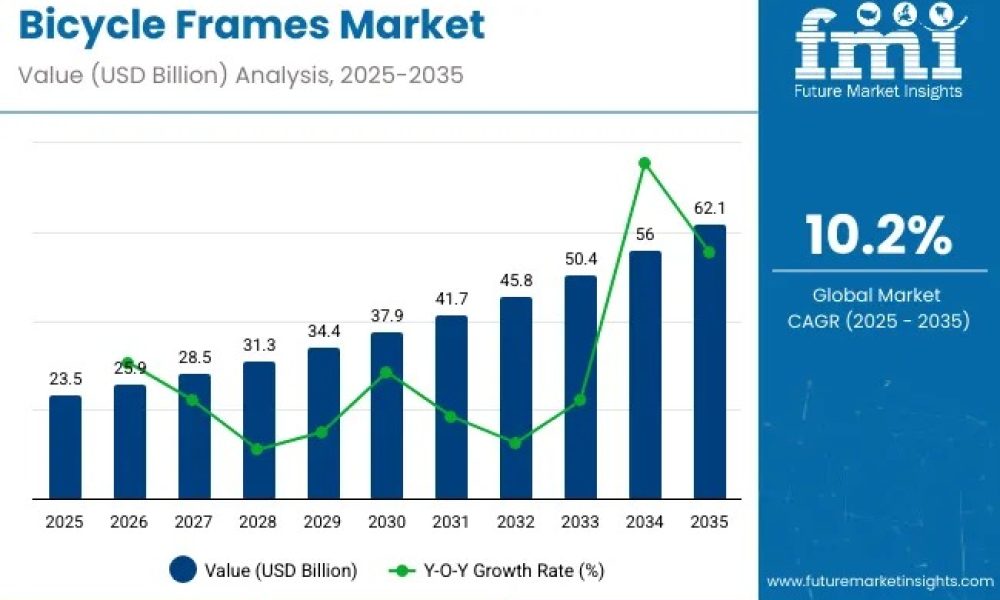
The global bicycle frames market is witnessing strong structural growth, valued at USD 23.5 billion in 2025 and projected to reach approximately USD 62.1 billion by 2035, expanding at a compound annual growth rate (CAGR) of 10.2% over the forecast period. The market’s 2.6x expansion over the next decade underscores the rising role of bicycles as mobility solutions, fitness assets, and sustainable transportation alternatives worldwide.
Growth is being supported by increasing health awareness, urban congestion, rising fuel costs, and large-scale investments in cycling infrastructure across North America, Europe, and Asia Pacific. Frame manufacturers are responding with lightweight materials, advanced manufacturing methods, and designs optimized for both conventional and electric bicycles.
Market Overview and Growth Drivers
Bicycle frames form the structural backbone of the global cycling industry, contributing nearly 40% of total bicycle manufacturing value. The market is highly responsive to macroeconomic indicators such as disposable income levels, urban mobility trends, and sustainability policies. During economic expansions, demand rises sharply for premium aluminum, carbon fiber, and titanium frames, while entry-level and mid-range frames remain resilient during slower cycles due to affordability and replacement demand.
Key growth drivers include:
- Rising participation in recreational and fitness cycling
- Expansion of urban cycling lanes and eco-mobility programs
- Increasing replacement cycles averaging five years
- Accelerating adoption of e-bikes globally
Get access to comprehensive data tables and detailed market insights — request your sample report today!
Quick Facts: Bicycle Frames Market
- Market Size (2025): USD 23.5 billion
- Projected Market Size (2035): USD 62.1 billion
- Forecast CAGR (2025–2035): 10.2%
- Leading Segment: Mountain bicycle frames
- Top Manufacturer: Giant Manufacturing Co. Ltd. (22% market share)
- Primary Growth Regions: Asia Pacific, Europe, North America
Material Innovation Reshaping Market Dynamics
Material selection remains central to competitiveness and profitability in the bicycle frames market. Aluminum frames account for nearly 40% of total demand, supported by affordability, corrosion resistance, and up to 25% weight reduction compared to steel. Carbon fiber frames represent 25% of the market and are expanding at an annual rate above 11%, driven by performance-oriented road, gravel, and mountain bicycles.
Steel continues to hold 20% share, particularly in budget and durability-focused models, while titanium maintains a niche position at around 10%, catering to premium and endurance cycling segments. The use of recycled aluminum, now representing nearly 16% of total output, is helping manufacturers reduce energy costs and align with sustainability targets.
E-Bikes and Aftermarket Demand Strengthen Revenue Stability
E-bikes now account for over 23% of global bicycle sales, significantly influencing frame design and demand patterns. Frames designed for electric bicycles must accommodate higher torque, integrated batteries, and reinforced structures, creating new revenue streams for manufacturers specializing in aluminum alloys and composite materials.
Europe alone recorded nearly 6.5 million e-bike sales, reinforcing both OEM supply contracts and aftermarket demand. The global bicycle frame aftermarket is valued at over USD 8.5 billion annually, supported by customization trends, modular upgrades, and online direct-to-consumer sales, which already represent more than 21% of frame transactions.
Regional Performance Highlights
Asia Pacific contributes over 40% of global demand, driven by large-scale manufacturing capacity and rising domestic cycling adoption. Europe and North America remain strong in premium, e-bike, and high-performance segments, where material innovation and customization play a decisive role.
Country-level growth trends include:
- India: CAGR of 9.4%, supported by sports cycling and domestic manufacturing expansion
- China: CAGR of 7.8%, driven by e-bike exports and aluminum frame production
- United States: CAGR of 7.3%, led by mountain bikes and customizable frames
- Germany: CAGR of 6.8%, supported by e-bike and professional cycling demand
- United Kingdom: CAGR of 8.0%, driven by recreational cycling and infrastructure investment
Drive Your Business Growth Strategy: Checkout the Report for Key Insights
Competitive Landscape
The market is led by Giant Manufacturing Co. Ltd., holding approximately 22% of global market share, followed by established players such as Trek, Merida, SCOTT Sports SA, Cannondale, Canyon, Cervélo, Cicli Pinarello SRL, and Bianchi. Competitive strategies focus on lightweight materials, aerodynamic design, OEM partnerships, and expansion of direct-to-consumer sales channels.
Recent product launches in 2024, including new electric mountain and cross-country bicycles with advanced alloy frames, highlight ongoing innovation across both performance and recreational segments.
Market Outlook
The bicycle frames market demonstrates strong long-term resilience, supported by sustainability initiatives, urban mobility transformation, and rising health awareness. While raw material costs and supply chain pressures remain challenges, advances in automation, 3D printing, and recyclable materials are improving cost efficiency and scalability.
With steady replacement demand, growing e-bike integration, and expanding premium segments, the global bicycle frames market is positioned for sustained double-digit growth through 2035, reinforcing its importance within the broader mobility and sports equipment ecosystem.
Why Choose FMI: Empowering Decisions that Drive Real-World Outcomes: https://www.futuremarketinsights.com/why-fmi
About Future Market Insights (FMI)
Future Market Insights, Inc. (FMI) is an ESOMAR-certified, ISO 9001:2015 market research and consulting organization, trusted by Fortune 500 clients and global enterprises. With operations in the U.S., UK, India, and Dubai, FMI provides data-backed insights and strategic intelligence across 30+ industries and 1200 markets worldwide.



