
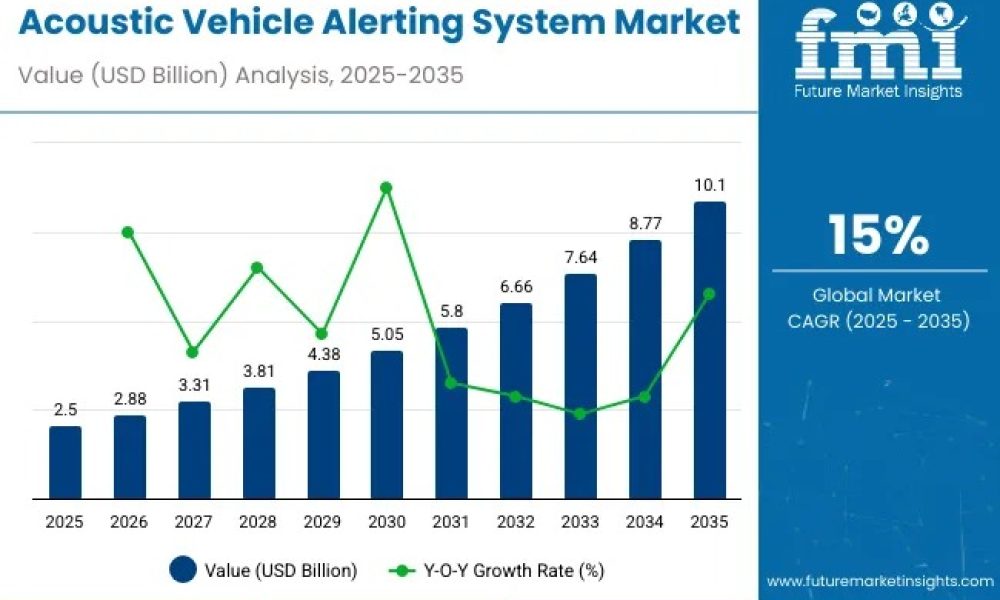
The global acoustic vehicle alerting system (AVAS) market is projected to grow from USD 2.5 billion in 2025 to USD 10.1 billion by 2035, registering a robust compound annual growth rate (CAGR) of 15% over the forecast period. This fourfold expansion reflects the rapid convergence of electric vehicle (EV) adoption, pedestrian safety regulations, and advancements in digital acoustic technologies that are redefining how vehicles interact with their surrounding environments.
AVAS, designed to emit artificial sounds at low vehicle speeds, has transitioned from a regulatory requirement into a strategic safety and user-experience component of modern mobility platforms. Inflection point mapping highlights how regulatory enforcement, followed by technology differentiation, is shaping accelerated market expansion over the next decade.
Regulatory Mandates Create the First Major Inflection Point
The first and most critical inflection point for the AVAS market emerged when safety authorities across Europe, North America, and Asia-Pacific mandated sound-emitting systems for electric and hybrid vehicles operating at low speeds. With silent drivetrains increasing pedestrian and cyclist risk, regulations requiring audible alerts below 30 km/h created an immediate and non-negotiable demand base.
As of 2025, more than 40 countries enforce AVAS installation standards, positioning regulatory compliance as the foundational growth driver. This mandate-driven phase has anchored AVAS adoption across passenger electric vehicles, where nearly 60% of global deployment is concentrated.
Get access to comprehensive data tables and detailed market insights — request your sample report today!
Technology-Led Differentiation Marks the Second Growth Phase
A second inflection point is expected in the early 2030s, when AVAS adoption transitions from compliance-focused to value-driven differentiation. Automakers are increasingly integrating advanced sound design, adaptive volume control, and customizable acoustic profiles that respond to speed, proximity, and ambient noise conditions.
Advancements in digital signal processing, directional audio, and multi-frequency alert systems are enabling enhanced pedestrian localization without contributing to urban noise pollution. These innovations are particularly relevant as EV penetration deepens in dense urban environments and smart city ecosystems.
By 2035, AVAS is expected to function not only as a safety device but also as an extension of vehicle identity, brand differentiation, and intelligent mobility platforms.
Passenger Vehicles Remain the Core Demand Anchor
By application, passenger vehicles account for approximately 40% of AVAS demand, making them the dominant market segment. High urban density, strict pedestrian safety standards, and rapid electrification of passenger cars have accelerated AVAS integration as standard OEM equipment.
Electric passenger vehicles typically deploy AVAS systems operating between 0–20 km/h, with average sound levels ranging from 56–68 dB, ensuring pedestrian awareness while minimizing noise intrusion. Deployment in electric passenger cars increased by 35% between 2023 and 2025, underscoring strong momentum.
Active Acoustic Systems Lead Technology Adoption
By technology type, active acoustic systems hold nearly 50% of market share, driven by their programmable and real-time sound generation capabilities. These systems use speakers and amplifiers to emit adaptive alerts that change frequency and volume based on vehicle speed and environmental conditions.
Active AVAS solutions typically operate within the 2–5 kHz frequency range, optimizing detectability for pedestrians. With average power consumption of 15–25 watts per unit, manufacturers are prioritizing energy-efficient designs to limit battery impact. Adoption of active systems is projected to grow at 18% CAGR through 2027, supported by smart city initiatives and stricter urban safety norms.
Electric Vehicles Drive Half of Global AVAS Adoption
By vehicle type, electric vehicles account for nearly 50% of AVAS installations, reflecting their near-silent low-speed operation. Hybrid vehicles follow at 30%, while internal combustion engine vehicles represent 20%, largely for regulatory compliance in mixed-mobility zones.
OEM-installed AVAS units typically add USD 80–120 per vehicle, while aftermarket systems average USD 150 per unit. As EV penetration increases globally, AVAS deployment is expected to scale in parallel, particularly across Europe, North America, and Asia-Pacific.
Regional Growth Led by Asia-Pacific, with China at the Forefront
Regionally, Asia-Pacific leads global AVAS growth, with China expanding at a 14.8% CAGR, supported by aggressive EV deployment, urban safety initiatives, and large-scale manufacturing capacity. By 2030, over 10 million EVs in China are expected to be equipped with AVAS.
The United States follows at 14.4% CAGR, driven by federal pedestrian safety regulations and strong adoption in electric passenger and commercial fleets. Germany, the United Kingdom, and India, each growing at 12.6% CAGR, represent strategically important markets where regulatory enforcement and electrification trends intersect with advanced automotive engineering.
Drive Your Business Growth Strategy: Checkout the Report for Key Insights
Competitive Landscape Shaped by OEM Leadership and Supplier Innovation
The AVAS market features a mix of global automakers and specialized technology suppliers. Toyota Motor Corporation leads the market with approximately 25% share, driven by widespread AVAS integration across its hybrid and electric portfolio.
Other prominent players include Honda Motor Co Ltd, Volkswagen AG, BMW AG, Subaru Corporation, Ford Motor Company, Nissan Motor Co Ltd, Daimler AG, Aisin Seiki, Harman International, Continental AG, and Voxx International. Competition increasingly centers on sound quality, system integration, regulatory compliance, and scalability across vehicle platforms.
Recent industry developments, including Gentex’s acquisition of VOXX International (December 2024) and Brose’s launch of a new AVAS platform (July 2024), highlight intensifying investment and consolidation aimed at strengthening technological capabilities.
Market Outlook: From Compliance to Intelligent Mobility Integration
By 2035, as the AVAS market reaches USD 10.1 billion, inflection point analysis indicates a decisive shift from regulation-driven adoption to experience-driven value creation. AVAS will increasingly integrate with ADAS, autonomous driving systems, IoT-enabled fleets, and predictive safety platforms, enabling real-time adaptation and enhanced pedestrian interaction.
Manufacturers that successfully combine regulatory alignment, advanced acoustic engineering, and smart connectivity are expected to define the next phase of growth. As urban mobility ecosystems evolve, AVAS is positioned to become an essential component of safe, intelligent, and human-centric transportation.
Why Choose FMI: Empowering Decisions that Drive Real-World Outcomes: https://www.futuremarketinsights.com/why-fmi
About Future Market Insights (FMI)
Future Market Insights, Inc. (FMI) is an ESOMAR-certified, ISO 9001:2015 market research and consulting organization, trusted by Fortune 500 clients and global enterprises. With operations in the U.S., UK, India, and Dubai, FMI provides data-backed insights and strategic intelligence across 30+ industries and 1200 markets worldwide.



