
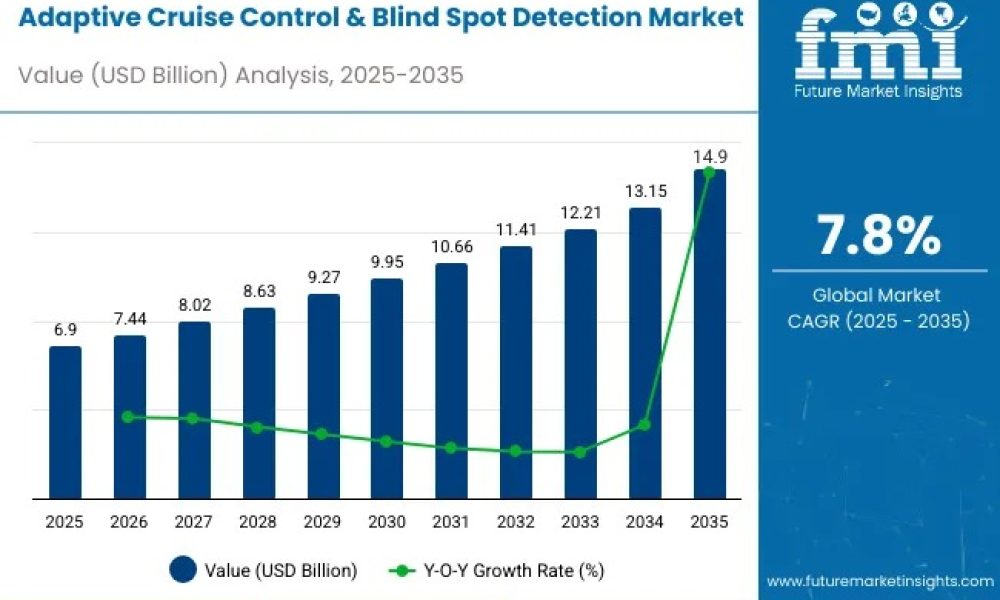
The global adaptive cruise control (ACC) and blind spot detection (BSD) market is valued at USD 6.9 billion in 2025 and is projected to reach USD 14.9 billion by 2035, reflecting a compound annual growth rate (CAGR) of 7.8% and a market expansion factor of approximately 2.2 over the forecast period.
Market growth is being shaped by technological advancement in advanced driver-assistance systems (ADAS), regulatory mandates focused on road safety, and increasing consumer demand for collision-avoidance and driver-assistance features across passenger and commercial vehicles.
Adaptive Cruise Control Leads Market Adoption
In 2025, adaptive cruise control accounts for approximately 55% of total market revenue, making it the leading segment by system type. ACC systems are increasingly integrated into passenger cars, SUVs, and luxury vehicles to manage speed and vehicle spacing, particularly during highway driving and congested traffic conditions.
Blind spot detection follows with a 45% market share, supporting lane-change safety and situational awareness. These systems are often paired with lane-keeping assistance and automated braking to deliver integrated safety solutions.
Get access to comprehensive data tables and detailed market insights — request your sample report today!
Passenger Cars and OEM Channels Drive Demand
Passenger cars represent around 70% of total market demand, driven by rising ADAS penetration in mid-range and premium vehicles. Commercial vehicles account for the remaining 30%, supported by fleet safety initiatives and regulatory compliance requirements.
The original equipment manufacturer (OEM) sales channel dominates with a 75% share, as ACC and BSD systems are increasingly factory-installed to meet safety regulations and consumer expectations. Aftermarket installations account for 25%, primarily serving older vehicles and regional fleets.
Radar Technology Remains the Preferred Detection Platform
By technology, radar-based systems hold approximately 50% market share in 2025, owing to their reliability in diverse weather and visibility conditions. Infrared and image-based systems each contribute about 20%, while other technologies make up the remaining 10%.
Radar modules operating in 24 GHz and 77 GHz frequency bands are widely adopted for long-range detection, adaptive braking, and blind spot monitoring. These systems are commonly integrated with cameras and control units to improve accuracy through sensor fusion.
Regional Growth Led by North America, Europe, and Asia Pacific
North America, Europe, and Asia Pacific are the key growth regions for the ACC and BSD market.
- United States: Forecast CAGR of 8.5%, supported by safety regulations and widespread adoption in premium and mid-range vehicles
- China: CAGR of 8.2%, driven by rapid electrification, domestic manufacturing scale, and government mandates
- Germany: CAGR of 7.4%, reflecting strong integration in premium vehicles and compliance with EU safety directives
- Japan: CAGR of 7.3%, supported by compact vehicle safety integration and government-backed autonomous driving initiatives
- United Kingdom: CAGR of 7.2%, driven by EV adoption and regulatory focus on collision prevention
Collectively, Europe and North America account for more than 55% of system deployment, while Asia Pacific is expected to record the fastest volume growth due to rising vehicle production and safety awareness.
Drive Your Business Growth Strategy: Checkout the Report for Key Insights
Competitive Landscape Led by Established ADAS Suppliers
The market is led by Robert Bosch GmbH, which holds approximately 24% market share in 2025. Other major players include Continental AG, Delphi Technologies PLC, DENSO Corp, Autoliv Inc., Magna International, WABCO Vehicle Control Services, ZF Friedrichshafen AG, Bendix Commercial Vehicle Systems (Knorr-Bremse AG), and Mando-Hella Electronics Corp.
Competition is centered on sensor accuracy, system integration, AI-enabled detection, and cost efficiency. Manufacturers are investing in multi-sensor fusion, modular system architectures, and software upgrades to enhance performance while reducing per-vehicle costs.
Technology and Market Dynamics
Growth is supported by rising adoption of ADAS in passenger vehicles, electric vehicles, and commercial fleets. ACC and BSD systems improve safety by maintaining safe following distances and alerting drivers to adjacent vehicle presence, reducing collision risk.
Component costs typically range from USD 400 to USD 1,200 per vehicle, depending on sensor configuration and software complexity. Integration with braking, steering, and connected vehicle systems continues to enhance functionality and long-term value.
Market Outlook Through 2035
With the market expected to reach USD 14.9 billion by 2035, future growth will be driven by AI-enabled detection, predictive driving algorithms, connected vehicle integration, and regulatory compliance. Companies focusing on advanced sensor fusion, seamless OEM integration, and scalable ADAS platforms are positioned to strengthen market share, while slower adopters may experience gradual competitive erosion.
The 7.8% CAGR reflects steady, regulation-backed expansion in a technology-driven and increasingly competitive global automotive safety market.
Why Choose FMI: Empowering Decisions that Drive Real-World Outcomes: https://www.futuremarketinsights.com/why-fmi
About Future Market Insights (FMI)
Future Market Insights, Inc. (FMI) is an ESOMAR-certified, ISO 9001:2015 market research and consulting organization, trusted by Fortune 500 clients and global enterprises. With operations in the U.S., UK, India, and Dubai, FMI provides data-backed insights and strategic intelligence across 30+ industries and 1200 markets worldwide.



