
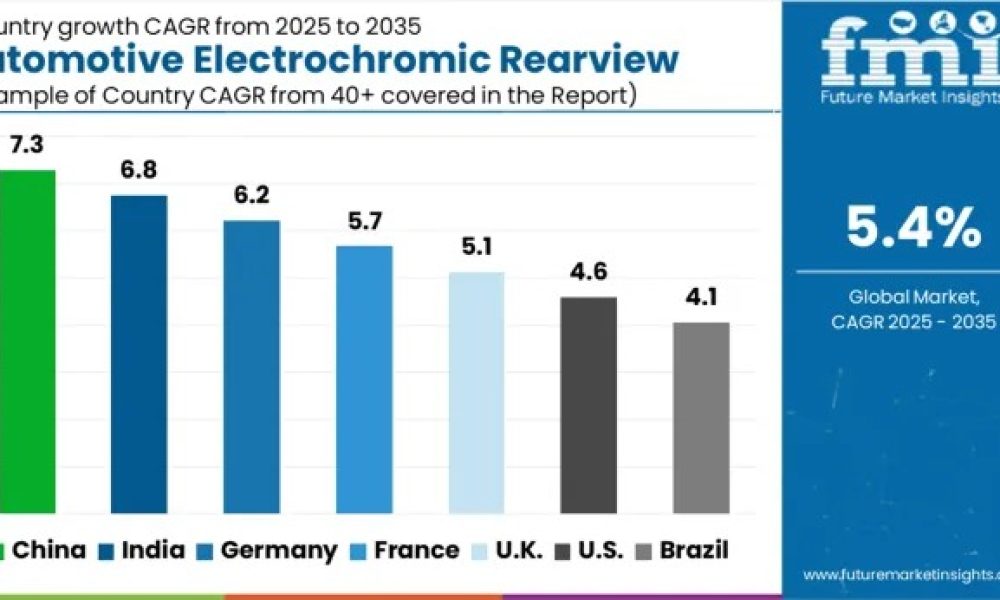
The global automotive electrochromic rearview modules market is estimated to be valued at USD 3.9 billion in 2025 and is projected to reach USD 6.6 billion by 2035, expanding at a compound annual growth rate (CAGR) of 5.4% during the forecast period. Market expansion reflects the automotive industry’s growing emphasis on glare reduction, adaptive visibility, and intelligent cockpit systems across passenger and electric vehicles.
Electrochromic rearview modules, which dynamically adjust mirror reflectance based on ambient lighting, are increasingly transitioning from premium-only features to standard equipment across mid-range vehicle segments. This shift is being supported by advancements in electrochromic materials, improved production scalability, and growing regulatory focus on driver visibility and road safety.
Technology Tier Differentiation Shapes Market Growth Trajectory
The market is segmented into basic electrochromic mirrors, hybrid sensor-integrated modules, and advanced smart mirrors with connectivity features, each contributing differently to overall growth. Basic electrochromic mirrors continue to form the foundation of the market due to their cost efficiency and widespread deployment in mid-segment vehicles. Their ability to automatically dim glare without complex electronics has ensured stable adoption across global OEM platforms.
Hybrid sensor-integrated modules, which combine electrochromic dimming with rain and light sensors, are witnessing faster adoption as automakers expand driver-assist feature sets. Meanwhile, advanced smart mirrors, incorporating cameras, displays, and connectivity, are expected to generate the strongest growth momentum toward the latter half of the forecast period. Although adoption volumes remain smaller, rising penetration in electric vehicles and luxury models is positioning this segment as a critical long-term growth driver.
Get access to comprehensive data tables and detailed market insights — request your sample report today!
Interior Electrochromic Rearview Mirrors Dominate Product Demand
By product type, interior electrochromic rearview mirrors account for 44.9% of total market revenue in 2025, making them the leading segment. Their dominance is supported by compact design, ease of integration, and consistent demand across high-volume production vehicles. Automakers increasingly favor interior electrochromic mirrors as a cost-effective safety enhancement that significantly improves nighttime driving comfort.
Advancements in electrochromic film durability, faster response times, and compatibility with embedded sensors have further strengthened their appeal within OEM supply chains. The growing inclusion of these mirrors as standard features across new vehicle trims continues to reinforce their market leadership.
Passenger Cars Anchor Market Volume and Adoption
Passenger cars represent 37.5% of total market revenue in 2025, underscoring their central role in driving electrochromic rearview module demand. Increasing adoption in compact and mid-size vehicles has been fueled by consumer preference for smart interior features and enhanced safety technologies.
Automakers are integrating electrochromic mirrors alongside infotainment upgrades and advanced driver assistance systems (ADAS) to differentiate offerings in competitive passenger car segments. Rising urban vehicle ownership and heightened awareness of night-driving safety further support sustained demand within this category.
Solid-State Technology Emerges as the Preferred Solution
By technology, solid-state electrochromic modules account for 53.2% of market revenue in 2025, reflecting their superior performance characteristics. Faster switching speeds, improved energy efficiency, and enhanced durability have made solid-state solutions the preferred choice for modern vehicle architectures.
This technology supports slimmer mirror profiles and seamless integration with sensors and digital cockpit systems. As production costs continue to optimize and scalability improves, solid-state electrochromic modules are expected to remain the cornerstone of innovation in rearview mirror systems.
Connected Vehicles and ADAS Integration Accelerate Adoption
The rapid evolution of connected and smart vehicles is significantly influencing the adoption of electrochromic rearview modules. Integration with cameras, sensors, and telematics systems enables enhanced rear visibility, improved nighttime performance, and compatibility with semi-autonomous driving features.
OEMs are increasingly viewing electrochromic mirrors as an integral component of intelligent vehicle ecosystems rather than standalone comfort features. This strategic shift is strengthening supplier-OEM collaborations and accelerating technology standardization across platforms.
Drive Your Business Growth Strategy: Checkout the Report for Key Insights
Asia-Pacific Leads Growth with China and India at the Forefront
Regionally, Asia-Pacific emerges as the fastest-growing market, led by China (7.3% CAGR) and India (6.8% CAGR). Growth in these markets is supported by rising passenger car production, increasing adoption of safety features, and expanding mid-segment vehicle offerings.
Europe continues to demonstrate steady expansion, with Germany (6.2% CAGR) leveraging its premium automotive manufacturing base and strong focus on innovation. North America, led by the United States (4.6% CAGR), remains a mature yet stable market supported by SUV and luxury vehicle demand.
Competitive Landscape Driven by Innovation and OEM Partnerships
The automotive electrochromic rearview modules market is characterized by strong competition among global suppliers, including Gentex, Ficosa, Magna, Samvardhana Motherson, Ichikoh, Honda Lock, Murakami, Konview, and SL. Gentex maintains a leadership position through continuous innovation and long-term supply agreements with major automakers.
Other players are strengthening market presence through integrated mirror solutions, cost-optimized designs, and collaborations aimed at enhancing ADAS compatibility. Competitive differentiation increasingly hinges on product performance, integration capability, and scalability across vehicle segments.
Market Outlook
With growing emphasis on driver safety, smart interiors, and connected mobility, the automotive electrochromic rearview modules market is expected to maintain steady expansion through 2035. While basic electrochromic mirrors will continue stabilizing market volumes, advanced smart mirror systems are anticipated to unlock incremental growth as vehicle digitalization intensifies. Suppliers that align technological innovation with cost efficiency and OEM integration are expected to secure long-term competitive advantage in this evolving automotive segment.
Why Choose FMI: Empowering Decisions that Drive Real-World Outcomes: https://www.futuremarketinsights.com/why-fmi
About Future Market Insights (FMI)
Future Market Insights, Inc. (FMI) is an ESOMAR-certified, ISO 9001:2015 market research and consulting organization, trusted by Fortune 500 clients and global enterprises. With operations in the U.S., UK, India, and Dubai, FMI provides data-backed insights and strategic intelligence across 30+ industries and 1200 markets worldwide.



