
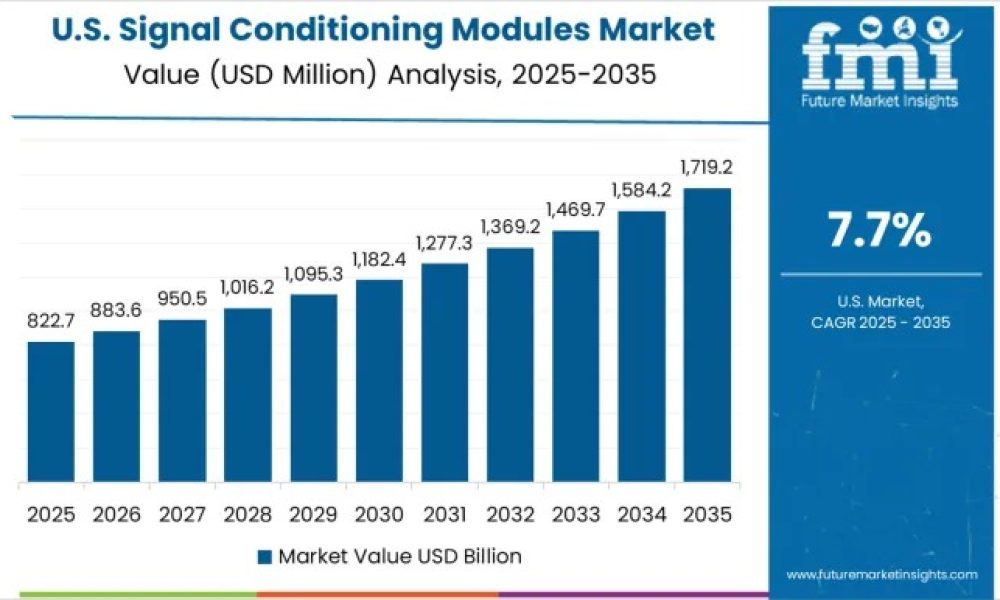
The global signal conditioning modules market is projected to grow from an estimated USD 1.7 billion in 2025 to approximately USD 3.9 billion by 2035, advancing at a compound annual growth rate (CAGR) of 9.0% during the forecast period. Market expansion is being driven by the increasing need for accurate, reliable, and standardized data acquisition across industrial automation, energy, oil & gas, healthcare, aerospace, and automotive applications.
Signal conditioning modules play a critical role in modern control and monitoring systems by filtering, amplifying, isolating, and converting raw sensor signals into usable formats for programmable logic controllers (PLCs), distributed control systems (DCS), and data acquisition platforms. As industries increasingly adopt smart manufacturing, Industrial Internet of Things (IIoT), and predictive maintenance frameworks, the importance of precise signal integrity continues to rise.
Market Growth Drivers: Digitalization and Data Accuracy
The accelerating digitalization of industrial infrastructure is a primary factor supporting growth in the signal conditioning modules market. Industries are placing greater emphasis on real-time monitoring, process optimization, and system reliability, all of which depend on accurate and noise-free signal transmission.
Growing investments in Industry 4.0 initiatives, smart factories, and automation upgrades have expanded the deployment of sensors across production lines, utilities, and infrastructure assets. Signal conditioning modules ensure compatibility between diverse sensor outputs and digital control systems, enabling seamless integration across both legacy and modernized facilities.
Additional momentum is coming from renewable energy monitoring, smart grids, advanced medical devices, and aerospace instrumentation, where precise measurement and isolation are essential for safety, compliance, and operational efficiency. However, challenges such as cost sensitivity in emerging markets and the technical complexity of integrating advanced conditioning systems remain considerations for broader adoption.
Get access to comprehensive data tables and detailed market insights — request your sample report today!
Market Snapshot and Key Takeaways
- Market Value (2025): USD 1.7 billion
- Forecast Value (2035): USD 3.9 billion
- Forecast CAGR (2025–2035): 9.0%
- Leading Form Segment: DIN rail / rack-mounted modules (58.6%)
- Key Growth Regions: North America, Asia-Pacific, Europe
- Major Industry Participants: ABB Ltd., Siemens AG, Rockwell Automation, Schneider Electric, Yokogawa Electric Corporation, National Instruments, Pepperl+Fuchs, Phoenix Contact, TE Connectivity, Weidmüller, and others
Segment Analysis: DIN Rail and Rack-Mounted Modules Dominate
By form, DIN rail- and rack-mounted signal conditioning modules are expected to account for 58.6% of total market revenue in 2025, making them the dominant configuration. Their leadership is supported by ease of installation, modular design, space efficiency, and compatibility with standardized control cabinets commonly used in industrial environments.
These modules offer robust mechanical support, streamlined cable management, and scalability, making them suitable for high-vibration and space-constrained applications. Their adaptability and availability of accessories allow customization across complex automation architectures, reinforcing their preference among system integrators and plant operators.
Type Insights: Temperature Signal Conditioners Lead
Among module types, temperature signal conditioners are projected to represent 26.9% of market share in 2025, reflecting the critical importance of temperature measurement across industrial processes. These modules convert thermocouple and RTD inputs into standardized signals compatible with monitoring and control equipment.
Accurate temperature conditioning is essential for maintaining process stability, product quality, energy efficiency, and safety compliance in sectors such as manufacturing, power generation, food & beverage processing, and HVAC. As temperature remains one of the most frequently monitored industrial parameters, demand for reliable and calibrated signal conditioners continues to strengthen.
Application Trends: Data Acquisition Remains Central
By application, data acquisition is expected to hold 39.4% of total market revenue in 2025, driven by the need for continuous monitoring, diagnostics, and performance evaluation. Signal conditioning modules ensure clean and accurate data capture from sensors and transducers, supporting applications ranging from quality control and laboratory testing to infrastructure health monitoring.
Integration with edge computing and cloud-based analytics platforms is enhancing scalability and visibility, allowing organizations to extract actionable insights from high-quality data streams. As enterprises prioritize transparency, predictive analytics, and system optimization, data acquisition remains a core application area for signal conditioning solutions.
Drive Your Business Growth Strategy: Checkout the Report for Key Insights
Regional Outlook: Industrial Modernization Supports Growth
Regionally, North America, Europe, and Asia-Pacific represent the primary growth engines for the signal conditioning modules market. North America benefits from early adoption of automation technologies, strong presence of process industries, and investments in smart infrastructure.
Europe’s growth is supported by advanced manufacturing ecosystems, stringent quality standards, and ongoing industrial modernization. Asia-Pacific is witnessing rapid expansion due to rising automation investments, expanding manufacturing capacity, and increasing adoption of IIoT technologies across China, Japan, India, and Southeast Asia.
Emerging economies present long-term opportunities as industries modernize and adopt standardized measurement and control systems, despite near-term price sensitivity.
Competitive Landscape and Industry Positioning
The signal conditioning modules market features a mix of global automation leaders, specialized instrumentation providers, and regional manufacturers. Leading companies such as Siemens, Rockwell Automation, ABB, Schneider Electric, Yokogawa Electric, National Instruments, and Pepperl+Fuchs compete through comprehensive product portfolios integrated with PLC and DCS platforms.
Specialized players focus on high-precision measurement solutions for aerospace, automotive testing, healthcare instrumentation, and energy applications. Key competitive differentiators include reliability, modularity, isolation performance, digital communication support, and IIoT readiness. Innovation in safety, accuracy, and system integration continues to define market leadership.
Outlook
The signal conditioning modules market is positioned for sustained growth through 2035, supported by the increasing need for accurate data interpretation, reliable signal transmission, and seamless system integration. As industrial systems become more connected and data-driven, signal conditioning modules will remain foundational components enabling automation, efficiency, and operational excellence across global industries.
Why Choose FMI: Empowering Decisions that Drive Real-World Outcomes: https://www.futuremarketinsights.com/why-fmi
About Future Market Insights (FMI)
Future Market Insights, Inc. (FMI) is an ESOMAR-certified, ISO 9001:2015 market research and consulting organization, trusted by Fortune 500 clients and global enterprises. With operations in the U.S., UK, India, and Dubai, FMI provides data-backed insights and strategic intelligence across 30+ industries and 1200 markets worldwide.



