
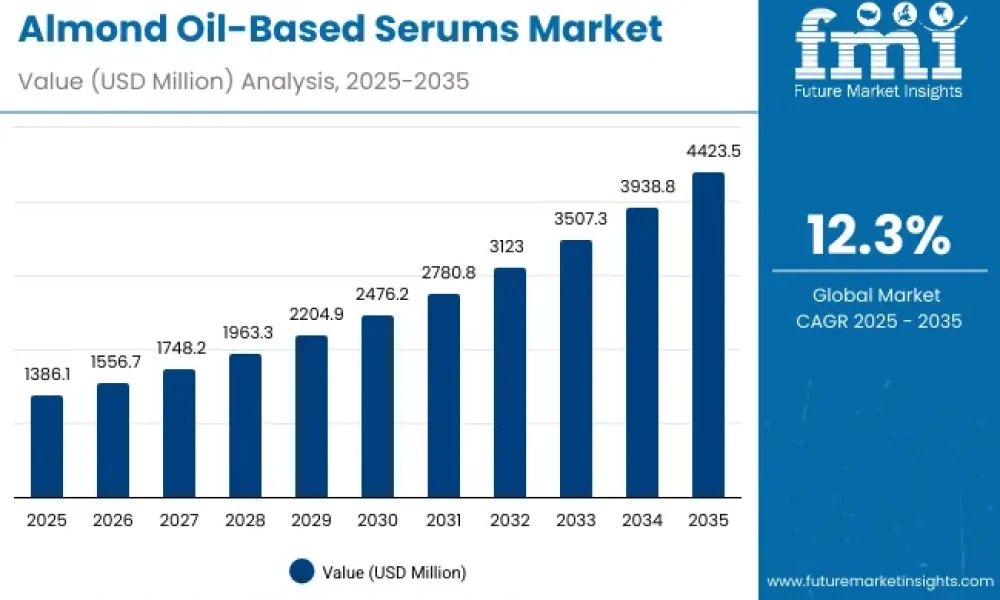
The global Almond Oil-Based Serums Market is forecast to grow from USD 1,386.1 million in 2025 to USD 4,423.5 million by 2035, reflecting an absolute increase of USD 3,037.4 million over the decade. This expansion represents a compound annual growth rate (CAGR) of 12.3% and a more than threefold increase in market size, according to the latest industry analysis.
The market’s growth is being shaped by rising consumer preference for natural, clean-label, and Ayurvedic-inspired skincare, alongside the rapid expansion of e-commerce and direct-to-consumer (D2C) beauty platforms. Asia-Pacific emerges as the fastest-growing region, while hydration remains the dominant functional segment globally.
Gain access to detailed segment-wise analysis and forecast statistics – Request the Sample Report Today
Market Growth Accelerates After 2030 as Asia-Pacific Adoption Scales
Between 2025 and 2030, the Almond Oil-Based Serums Market is expected to expand from USD 1,386.1 million to USD 2,476.2 million, adding USD 1,090.1 million and accounting for 36% of total decade growth. During this period, demand is concentrated in hydration and brightening serums, with hydration alone capturing 54.5% of market share in 2025. Natural/organic and Ayurvedic-inspired claims continue to guide purchasing decisions.
From 2030 to 2035, growth accelerates sharply, contributing USD 1,947.3 million, or 64% of total market expansion. This phase is driven primarily by Asia-Pacific, led by India (23.6% CAGR) and China (23.4% CAGR). Increasing penetration of online beauty platforms, subscription-based skincare models, and clean-label certifications further reinforces adoption during the latter half of the forecast period.
Hydration Serums Anchor Demand Across Premium and Mass Segments
By function, hydration-focused almond oil serums are projected to remain the backbone of the market, accounting for 54.5% of global revenue in 2025. These products are favored for addressing dryness, dullness, and skin barrier support, while also being positioned as both daily-use solutions and premium anti-aging treatments. Rising awareness of skin health and climate-related hydration needs continues to support this segment’s leadership.
By product type, serums dominate with a 52.5% value share in 2025, benefiting from their lightweight texture, fast absorption, and compatibility with layered skincare routines. Concentrated formulations that deliver hydration, brightening, and repair in a single step are gaining traction across both developed and emerging markets.
Natural and Organic Claims Drive Consumer Trust
By claim, natural/organic formulations account for 51.5% of market share in 2025, making them the leading claim category. Demand is reinforced by consumer preference for chemical-free, plant-derived skincare, transparency in ingredient sourcing, and sustainable packaging. Almond oil’s positioning as a safe, effective, and versatile ingredient supports adoption across premium and mass channels.
Regional Outlook Highlights Strong Growth Disparities
- The Asia-Pacific region leads global growth, supported by cultural alignment with natural and Ayurvedic skincare. India’s market benefits from rising disposable incomes, expanding e-commerce reach, and strong local brands such as Forest Essentials and Khadi Natural. China’s rapid growth is fueled by competitive pricing, multifunctional formulations, and cross-border e-commerce platforms.
- In Europe, steady expansion is led by the United Kingdom (13.6% CAGR) and Germany (10.1% CAGR), where regulatory emphasis on clean-label products and sustainability supports consistent demand. Japan (16.9% CAGR) reflects strong interest in high-quality formulations that combine traditional ingredients with advanced skincare innovation.
- North America, led by the United States (9.1% CAGR), represents a more mature but stable market. U.S. demand is driven by hydration-led serums, clean-label and dermatologist-tested claims, and growing reliance on D2C channels and subscription-based skincare routines.
Competitive Landscape Remains Moderately Fragmented
The Almond Oil-Based Serums Market is moderately fragmented, with heritage Ayurvedic brands, global beauty companies, and emerging indie players competing across channels. Forest Essentials holds a 7.6% global market share in 2025, supported by premium Ayurvedic positioning and international expansion. Other key participants include L’Oréal, Clarins, Weleda, and Khadi Natural, which blend natural claims with scientific formulation and multi-channel distribution.
Recent developments include Forest Essentials’ global expansion through luxury retail platforms in 2024 and Khadi Natural’s 2025 launch of clean-label almond oil serums targeting tier-2 and tier-3 Indian cities.
Outlook
With demand increasingly shaped by clean beauty standards, multifunctional formulations, and digital-first sales models, the Almond Oil-Based Serums Market is positioned for sustained long-term growth. Hydration-led, natural, and Ayurvedic-inspired serums are expected to remain central to consumer routines, while Asia-Pacific continues to redefine the global growth trajectory through 2035.
Have a specific Requirements and Need Assistant on Report Pricing or Limited Budget please contact us – [email protected]
About Future Market Insights (FMI)
Future Market Insights, Inc. (FMI) is an ESOMAR-certified, ISO 9001:2015 market research and consulting organization, trusted by Fortune 500 clients and global enterprises. With operations in the U.S., UK, India, and Dubai, FMI provides data-backed insights and strategic intelligence across 30+ industries and 1200 markets worldwide
Why Choose FMI: https://www.futuremarketinsights.com/why-fmi



