
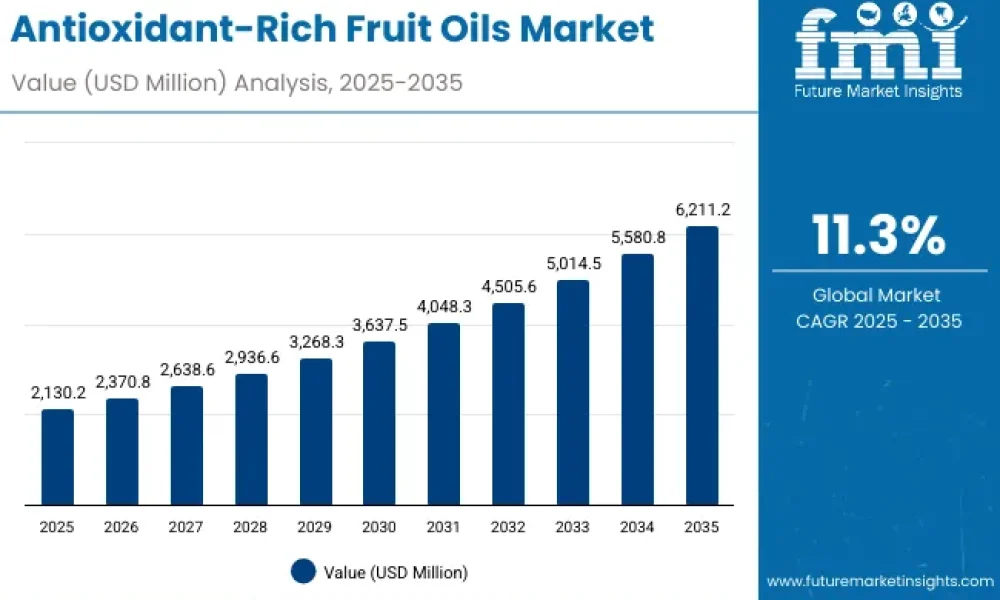
The global antioxidant-rich fruit oils market is entering a decade of sustained expansion, supported by rising demand for clinically backed natural skincare ingredients, premiumization of beauty routines, and the rapid adoption of personalized, plant-based formulations. Valued at USD 2,130.2 million in 2025, the market is projected to reach USD 6,211.2 million by 2035, generating an incremental opportunity of USD 4,081 million over the forecast period and expanding at a compound annual growth rate (CAGR) of 11.3%.
This growth reflects a structural shift in how fruit-derived oils—such as pomegranate, grape seed, acai, berry, and citrus oils—are positioned within cosmetics, dermocosmetics, and adjacent wellness categories. Once considered niche botanical additives, these oils are now increasingly integrated as functional actives with antioxidant, anti-aging, and skin barrier–supporting properties.
Explore the full market insights and exclusive data breakdowns – Request Your Sample Report Now
Market Context: From Botanical Appeal to Clinical Validation
Between 2020 and 2024, the market grew from USD 1,500.7 million to USD 2,016.4 million, driven by clean-label adoption and innovation among established ingredient suppliers. Companies including Croda, DSM-Firmenich, and Givaudan collectively accounted for 41.6% of market share during this period, leveraging integrated portfolios and supply chain capabilities to support cosmetic-grade antioxidant oils.
By 2025, the market reaches a turning point. Demand is increasingly shaped by digitally native brands, D2C skincare platforms, and Ayurveda-aligned startups, shifting the revenue mix away from commodity oils toward premium, functional extracts with targeted claims such as anti-aging, UV defense, and barrier repair. Competitive advantage is increasingly defined by scientific substantiation, traceability, and sustainability certifications.
Growth Outlook: Acceleration in the Second Half of the Decade
From 2025 to 2030, the market is expected to expand to USD 3,637.5 million, adding USD 1,507.3 million in value. Growth in this phase is driven primarily by the rise of serum-based applications, as consumers favor lightweight, fast-absorbing formats compatible with antioxidant-rich oils.
Stronger acceleration is anticipated between 2030 and 2035, when the market adds USD 2,573.7 million, accounting for nearly 63% of total decade growth. This phase is expected to be shaped by Asia-Pacific adoption, e-commerce–led premium launches, and AI-enabled personalization platforms that support modular oil blending based on individual skin biomarkers.
Segment Insights: Anti-Aging and Serums Anchor Demand
By application, anti-aging remains the core revenue driver, accounting for 47.5% of market value in 2025. Fruit oils rich in polyphenols and vitamins—particularly pomegranate, grape seed, and acai—are increasingly positioned as both preventive and restorative solutions addressing oxidative stress and visible aging.
By product type, serums dominate with a 45.5% share, reflecting consumer preference for high-purity, concentrated formats that enhance bioavailability. Innovations such as oil-in-serum hybrids, waterless formulations, and rapid-absorption carriers are reinforcing serum leadership across both mass and premium segments.
Distribution Shifts: E-Commerce Gains Strategic Importance
E-commerce is projected to represent 44.6% of market value in 2025, highlighting the growing influence of digital education, ingredient transparency tools, and D2C engagement models. Subscription programs, personalization quizzes, and curated clean beauty assortments are strengthening online channels as critical touchpoints for antioxidant-rich fruit oil adoption.
Regional Dynamics: Asia-Pacific Leads Growth
Geographically, the market shows clear divergence in growth rates. Asia-Pacific is the fastest-growing region, led by India (22.7% CAGR) and China (21.9%), where clean beauty adoption intersects with Ayurvedic and Traditional Chinese Medicine frameworks, strong digital commerce ecosystems, and rising urban incomes.
In contrast, North America and Europe exhibit steadier growth. The United States market is forecast to grow from USD 465.06 million in 2025 to USD 1,242.24 million by 2035 at a CAGR of 8.7%, supported by clinical positioning, premiumization, and personalized e-commerce strategies. Germany (9.7%) and the UK (13.0%) reflect demand shaped by regulatory rigor, dermatological validation, and certified natural actives.
Competitive Landscape and Industry Direction
The antioxidant-rich fruit oils market remains moderately fragmented. Global leaders such as BASF SE, DSM-Firmenich, and Croda International dominate bioactive ingredient manufacturing, while mid-sized and niche players—including Ashland, Sabinsa, Aromtech, Aldivia, Organic Harvest, and Eminence Organics—differentiate through encapsulation technologies, Ayurvedic integration, and ethical sourcing.
Looking ahead, the market’s trajectory will be shaped by clinical hybridization of oils with nutraceutical attributes, AI-driven personalization, and continued convergence between beauty, wellness, and dermatology. As regulatory frameworks increasingly emphasize transparency and efficacy, stakeholders investing in science-backed narratives and traceable supply chains are expected to define the next phase of market leadership.
Have a specific Requirements and Need Assistant on Report Pricing or Limited Budget please contact us – [email protected]
About Future Market Insights (FMI)
Future Market Insights, Inc. (FMI) is an ESOMAR-certified, ISO 9001:2015 market research and consulting organization, trusted by Fortune 500 clients and global enterprises. With operations in the U.S., UK, India, and Dubai, FMI provides data-backed insights and strategic intelligence across 30+ industries and 1200 markets worldwide
Why Choose FMI: https://www.futuremarketinsights.com/why-fmi



