
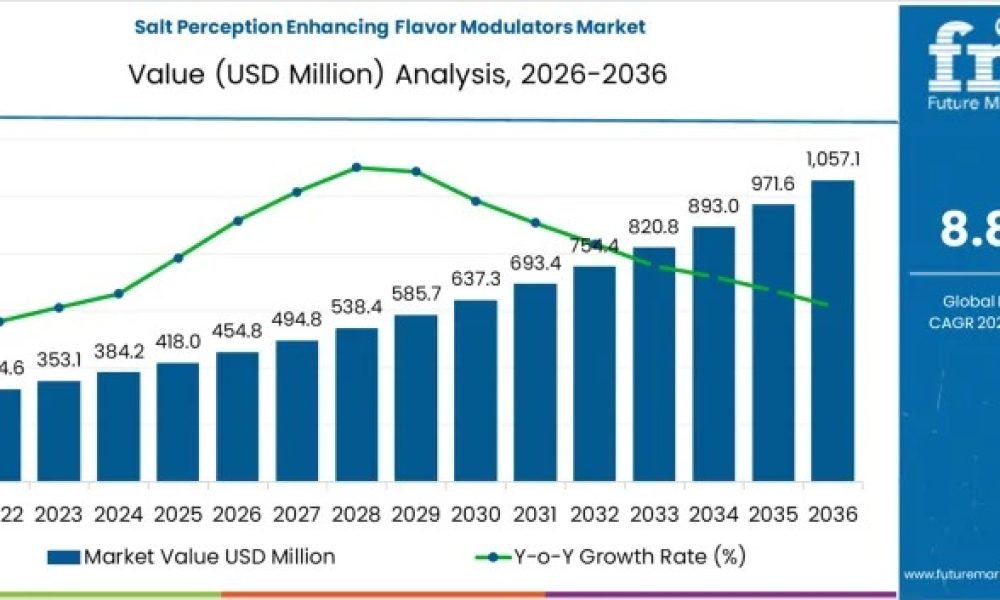
The global salt perception enhancing flavor modulators market is valued at USD 454.8 million in 2026 and is forecast to reach USD 1,057.1 million by 2036, expanding at a CAGR of 8.8%. Market momentum is increasingly shaped by how effectively these systems replicate sodium’s functional roles—flavor amplification, mouthfeel balance, and aroma release—rather than by the pace of sodium reduction initiatives alone. Removing salt directly remains a high-risk reformulation step, making perception-based modulation a preferred, lower-risk pathway for manufacturers.
Salt perception enhancers create value by delivering consistent sensory lift across processing conditions and shelf life. Manufacturers prioritize solutions that allow sodium reduction without destabilizing established product profiles, as taste failure directly impacts repeat purchase rates and brand equity. Cost efficiency is therefore measured less by ingredient price and more by reduced reformulation cycles, fewer sensory panel iterations, and minimized post-launch corrections.
Explore trends before investing – request a sample report today!
Market Snapshot
- Market Value (2026): USD 454.8 million
- Forecast Value (2036): USD 1,057.1 million
- CAGR (2026–2036): 8.8%
- Leading Application: Dairy
- Fastest-Growing Countries: China, France, USA, Germany
Demand Drivers Rooted in Sensory Performance
Demand for salt perception enhancing flavor modulators continues to rise as food and beverage manufacturers respond to public health guidance on sodium reduction without compromising taste quality. Excessive sodium intake is linked to hypertension and cardiovascular disease, prompting regulatory scrutiny and voluntary reduction targets across major markets. Flavor modulators enable producers to maintain salty taste perception at lower sodium levels by interacting with taste receptors and flavor networks rather than relying solely on mineral replacement.
Clean-label expectations further shape procurement decisions. Buyers favor modulators derived from natural or fermentation-based sources that align with transparency requirements while delivering reliable performance across diverse food matrices such as snacks, soups, sauces, dairy, processed meats, and convenience foods.
Application Landscape
Dairy represents 50.0% of global demand, reflecting the critical role salt plays in cheese, spreads, savory yogurts, and dairy-based sauces, where it influences protein interactions and overall flavor balance. Beverages account for 25.0%, driven by savory drinks, functional broths, and plant-based formulations that require taste clarity without excessive mineral content. Bakery applications hold 15.0%, while meat applications represent 10.0%, where sodium reduction must be carefully managed to preserve texture, safety, and flavor.
Key Insights
- Dairy leads due to high sensitivity to sodium reduction
- Beverages rely on modulators to avoid mineral off-notes
- Bakery and meat applications show targeted but essential adoption
Ingredient and Channel Dynamics
Yeast extract-based modulators dominate with a 45.0% share, supported by strong umami delivery, clean-label positioning, and broad compatibility. Potassium chloride follows at 35.0%, often paired with masking systems to manage bitterness. Peptide-based modulators hold 15.0%, valued for precision taste modulation at low inclusion levels, while spices contribute 5.0% as complementary enhancers.
Direct-to-B2B channels control 60.0% of global supply, reflecting the formulation-specific and technical nature of salt perception enhancement. Manufacturers favor close collaboration with suppliers offering sensory validation, regulatory documentation, and application support. Distributors and contract manufacturing each account for 20.0% combined, supporting regional scale and integrated flavor solutions.
Regional Growth Outlook
Growth quality between 2026 and 2036 is driven by disciplined, risk-managed reformulation strategies rather than aggressive sodium cuts.
- China leads with an 11.8% CAGR, supported by government-led salt reduction campaigns and large-scale packaged food reformulation.
- France follows at 11.2%, balancing regulatory alignment with strong culinary quality expectations.
- USA posts 10.9%, shaped by labeling scrutiny and brand-led reformulation across snacks and ready meals.
- Germany records 10.7%, reflecting structured, gradual sodium reduction and high trust in food quality standards.
To Access The Full Market Analysis, Strategic Recommendations, And Analyst Support, Purchase The Complete Report Here.
Competitive Landscape
The market is moderately consolidated, with margin concentration around platforms that integrate salt enhancement, bitterness control, and flavor rounding into single systems. Buyers assess suppliers on sensory reliability, matrix versatility, regulatory coverage, and documentation depth rather than headline cost per kilogram.
Key players include Givaudan, IFF, Kerry, DSM-Firmenich, Symrise, and T. Hasegawa, each leveraging proprietary sensory science and application expertise to deliver repeatable salt perception outcomes under commercial manufacturing conditions.
About Future Market Insights (FMI)
Future Market Insights, Inc. (FMI) is an ESOMAR-certified, ISO 9001:2015 market research and consulting organization, trusted by Fortune 500 clients and global enterprises. With operations in the U.S., UK, India, and Dubai, FMI provides data-backed insights and strategic intelligence across 30+ industries and 1,200 markets worldwide.



