
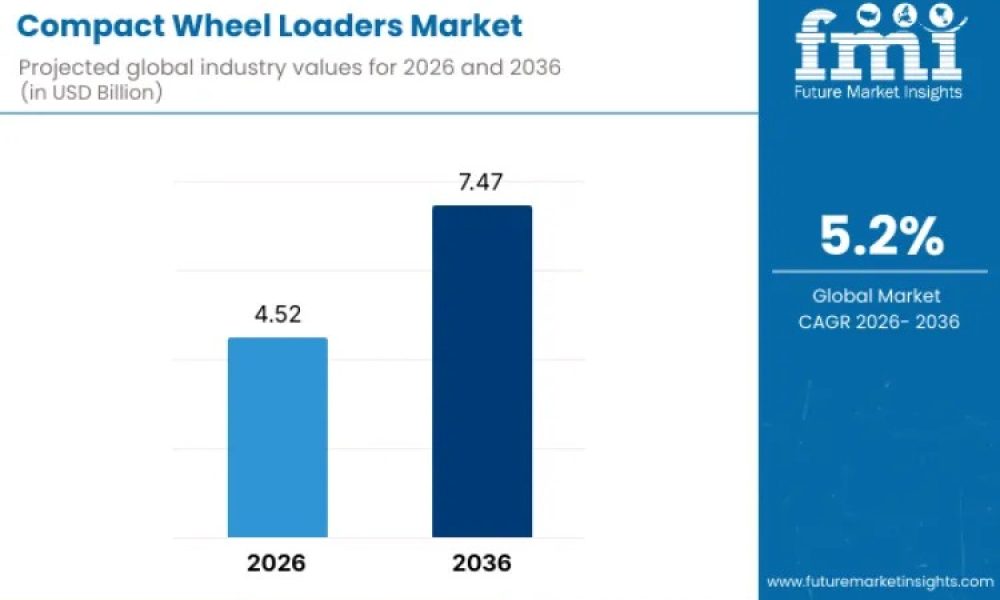
The global compact wheel loaders market is entering a decade of strong, structurally supported growth, driven by expanding construction activity, accelerating urbanization, and rising demand for versatile, space-efficient machinery. The market is projected to grow from USD 4.52 billion in 2026 to USD 7.47 billion by 2036, registering a compound annual growth rate (CAGR) of 5.2% over the forecast period. This expansion reflects the increasing strategic importance of compact loaders across construction, agriculture, utilities, and material handling applications, particularly in space-constrained and productivity-focused environments.
Compact wheel loaders have become indispensable across job sites where maneuverability, multi-functionality, and efficiency are critical. Their compact footprint, compatibility with a wide range of attachments, and ability to operate effectively in confined spaces make them well-suited for urban construction, road maintenance, landscaping, and farm operations. As cities expand vertically and infrastructure projects become more complex, demand for equipment that can deliver high output without occupying excessive space continues to rise.
Infrastructure Growth and Urbanization Drive Core Demand
One of the primary drivers shaping the compact wheel loaders market is the sustained increase in global construction and infrastructure investment, particularly in emerging economies. Rapid urbanization is creating demand for compact machinery capable of operating in dense city environments, where traditional large-scale equipment faces access and efficiency limitations. Compact wheel loaders are increasingly deployed for material transport, site preparation, utility work, and maintenance activities across residential, commercial, and municipal projects.
The agriculture sector is another key growth pillar. Compact loaders are widely used on farms for transporting feed, grain, fertilizer, and supplies, supporting mechanization and productivity improvements in both developed and developing regions. As agricultural operations modernize and labor availability tightens, demand for efficient, easy-to-operate compact equipment continues to expand, reinforcing long-term market growth.
Get access to comprehensive data tables and detailed market insights — request your sample report today!
Technology Integration Reshaping Competitive Dynamics
Technological advancement is playing a central role in redefining value creation within the compact wheel loaders market. Manufacturers are integrating automation features, telematics systems, predictive maintenance capabilities, and electric powertrains to enhance operational efficiency, reduce downtime, and lower total cost of ownership. Telematics-enabled loaders provide real-time insights into machine health, utilization, and fuel efficiency, supporting better fleet management and productivity optimization.
Electrification is emerging as a particularly important trend, especially in regions with strict emission regulations and growing emphasis on sustainability. Electric compact wheel loaders are gaining traction in urban construction, indoor applications, and environmentally sensitive areas, where low noise and zero emissions are critical. While these innovations strengthen the value proposition of compact loaders, high initial acquisition costs and increasing technological complexity may limit adoption in price-sensitive markets, creating differentiation between premium and cost-focused segments.
Market Segmentation Highlights Strong Concentration
By product type, skid steer loaders dominate the market, accounting for over 40% of total share by 2036. Their popularity stems from exceptional versatility, ability to operate in tight spaces, and compatibility with multiple attachments, making them highly attractive to contractors and rental companies. Skid steer loaders deliver strong utilization rates across diverse job site conditions, reinforcing their leadership position within the compact loader category.
From an application perspective, construction represents the leading segment, projected to capture approximately 50% of total market demand by 2036. Urban construction projects increasingly rely on compact loaders to address space constraints while maintaining productivity. Growing project complexity, tighter timelines, and rising labor costs further support adoption, as contractors seek efficient, multi-purpose machinery capable of maximizing output per square meter.
Regional Outlook Reflects Diverse Growth Patterns
Regionally, North America and Europe are expected to maintain market leadership, supported by established construction industries, mature rental fleets, and high adoption of advanced equipment technologies. These regions emphasize productivity, safety, and emission compliance, driving steady replacement demand and technology upgrades.
The Asia-Pacific region is forecast to experience the fastest growth, fueled by rapid urbanization, industrial development, and large-scale infrastructure initiatives. Countries such as India and China, growing at 5.5% and 5.4% CAGR respectively, are benefiting from government-backed infrastructure programs, smart city development, and increasing mechanization across construction and agriculture. China’s strong domestic manufacturing base further enhances market competitiveness through cost-efficient, scalable production.
The United States, with a projected CAGR of 5.3%, remains the single largest market, driven by infrastructure modernization, strong rental penetration, and widespread adoption of telematics-enabled equipment. Germany (5.2%) continues to set benchmarks in emission-compliant and electric compact loader technologies, while Japan (5.0%) sustains demand through its focus on compact, reliable machinery suited to dense urban environments. The United Kingdom and South Korea, growing at 4.9% and 4.1% respectively, reflect steady expansion supported by urban redevelopment and technology adoption.
Competitive Landscape Emphasizes Innovation and Aftermarket Strength
The compact wheel loaders market is highly competitive, characterized by the presence of global OEMs, specialized compact equipment manufacturers, and regional players. Leading companies such as Caterpillar Inc., Deere & Company, CNH Industrial N.V., Kubota Corporation, and Wacker Neuson SE compete through continuous innovation in hydraulic systems, powertrain efficiency, telematics platforms, and attachment compatibility.
Market leaders are strengthening their positions through extensive dealer networks, robust aftermarket services, and technology-led differentiation. Electric loader development, remote operation capabilities, and advanced operator assistance systems are becoming key competitive levers, alongside reliability and lifecycle support. Regional manufacturers and niche players complement the market by offering customized solutions, rental-focused models, and application-specific attachments.
Outlook: A Market Defined by Productivity and Adaptability
Looking ahead, the compact wheel loaders market is positioned for resilient, long-term growth as construction, agriculture, and infrastructure sectors increasingly prioritize efficiency, adaptability, and sustainability. While economic cycles and skill shortages may introduce short-term volatility, the structural shift toward compact, multi-functional equipment supports a positive long-term outlook.
With technology integration accelerating and regional demand diversifying, the compact wheel loaders market offers a compelling mix of scale, innovation, and sustained relevance. Detailed market intelligence, competitive benchmarking, and forward-looking analysis are critical for stakeholders seeking to navigate this evolving landscape and capture emerging opportunities across global markets.
The complete market report provides in-depth segmentation analysis, country-level forecasts, competitive positioning, and strategic insights shaping the compact wheel loaders industry through 2036.
Why Choose FMI: Empowering Decisions that Drive Real-World Outcomes: https://www.futuremarketinsights.com/why-fmi
About Future Market Insights (FMI)
Future Market Insights, Inc. (FMI) is an ESOMAR-certified, ISO 9001:2015 market research and consulting organization, trusted by Fortune 500 clients and global enterprises. With operations in the U.S., UK, India, and Dubai, FMI provides data-backed insights and strategic intelligence across 30+ industries and 1200 markets worldwide.



