
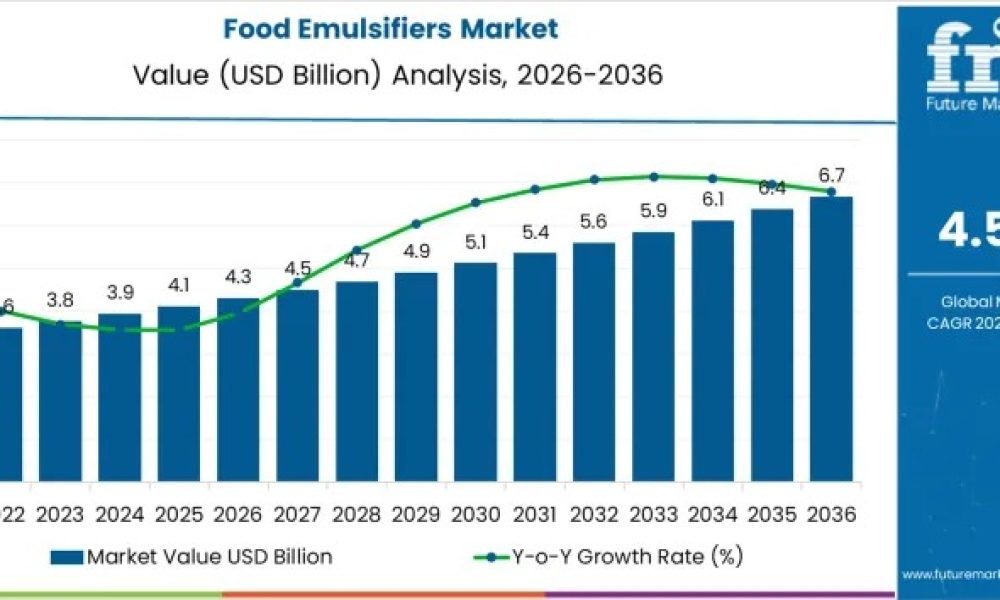
The global food emulsifiers market is entering a decisive decade of transformation, driven by changing consumer expectations, evolving regulatory frameworks, and innovation in ingredient science. Valued at USD 4.3 billion in 2026, the market is projected to reach USD 6.7 billion by 2036, expanding at a compound annual growth rate (CAGR) of 4.5%. Growth is being fueled not only by volume demand from processed and convenience foods, but also by value creation through premium, clean-label, and plant-derived emulsifier solutions.
As food manufacturers respond to heightened scrutiny around ingredient transparency, emulsifiers are shifting from commoditized functional additives to strategic formulation tools. Cost structures across the industry are expected to evolve significantly, particularly as demand accelerates for natural and sustainably sourced emulsifiers. Plant-based emulsifiers, while commanding higher prices, are unlocking margin opportunities for suppliers that can scale production efficiently and ensure supply chain resilience.
Explore trends before investing – request a sample report today!
Market Fundamentals and Performance Snapshot
The food emulsifiers market remains anchored in essential food functionality—enabling stable blends of oil and water, improving texture, and extending shelf life across a wide array of products. However, differentiation is increasingly driven by health alignment and application specificity.
Quick Market Highlights
- Market Value (2026): USD 4.3 Billion
- Forecast Value (2036): USD 6.7 Billion
- Forecast CAGR (2026–2036): 4.5%
- Leading Product Type: Lecithin
- Leading Application: Bakery Products
- High-Growth Regions: Asia Pacific, North America
Clean-Label Demand Redefines Competitive Advantage
The rise of clean-label and health-conscious consumption is reshaping purchasing decisions across bakery, dairy, confectionery, beverages, and functional foods. Consumers increasingly favor recognizable, minimally processed ingredients, prompting manufacturers to reformulate products without sacrificing texture or stability.
This shift has elevated the role of natural emulsifiers, particularly lecithin sourced from soy, sunflower, and other plant bases. While these ingredients carry higher procurement costs, they offer manufacturers the ability to justify premium pricing—especially in gluten-free, vegan, low-sugar, and fortified food categories. Companies capable of integrating sustainability, regulatory compliance, and functional performance are emerging as clear market leaders.
Segment-Wise Insights Highlight Value Concentration
From a product perspective, lecithin accounts for approximately 40% of the global market, maintaining leadership due to its natural origin, multifunctionality, and compatibility with clean-label formulations. Its ability to improve mouthfeel, prevent separation, and enhance shelf stability ensures continued dominance as consumer preferences shift toward plant-based foods.
On the application front, bakery products represent nearly 30% of total demand. Emulsifiers are indispensable in baked goods, where they improve dough handling, volume, crumb softness, and freshness. As bakeries innovate with healthier recipes and longer shelf-life requirements, emulsifier adoption remains structurally strong.
Pricing Power and Margin Dynamics
Margin concentration in the food emulsifiers market is increasingly favoring companies with differentiated portfolios and integrated operations. Larger players benefit from scale advantages, stronger supplier relationships, and optimized distribution networks, enabling better control over raw material volatility.
Smaller and mid-sized manufacturers, by contrast, are finding opportunity in regional markets and niche applications, where customized emulsifier solutions can command higher margins. Regulatory alignment and application-specific R&D are becoming decisive factors in capturing long-term value.
Regional Growth Outlook Remains Robust
Asia Pacific and North America continue to anchor global growth, supported by expanding food processing industries and strong innovation pipelines. Country-level growth trends underscore the market’s global momentum:
- China: CAGR of 7.6%, driven by urbanization, rising disposable incomes, and food safety initiatives
- United States: CAGR of 6.8%, supported by clean-label reformulation and plant-based food expansion
- Germany: CAGR of 5.9%, reflecting stringent quality standards and demand for natural ingredients
- United Kingdom: CAGR of 5.7%, fueled by functional foods and dairy alternatives
- South Korea: CAGR of 5.6%, driven by convenience foods and premium packaged products
Competitive Landscape Anchored in Innovation
The food emulsifiers market is highly competitive, with leading players emphasizing formulation expertise, regulatory compliance, and application versatility. Global companies such as Cargill Inc., Koninklijke DSM N.V., Archer-Daniels-Midland Company, BASF SE, and Ingredion Incorporated are investing heavily in clean-label solutions and customized emulsifier systems.
Mid-tier and specialty players are differentiating through bio-based emulsifiers, regional customization, and functional performance tailored to specific food categories. Across the board, innovation, sustainability, and scalability are defining success.
To Access The Full Market Analysis, Strategic Recommendations, And Analyst Support, Purchase The Complete Report Here.
Outlook: Emulsifiers as Strategic Food Ingredients
Looking ahead, emulsifiers will continue to evolve from behind-the-scenes stabilizers to high-value enablers of food innovation. As functional foods, plant-based alternatives, and premium bakery products gain traction, demand for advanced emulsifier systems will remain resilient. Companies that align formulation science with clean-label expectations and cost efficiency will be best positioned to lead the next phase of market growth.
About Future Market Insights (FMI)
Future Market Insights, Inc. (FMI) is an ESOMAR-certified, ISO 9001:2015 market research and consulting organization, trusted by Fortune 500 clients and global enterprises. With operations in the U.S., UK, India, and Dubai, FMI provides data-backed insights and strategic intelligence across 30+ industries and 1,200 markets worldwide.



