
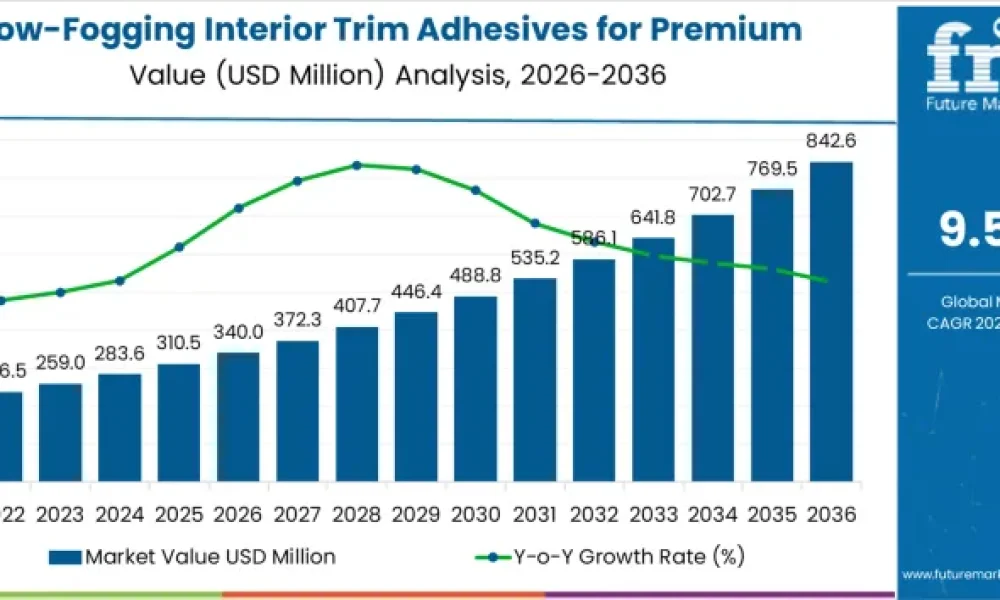
The global low fogging interior trim adhesives for premium automotive cabins market, valued at USD 340 million in 2026, is forecasted to expand to USD 845 million by 2036, achieving a compound annual growth rate (CAGR) of 9.5%. This growth trajectory pivots on stringent cabin air quality standards, material compatibility, and emission thresholds, rather than sheer adhesive volumes. As premium vehicles prioritize occupant comfort through low-volatile formulations, suppliers face elevated development costs for refined chemistries—but secure premium program access and pricing stability once qualified.
Waterborne acrylic and polyurethane dispersions lead with 34% demand share, excelling in low-emission bonding across foams, textiles, and plastics. These systems ensure compliance with fogging limits, thermal stability, and automated assembly integration. Instrument panels and cockpit modules dominate applications at 24% share, as their visibility and proximity to occupants demand rigorous emission control. Asia Pacific, Europe, and North America drive regional momentum, with China topping CAGRs at 10.8%.
Phased Growth Forecast Through 2036
From 2026 to 2031, the market advances from USD 340 million to USD 486 million, adding USD 146 million amid rising adoption in luxury and upper-mid vehicles. This phase builds on expanded qualifications for dashboards, headliners, and door panels, addressing historical constraints from limited low-fogging options. Growth accelerates from 2031 to 2036, surging from USD 486 million to USD 845 million and adding USD 359 million. Platform standardization, soft-touch materials, and electrified vehicle heat patterns fuel this momentum, embedding low-fogging adhesives as standard in high-value interiors.
Core Market Drivers and Restraints
Demand stems from premium cabins’ vulnerability to volatile organic compounds (VOCs) that fog windshields and displays under heat. Tighter sealing, larger glass surfaces, and elevated temperatures in modern vehicles intensify this risk, prompting OEMs to enforce low-fogging specs via thermal performance and odor tests. Electrified architectures and regulatory scrutiny on interior air quality further propel adoption, tying procurement to validated durability across substrates.
Challenges include high formulation costs, precise application needs, and revalidation risks that lock in suppliers early. Sourcing compliant raw materials limits flexibility, while trade-offs balance luxury tailoring against scalable economics. Profit pools concentrate among firms embedded in long-run premium programs, leveraging technical support during design cycles.
Get access to comprehensive data tables and detailed market insights — request your sample report today!
Adhesive Chemistry and Application Leadership
Waterborne acrylic and polyurethane dispersions command leadership due to reliable, low-emission performance in spray/roll systems, resisting plasticizer migration for sustained aesthetics. Solvent-free polyurethanes, modified silane, and low-fogging hot melts fill niche roles, prioritizing process control and flexibility.
Instrument panels lead applications, subjected to stringent OEM aging tests for visible, occupant-proximate components. Door panels, headliners, seats, and consoles follow, with secondary focus on durability. These priorities reflect quality sensitivity over bonded area, driving early validation in high-scrutiny zones.
Operational adoption hinges on heat/UV/vibration compatibility, controlled dispensing, and VOC monitoring in assembly lines. Limitations—such as cost and line adjustments—confine use to premium segments justifying the investment.
Regional Growth Dynamics
Country-level CAGRs highlight divergent trajectories:
| Country | CAGR (%) |
| China | 10.8 |
| India | 10.2 |
| USA | 8.1 |
| Germany | 7.4 |
| Japan | 6.9 |
China’s 10.8% CAGR reflects premium manufacturing hubs integrating adhesives for air quality and automated lines, outpacing India’s 10.2% urban-driven growth. The USA advances at 8.1%, balancing safety and efficiency in high-end assembly. Germany’s 7.4% emphasizes EU VOC compliance; Japan’s 6.9% prioritizes precision in mature markets.
Competitive Strategies and Market Positioning
Competition revolves around emission stability under thermal cycling, substrate versatility, and OEM alignment. Henkel AG & Co. KGaA and Sika AG embed validated families in headliners and panels, ensuring batch repeatability. H.B. Fuller tailors rheology for condensation resistance; 3M integrates with acoustic/vibration needs. Arkema/Bostik advances water-based hybrids for takt-time efficiency.
Suppliers gain edges through early design collaboration, incremental refinements, and audit readiness. Portfolio depth supports multi-application fit, with leadership tied to long-term cabin performance over raw strength.
Strategic Imperatives for Market Leadership
As cabins evolve with electrification and luxury specs, low-fogging adhesives will anchor interior quality. Firms mastering qualification depth, supply chain integration, and emission control will capture value in this USD 505 million expansion. The shift to platform-level standardization demands proactive adaptation to heat profiles and VOC norms.
The full Low Fogging Interior Trim Adhesives for Premium Automotive Cabins Market Report – 2026-2036, last updated December 24, 2025, provides granular forecasts, chemistry breakdowns, regional analyses, competitive benchmarking, and procurement strategies. This authoritative resource equips stakeholders to navigate specs, secure approvals, and dominate premium programs.
Why Choose FMI: Empowering Decisions that Drive Real-World Outcomes: https://www.futuremarketinsights.com/why-fmi
About Future Market Insights (FMI)
Future Market Insights, Inc. (FMI) is an ESOMAR-certified, ISO 9001:2015 market research and consulting organization, trusted by Fortune 500 clients and global enterprises. With operations in the U.S., UK, India, and Dubai, FMI provides data-backed insights and strategic intelligence across 30+ industries and 1200 markets worldwide.



