
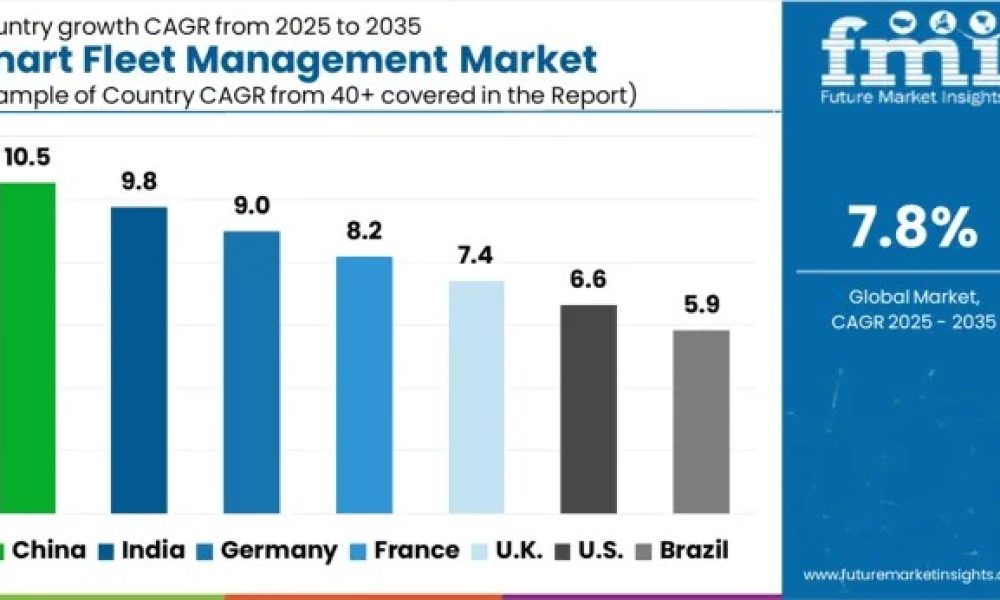
The global smart fleet management market is on a sustained growth trajectory, driven by the rapid digitalization of transportation networks and the increasing reliance on data-driven operational strategies. The market is projected to expand from USD 82.4 billion in 2025 to USD 174.7 billion by 2035, registering a compound annual growth rate (CAGR) of 7.8% over the forecast period. This steady expansion reflects the transformation of fleet operations from manual oversight to intelligent, connected, and analytics-led systems across logistics, passenger transport, corporate fleets, and public sector applications.
Phased Growth Reflects Maturing Adoption
Between 2025 and 2027, the market is expected to grow from USD 82.4 billion to USD 88.9 billion, marking an early adoption phase characterized by the rollout of AI-powered route optimization, predictive maintenance, and fuel management systems. Large fleet operators are leading adoption as they seek to reduce operating costs, improve asset utilization, and meet rising service-level expectations in logistics and delivery operations.
From 2028 to 2031, revenues are forecast to rise from USD 95.8 billion to USD 111.3 billion. This mid-phase growth is reinforced by regulatory mandates related to vehicle tracking, emissions reporting, and driver safety compliance. Expanding urban and intercity logistics networks, coupled with the integration of IoT-enabled sensors and cloud platforms, are enabling real-time monitoring and performance optimization at scale.
By 2032 to 2035, the market is projected to strengthen significantly, reaching USD 174.7 billion. This period is defined by widespread deployment of advanced telematics, predictive analytics platforms, and the early integration of autonomous and semi-autonomous vehicle technologies. Software-as-a-service models, mobile applications, and unified dashboards are becoming central to fleet operations, positioning smart fleet management as an indispensable component of global commercial transportation ecosystems.
Get access to comprehensive data tables and detailed market insights — request your sample report today!
Market Structure Anchored in Commercial Transport
The smart fleet management market draws demand from several interconnected sectors, with commercial logistics and transportation accounting for 35% of total adoption. Trucking, last-mile delivery, and intercity freight operators increasingly rely on telematics, GPS tracking, and route optimization to enhance efficiency, control fuel costs, and ensure on-time deliveries.
The passenger and public transport segment contributes 25%, as buses, taxis, and ride-sharing fleets deploy intelligent systems for vehicle tracking, predictive maintenance, and driver behavior monitoring. These capabilities enhance safety, reliability, and passenger experience while supporting regulatory compliance.
Automotive leasing and rental services represent 15% of the market, using fleet analytics and condition monitoring to optimize utilization and reduce downtime. Enterprise mobility and corporate fleets account for another 15%, adopting solutions for scheduling, fuel management, and compliance reporting. Government and municipal fleets make up the remaining 10%, leveraging GPS-enabled dispatch, monitoring, and maintenance systems to improve emergency response and public service efficiency.
Collectively, commercial transport, passenger services, and corporate fleets represent 75% of total demand, highlighting how operational efficiency, cost control, and safety remain the core drivers of market expansion.
Technology Adoption Drives Competitive Advantage
Growth in the smart fleet management market is closely tied to advances in telematics, IoT connectivity, and cloud-based analytics. Hardware remains the foundation of these systems, with the hardware segment accounting for 42.7% of the market in 2025. GPS modules, telematics devices, sensors, and diagnostic tools enable real-time data capture, forming the backbone of intelligent fleet operations.
Improvements in sensor accuracy, miniaturization, and energy efficiency have enhanced reliability while lowering maintenance requirements. Integration with cloud platforms allows continuous data flow, remote diagnostics, and predictive insights, increasing the return on investment for fleet operators.
By transport mode, roadways dominate with a 56.3% share, reflecting the scale of global road transport networks and the rapid adoption of smart solutions in trucking, delivery, and urban mobility. E-commerce growth, last-mile delivery expansion, and rising freight volumes are accelerating demand for route optimization, fuel efficiency, and driver safety solutions in road-based fleets.
In terms of connectivity, cloud-based solutions lead with a 38.4% share, supported by scalability, cost efficiency, and ease of deployment. Cloud platforms enable centralized fleet management, real-time analytics, and seamless integration with enterprise systems. Enhanced cybersecurity and compliance with data protection standards have further strengthened adoption, particularly among large and geographically dispersed fleets.
Regulation, Safety, and Cost Optimization Fuel Demand
The market’s growth is reinforced by regulatory requirements related to emissions monitoring, driver working hours, and vehicle safety. Fleet operators are increasingly adopting automated tracking and reporting tools to meet compliance mandates while reducing administrative burden.
Safety remains a critical priority, with telematics providing real-time alerts for speeding, harsh braking, and route deviations. Predictive maintenance and driver behavior monitoring reduce accident rates, lower insurance costs, and extend vehicle lifecycles. At the same time, analytics-driven fuel and maintenance optimization strategies are delivering measurable cost savings, making smart fleet management systems a strategic investment rather than a discretionary expense.
Regional Momentum and Competitive Landscape
Asia-Pacific is emerging as a high-growth region, led by China (10.5% CAGR) and India (9.8%), supported by expanding logistics networks, e-commerce growth, and government-backed smart mobility initiatives. Europe, with markets such as France (8.2%) and the UK (7.4%), emphasizes sustainability, driver safety, and regulatory compliance. North America, led by the United States (6.6%), remains a mature yet steadily expanding market focused on performance monitoring and operational transparency.
Competition is shaped by technology depth, interoperability, and analytics capability. Key players including Robert Bosch GmbH, General Motors, Siemens, Cisco Systems, Continental AG, Denso Corporation, and Avnet are advancing modular, scalable solutions that integrate hardware, software, and connectivity. Strategic partnerships with OEMs, IoT providers, and software developers are accelerating innovation and deployment.
Outlook
With revenues set to more than double by 2035, the smart fleet management market is transitioning from a growth enabler to a foundational layer of modern transportation infrastructure. Detailed analysis of segment dynamics, regional trends, and competitive strategies highlights significant opportunities for stakeholders seeking deeper insight into this evolving market and its long-term value creation potential.
Why Choose FMI: Empowering Decisions that Drive Real-World Outcomes: https://www.futuremarketinsights.com/why-fmi
About Future Market Insights (FMI)
Future Market Insights, Inc. (FMI) is an ESOMAR-certified, ISO 9001:2015 market research and consulting organization, trusted by Fortune 500 clients and global enterprises. With operations in the U.S., UK, India, and Dubai, FMI provides data-backed insights and strategic intelligence across 30+ industries and 1200 markets worldwide.



