
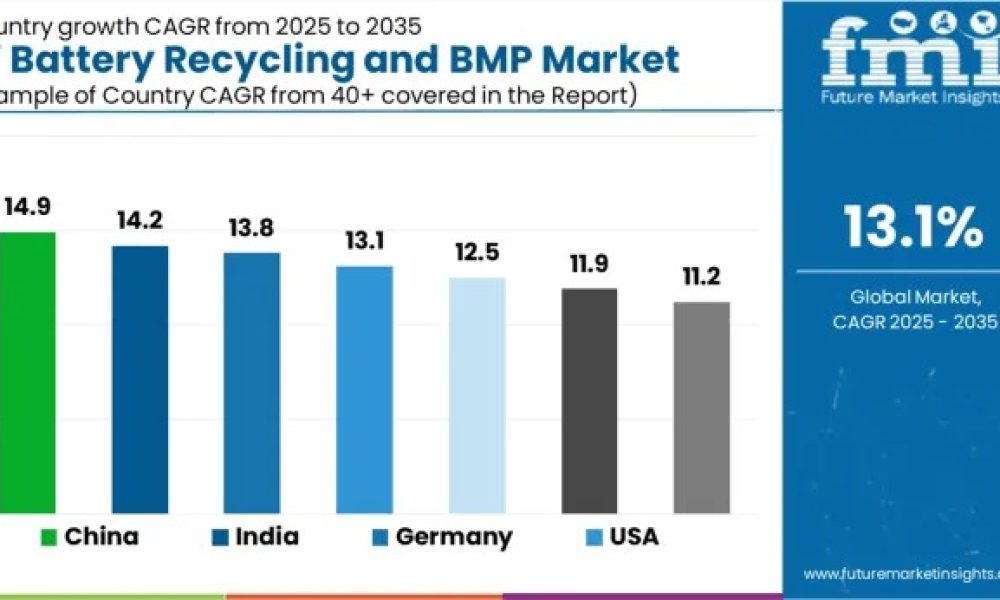
The global landscape for electric vehicle (EV) sustainability is undergoing a seismic shift. According to the latest industry data, the EV Battery Recycling and Black Mass Processing Market is projected to grow from USD 8.6 billion in 2025 to approximately USD 29.7 billion by 2035. This represents an absolute increase of USD 21.1 billion—a staggering 245% expansion over the next decade.
As the first generation of mass-market electric vehicles reaches end-of-life, the industry is transitioning from pilot-scale recycling to a high-volume, industrialized recovery ecosystem. The market is forecast to expand at a Compound Annual Growth Rate (CAGR) of 13.1%, as senior decision-makers across the automotive and energy sectors pivot toward secured, secondary supply chains.
The Rise of Black Mass: A Strategic Asset
At the heart of this growth is “Black Mass”—the intermediate product derived from shredding end-of-life batteries, rich in lithium, nickel, cobalt, and manganese. With raw materials representing up to 70% of battery manufacturing costs, the ability to process black mass has transformed from an environmental obligation into a strategic economic imperative.
Industry figures for 2025 highlight a market valuation of USD 8.6 billion, with Cathode Precursor Manufacturing already claiming a dominant 55% share of the total value. Hydrometallurgical processing has emerged as the primary technological pathway, commanding 48% of the market due to its superior mineral recovery efficiency.
Get access to comprehensive data tables and detailed market insights — request your sample report today!
A Two-Phase Expansion Cycle
The market’s evolution is categorized into two distinct strategic windows. Between 2025 and 2030, the market is projected to reach USD 16.3 billion, driven by early EV retirement volumes and stringent mandates like the EU Battery Regulation, which requires 70% recycling efficiency by 2030.
Following this, the 2030–2035 phase will see the market surge by an additional USD 13.4 billion. This second wave is fueled by the massive volume of batteries sold during the 2020-2024 EV boom finally reaching their scrap date, creating a “tsunami” of feedstock for advanced hydrometallurgical recovery and integrated “closed-loop” ecosystems.
Technological Dominance: Hydrometallurgy and NMC Chemistries
Hydrometallurgical processing is favored by industry leaders because it can recover over 95% of critical minerals at battery-grade purity. This allows for the direct reintegration of materials into the supply chain, bypassing the need for energy-intensive primary mining.
Simultaneously, NMC (Nickel-Manganese-Cobalt) chemistries will dominate recycling feedstock, accounting for 52% of processing volumes in 2025. The high concentration of precious metals in NMC batteries offers the most compelling ROI for commercial-scale recyclers. However, LFP (Lithium Iron Phosphate) recycling is gaining traction, representing 28% of the market as entry-level EVs and stationary storage units begin to retire.
Regional Leadership and Infrastructure
- China: The undisputed leader, projected for a 14.9% CAGR through 2035. With giants like CATL and GEM Co., China has established the world’s most sophisticated black mass infrastructure, supported by early-mover government policies.
- North America: Forecasted at a 13.1% CAGR, bolstered by Department of Energy (DOE) grants and Inflation Reduction Act (IRA) incentives that prioritize domestic critical material processing and recycling hubs.
- Europe (Germany/France): Driven by the EU Battery Regulation, Germany (13.8% CAGR) and France (11.9% CAGR) are leading the charge in integrating recycled content into new cathode precursor supply chains to meet mandatory quotas.
Competitive Landscape
The market is characterized by a mix of specialized recyclers and integrated battery giants. GEM Co., Ltd. is projected to lead the market with a 12% share in 2025, followed closely by innovators such as Umicore, Li-Cycle, Redwood Materials, and Huayou Cobalt. These players are increasingly moving toward automated processing and quality control systems to handle the rising complexity of battery architectures.
Why Choose FMI: Empowering Decisions that Drive Real-World Outcomes: https://www.futuremarketinsights.com/why-fmi
About Future Market Insights (FMI)
Future Market Insights, Inc. (FMI) is an ESOMAR-certified, ISO 9001:2015 market research and consulting organization, trusted by Fortune 500 clients and global enterprises. With operations in the U.S., UK, India, and Dubai, FMI provides data-backed insights and strategic intelligence across 30+ industries and 1200 markets worldwide.



