
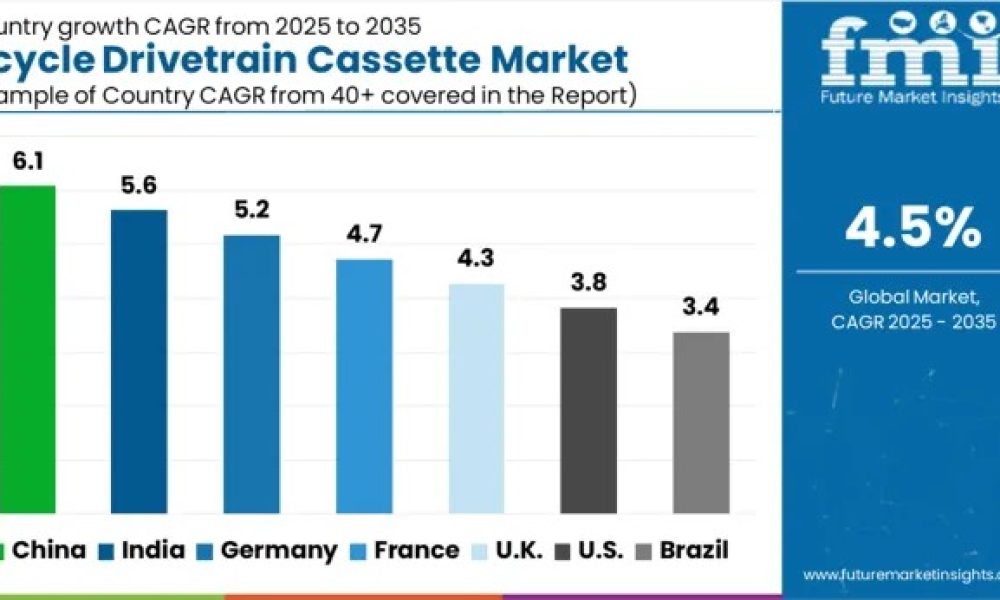
The global bicycle drivetrain cassette market is entering a phase of sustained, technology-led growth, underpinned by rising participation in cycling as a sport, a fitness activity, and a sustainable mode of transportation. According to the latest industry analysis, the market is projected to expand from USD 486.8 million in 2025 to USD 755.9 million by 2035, registering a compound annual growth rate (CAGR) of 4.5% over the forecast period. This consistent upward trajectory reflects the increasing importance of drivetrain cassettes as performance-critical components rather than replaceable accessories.
Drivetrain cassettes play a central role in optimizing gear ratios, cadence control, and overall riding efficiency. As cyclists increasingly demand smoother shifting, higher durability, and lighter components, manufacturers are responding with advanced designs and materials that enhance both performance and longevity. This evolution is reshaping competitive dynamics across the global bicycle components ecosystem.
Performance Cycling and Sustainability Trends Drive Demand
The growing global focus on healthy lifestyles and low-emission mobility solutions continues to fuel bicycle adoption across urban and recreational settings. Cycling’s expansion as a mainstream fitness activity, combined with rising participation in competitive and adventure cycling disciplines, has directly translated into stronger demand for high-quality drivetrain systems.
In parallel, the rapid growth of the electric bicycle segment is creating incremental demand for robust and torque-resistant cassettes capable of handling higher loads. E-bikes, particularly in the mountain and commuter categories, require drivetrain components that deliver consistent performance under sustained stress, reinforcing the need for precision-engineered cassette solutions.
As a result, drivetrain cassettes now account for an estimated 18–20% share of the overall bicycle components market, highlighting their strategic importance within the value chain. Their contribution extends across multiple adjacent industries, including cycling equipment, bicycle manufacturing, and the broader sports and outdoor equipment market.
Get access to comprehensive data tables and detailed market insights — request your sample report today!
Material Innovation Reshapes Competitive Landscape
One of the most influential growth drivers in the bicycle drivetrain cassette market is ongoing innovation in materials and manufacturing processes. While steel continues to dominate due to its balance of cost, durability, and wear resistance, manufacturers are increasingly refining machining techniques and surface treatments to extend product life and improve shifting precision.
Steel cassettes are projected to account for 52.4% of market revenue in 2025, reflecting their widespread adoption across entry-level, mid-range, and performance bicycles. Their resilience in harsh riding environments—such as wet, muddy, or high-torque conditions—makes them particularly attractive for mountain biking and daily commuting applications.
At the same time, aluminum and titanium cassettes are gaining traction in premium segments, driven by demand for lightweight solutions that improve acceleration and climbing efficiency. Although higher material costs present pricing challenges, these advanced cassettes are increasingly favored by competitive cyclists and enthusiasts seeking marginal performance gains.
Mountain Bikes Lead Segmental Growth
By bicycle type, the mountain bike segment is expected to hold 41.6% of global market revenue in 2025, maintaining its leadership position. The technical demands of off-road riding—ranging from steep elevation changes to variable terrain—require wider gear ranges, higher torque capacity, and enhanced durability.
Manufacturers are continuously improving cassette designs for mountain bikes, focusing on load-bearing performance, mud-shedding capabilities, and reliable shifting under stress. The expansion of trail infrastructure, adventure tourism, and organized mountain biking events worldwide continues to reinforce long-term demand in this segment.
Cassette size preferences further illustrate the market’s shift toward balanced performance. The 11–28T cassette size is projected to represent 36.9% of market revenue in 2025, favored for its versatility across road, endurance, and mixed-terrain riding. Its smooth gear progression supports cadence efficiency, making it a preferred choice for both recreational and performance-focused cyclists.
Regional Growth Patterns Highlight Emerging Opportunities
Regionally, Asia-Pacific, North America, and Europe remain the primary growth engines for the bicycle drivetrain cassette market. Emerging economies are showing particularly strong momentum, supported by urbanization, rising disposable incomes, and government initiatives promoting cycling as an eco-friendly transport solution.
China leads global growth with a projected CAGR of 6.1%, driven by its vast cycling population, expanding middle class, and strong demand for both traditional and electric bicycles. India follows closely with a 5.6% CAGR, supported by growing fitness awareness, urban commuting needs, and increasing accessibility through e-commerce channels.
In contrast, mature markets such as the United States, the United Kingdom, France, and Germany are characterized by steady growth anchored in premium product adoption, technological innovation, and the rapid uptake of e-bikes. These regions are increasingly focused on high-performance, lightweight, and electronically compatible drivetrain solutions.
Competitive Landscape Focused on Differentiation
The bicycle drivetrain cassette market is highly competitive, with leading players emphasizing material quality, gear optimization, and system compatibility to differentiate their offerings. Companies such as Box Components, Campagnolo, Ethirteen Components, Full Speed Ahead, Garbaruk, KCNC International, KMC Chain, Leonardi Cassettes, Miche.it, and microSHIFT are actively investing in design innovation and targeted product portfolios.
Competition is increasingly driven by precision engineering, durability claims, and the ability to address diverse rider profiles—from professional racers to daily commuters. As drivetrain technology evolves toward 12-speed systems and electronic shifting compatibility, suppliers that align product development with these trends are expected to strengthen their market positions.
Outlook: From Component to Strategic Performance Enabler
Looking ahead, the bicycle drivetrain cassette market is poised to benefit from long-term structural trends favoring cycling, sustainability, and performance optimization. While challenges such as raw material price volatility and competition from alternative drivetrain technologies remain, demand fundamentals remain resilient.
As drivetrain cassettes continue to evolve from peripheral components into essential performance enablers, innovation in materials, gear design, and customization will remain central to value creation. Detailed insights into segmental performance, regional opportunities, and competitive strategies are critical for stakeholders seeking to navigate this evolving market landscape and capitalize on its growth potential over the coming decade.
Why Choose FMI: Empowering Decisions that Drive Real-World Outcomes: https://www.futuremarketinsights.com/why-fmi
About Future Market Insights (FMI)
Future Market Insights, Inc. (FMI) is an ESOMAR-certified, ISO 9001:2015 market research and consulting organization, trusted by Fortune 500 clients and global enterprises. With operations in the U.S., UK, India, and Dubai, FMI provides data-backed insights and strategic intelligence across 30+ industries and 1200 markets worldwide.



