
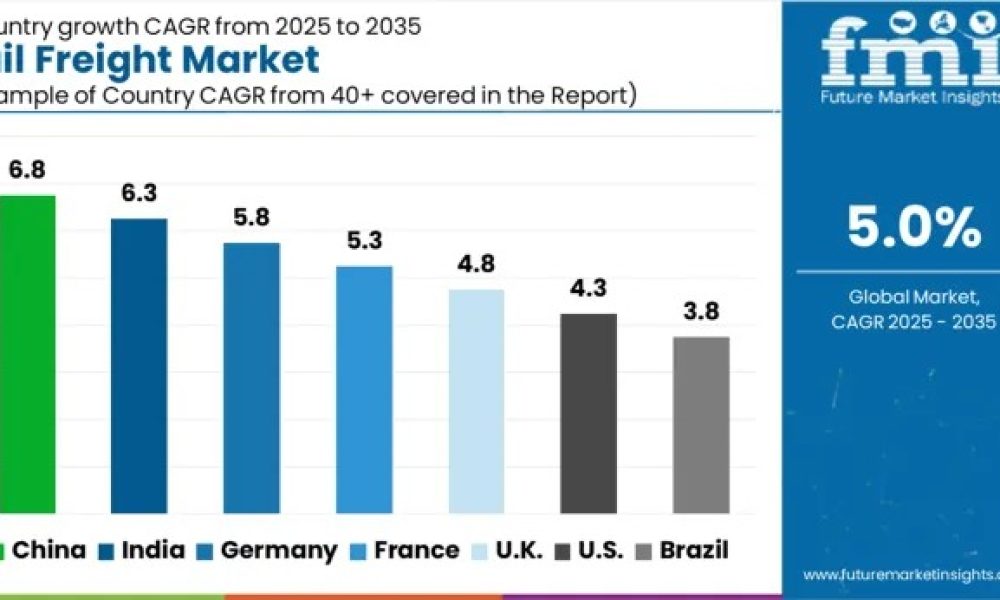
The global rail freight market is demonstrating sustained momentum as industries and governments increasingly prioritize resilient, cost-efficient, and scalable freight transportation solutions. Valued at USD 370.0 billion in 2025, the market is projected to reach USD 602.7 billion by 2035, expanding at a compound annual growth rate (CAGR) of 5.0% over the forecast period. This steady trajectory reflects rail freight’s enduring relevance amid shifting trade patterns, infrastructure modernization, and intensifying pressure on alternative freight modes.
Year-on-year progression underscores consistent demand growth. Market value rises from USD 370.0 billion in 2025 to USD 388.5 billion in 2026, followed by USD 407.9 billion in 2027 and USD 428.3 billion in 2028. By 2029, revenues are expected to reach USD 449.7 billion, reinforcing rail freight’s expanding role in bulk commodity movement and intermodal cargo transport. Momentum accelerates further in the early 2030s, with the market advancing to USD 472.2 billion in 2030, USD 495.8 billion in 2031, and crossing USD 520.6 billion in 2032. By 2035, rail freight revenues are forecast to close at USD 602.7 billion, highlighting long-term stability in global freight systems.
This ten-year expansion highlights rail freight’s ability to outperform more volatile air and maritime alternatives. Even under competitive pressure from road transport, rail continues to serve as a resilient logistics backbone, particularly for high-volume, long-distance, and cross-border cargo flows. Ongoing investments in modern rolling stock, electrification, digital signaling, and real-time tracking platforms are improving operational reliability and reinforcing confidence in rail-based logistics networks.
Rail Freight’s Strategic Weight Across Global Logistics
Rail freight accounts for an estimated 18% of the global freight transportation market, nearly 21% of the intermodal transport market, and around 17% of surface transport activity. When aggregated across its parent sectors—including logistics and supply chains, freight and cargo transport, and intermodal systems—the rail freight category contributes approximately 82% in combined influence. This proportion underscores rail freight’s structural importance as a central spine of freight movement, balancing efficiency, capacity, and cost control.
Its strength lies in providing reliable transport for bulk commodities, heavy industrial goods, and strategic trade corridors where consistency outweighs speed. Long-term contracts with mining, agriculture, manufacturing, and energy sectors further anchor demand, while integration with ports and inland terminals enhances connectivity. As multimodal strategies evolve, rail is expected to retain its central role rather than face displacement, reinforcing its position as a strategic lever for supply chain resilience and competitiveness.
Get access to comprehensive data tables and detailed market insights — request your sample report today!
Drivers Sustaining Market Growth
The rail freight market is expanding on the back of rising demand for cost-efficient, high-capacity, and environmentally sustainable transport solutions. Rail offers a significantly lower cost per ton-mile compared to road haulage, particularly for long-haul routes, while also delivering lower emissions per unit of cargo moved. This advantage is becoming increasingly relevant as fuel price volatility and sustainability targets reshape freight economics.
Infrastructure investment remains a core catalyst. Modernization of rolling stock, electrification of corridors, expansion of intermodal terminals, and deployment of digital tracking systems have collectively improved transit reliability and asset utilization. At the same time, recovery in industrial output and steady growth in cross-border trade are boosting cargo volumes across domestic and international routes. Policy-driven modal shift initiatives—particularly in Europe and parts of Asia—are further reinforcing adoption by encouraging movement away from road transport.
Segmental Performance Highlights
By cargo type, containerized rail freight is projected to command 46.8% of market revenue in 2025, maintaining its leadership due to compatibility with intermodal logistics systems. Standardized containers enable faster handling, improved security, and seamless transfers between sea, rail, and road. Growing integration between ports and inland terminals continues to strengthen this segment’s outlook as global supply chains prioritize efficiency and resilience.
By service type, full carload (FCL) services are expected to account for 52.4% of market revenue in 2025. Industries shipping bulk commodities such as minerals, chemicals, and agricultural products favor FCL due to dedicated capacity, predictable scheduling, and cost efficiency over long distances. Long-term freight contracts and specialized railcar fleets provide stability for operators and reliability for shippers.
From a distance perspective, long-haul rail freight dominates with an estimated 58.9% market share in 2025. Rail’s inherent efficiency over extended distances, combined with lower environmental impact and improved corridor infrastructure, continues to position long-haul services as a preferred option for interregional and cross-border transport.
Regional Dynamics Shape Growth Trajectories
Growth is most pronounced across Asia-Pacific, Europe, and North America, supported by national investment programs and expanding trade corridors. China leads with a projected CAGR of 6.8%, driven by Belt and Road initiatives, electrified networks, and expanding interprovincial freight flows. India follows at 6.3% CAGR, supported by Dedicated Freight Corridors that reduce congestion and improve turnaround times. Germany is expected to grow at 5.8%, benefiting from EU-backed cross-border corridors and efficiency-driven upgrades.
Mature markets such as the United States (4.3%) and United Kingdom (4.8%) continue to post steady gains, supported by intermodal traffic, infrastructure upgrades, and digital adoption, even as they contend with capacity constraints and modal competition.
Competitive Landscape and Industry Outlook
The rail freight market is led by large, vertically integrated operators including BNSF Railway, Union Pacific Railroad, CSX Corporation, Norfolk Southern Railway, Deutsche Bahn AG, SNCF Logistics, Canadian National Railway, Canadian Pacific Railway, China Railway Corporation, and DHL Group. These players leverage extensive networks, terminal assets, and technology investments to deliver end-to-end logistics solutions. Competitive differentiation increasingly hinges on reliability, network coverage, multimodal integration, and environmental performance.
Looking ahead, rail freight is positioned to remain a cornerstone of global and regional supply chains. As trade volumes expand, sustainability imperatives strengthen, and logistics networks seek resilience, rail freight’s combination of scale, efficiency, and reliability is expected to sustain long-term growth. The market’s steady progression toward USD 602.7 billion by 2035 signals not only expansion, but enduring strategic relevance within the global freight ecosystem.
Why Choose FMI: Empowering Decisions that Drive Real-World Outcomes: https://www.futuremarketinsights.com/why-fmi
About Future Market Insights (FMI)
Future Market Insights, Inc. (FMI) is an ESOMAR-certified, ISO 9001:2015 market research and consulting organization, trusted by Fortune 500 clients and global enterprises. With operations in the U.S., UK, India, and Dubai, FMI provides data-backed insights and strategic intelligence across 30+ industries and 1200 markets worldwide.



