
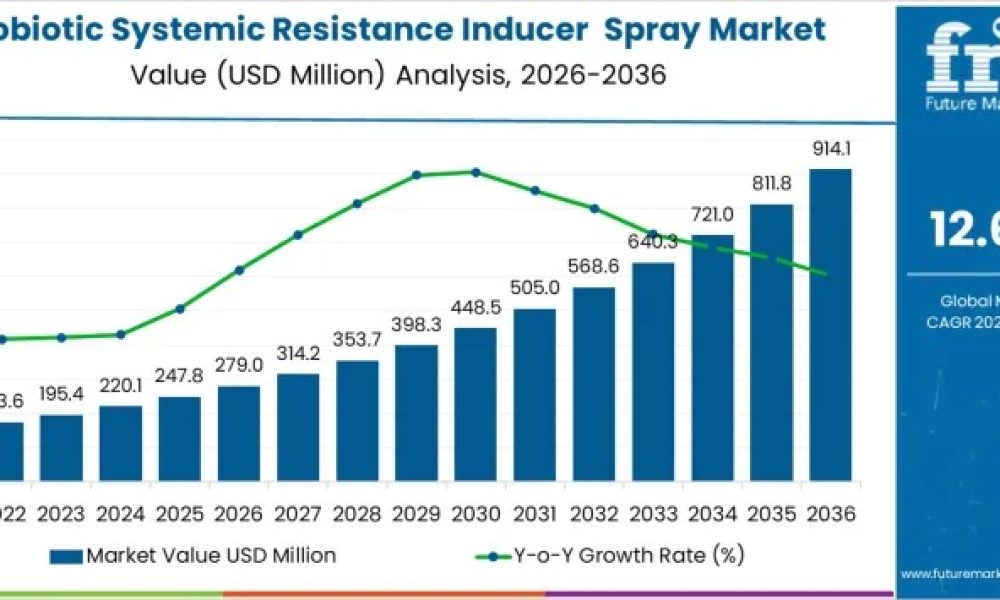
The global Probiotic Systemic Resistance Inducer Spray Market is entering a decisive growth phase as agriculture increasingly prioritizes biological crop protection and reduced chemical dependency. According to recent market assessments, the industry is projected to expand from USD 279 million in 2026 to USD 914.1 million by 2036, registering a robust CAGR of 12.6%. This growth reflects a structural shift in farming practices, where enhancing plant immunity through natural mechanisms is becoming central to long-term productivity and environmental stewardship.
Subscribe for Year-Round Insights → Stay ahead with quarterly and annual data updates:
Probiotic systemic resistance inducer (SAR) sprays work by stimulating a plant’s innate defense system rather than directly targeting pathogens. This mode of action is particularly valuable at a time when farmers face mounting challenges from climate variability, pest resistance, and tightening regulations on conventional agrochemicals. By activating systemic acquired resistance pathways, these sprays help crops better withstand diseases and environmental stress while aligning with the global push for greener agricultural inputs.
Market Dynamics Shaping Growth
Several converging factors are accelerating adoption of SAR sprays worldwide. Regulatory pressure to reduce synthetic pesticide use, rising consumer demand for residue-free produce, and increased awareness of soil and ecosystem health are pushing growers toward biological solutions. SAR sprays offer a compelling value proposition by enhancing resilience without compromising yield or quality. Advances in plant physiology and microbial science have also improved formulation efficacy, enabling more consistent field performance across diverse crops.
From a strategic standpoint, SAR sprays are increasingly integrated into integrated pest and crop management programs. Rather than replacing conventional inputs outright, they complement existing practices, helping farmers optimize input efficiency while reducing environmental impact.
Key Takeaways Driving Industry Momentum
- Strong financial outlook: The market’s projected tripling in value by 2036 underscores rising confidence in biological crop protection.
- Technology-led innovation: Improved prebiotic compounds now offer longer-lasting and more reliable activation of plant defense responses.
- Sustainability alignment: SAR sprays directly support global sustainability goals by lowering chemical loads in agriculture.
Segment Insights: Where Demand Is Concentrated
Oligosaccharide-based inducers currently lead the market, accounting for roughly 34% of global demand. Their dominance stems from their proven ability to trigger systemic resistance pathways effectively across a wide range of crops. These compounds are widely regarded as a cornerstone of green agriculture strategies, particularly in regions seeking rapid reductions in chemical pesticide use.
In terms of application, foliar spraying remains the preferred method, representing about 58% of market share. Direct leaf application allows rapid absorption and quick activation of defense mechanisms, making it especially effective during periods of high disease pressure. Ease of use and compatibility with existing spraying routines further reinforce its popularity among growers.
Regional Outlook: Asia Pacific at the Forefront
Geographically, Asia Pacific, North America, and Latin America are the fastest-growing regions for SAR sprays. India stands out with an estimated CAGR of 15.1%, driven by its vast agricultural base, rising disease pressure, and strong policy push toward sustainable farming. China follows closely, supported by modernization initiatives and increasing emphasis on green inputs in large-scale farming systems.
In Latin America, Brazil’s expansive cultivation of soybeans, sugarcane, and coffee is fueling steady adoption of SAR sprays as farmers seek resilience against pests and climate stress. Meanwhile, North America and Europe continue to see consistent growth, supported by regulatory frameworks that favor biological crop protection and innovation-driven farming.
Challenges and Adoption Barriers
Despite strong momentum, adoption is not without challenges. Field performance can vary depending on crop type, environmental conditions, and pathogen pressure, requiring tailored agronomic guidance. Cost sensitivity in certain regions and limited awareness of biological modes of action can also slow uptake. Addressing these barriers through education, demonstration trials, and precision application guidance will be critical to sustaining long-term growth.
Competitive Landscape
Leading agrochemical and agritech companies are actively positioning SAR sprays within broader plant health portfolios. Firms such as Syngenta Group, Bayer CropScience, BASF SE, UPL Limited, and Corteva Agriscience are investing in R&D, field validation, and crop-specific recommendations to strengthen market confidence. Their strategies increasingly emphasize compatibility with integrated management systems and measurable improvements in stress tolerance and disease resistance.
Outlook Through 2036
Looking ahead, the Probiotic Systemic Resistance Inducer Spray Market is poised to play a pivotal role in the evolution of global agriculture. As food security concerns intensify and sustainability becomes non-negotiable, SAR sprays offer a scalable, science-backed pathway to resilient crop production. Continued innovation, supportive regulation, and farmer education will determine the pace at which this market realizes its full potential.
Get data that aligns with your strategic priorities — ask for report customization today:
Have a specific Requirements and Need Assistant on Report Pricing or Limited Budget please contact us – [email protected]
About Future Market Insights (FMI)
Future Market Insights, Inc. (FMI) is an ESOMAR-certified, ISO 9001:2015 market research and consulting organization, trusted by Fortune 500 clients and global enterprises. With operations in the U.S., UK, India, and Dubai, FMI provides data-backed insights and strategic intelligence across 30+ industries and 1200 markets worldwide.
Contact Us:
Future Market Insights Inc.
Christiana Corporate, 200 Continental Drive,
Suite 401, Newark, Delaware – 19713, USA
T: +1-347-918-3531



