
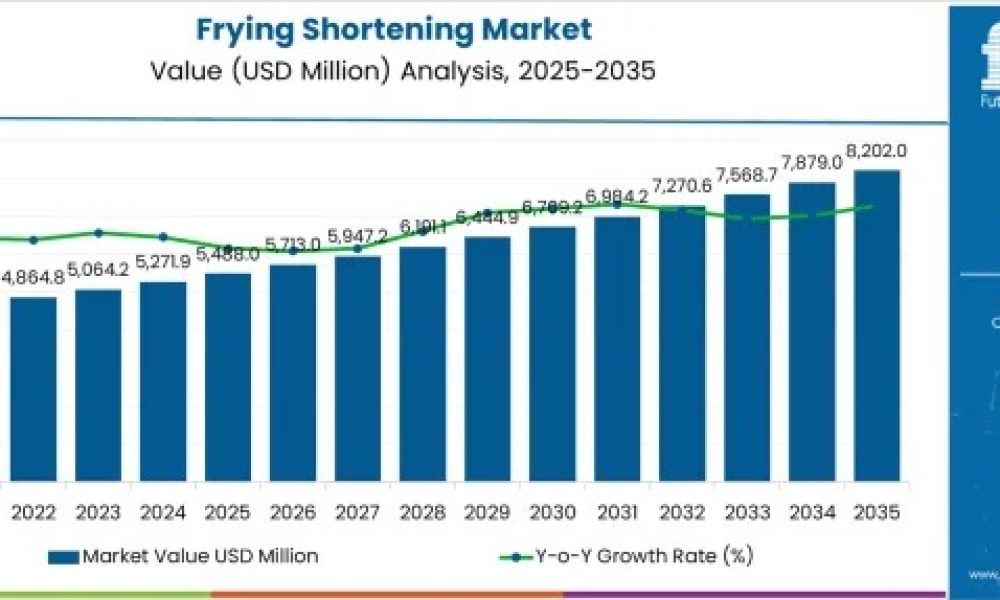
The global Frying Shortening Market is undergoing a steady yet transformative growth phase, supported by evolving dietary preferences, regulatory shifts on trans fats, and rising demand for consistent, high-performance frying solutions. The market is estimated to be valued at USD 5,488.0 million in 2025 and is projected to reach USD 8,202.0 million by 2035, expanding at a compound annual growth rate (CAGR) of 4.1% during the forecast period.
Frying shortenings remain a critical ingredient across quick-service restaurants (QSRs), bakeries, snack manufacturers, and packaged food producers. Their ability to deliver uniform texture, prolonged fry life, oxidative stability, and shelf-life extension continues to make them indispensable in large-scale food processing and commercial kitchens.
Explore trends before investing – request a sample report today!
Market Evolution Driven by Performance and Compliance
The market’s expansion is closely tied to the global rise in fried and convenience food consumption, particularly across urbanized regions and emerging economies. As food processors face increasing scrutiny over fat composition, there has been a clear transition from traditional hydrogenated fats toward trans-fat-free, cholesterol-free, and thermally stable frying shortenings.
Advancements in oil processing technologies, emulsification techniques, and precision blending have enabled manufacturers to develop shortenings with optimized fatty acid profiles. These innovations ensure compliance with food safety regulations while maintaining frying efficiency across diverse applications—from deep frying to baking and dry-mix formulations.
Growing consumer awareness around clean-label ingredients, traceable sourcing, and sustainability is further influencing product reformulation strategies. This shift is encouraging suppliers to invest in organic certifications, responsible sourcing initiatives, and transparent supply chains.
Quick Market Snapshot (2025)
- Industry Value: USD 5,488.0 million
- Forecast Value (2035): USD 8,202.0 million
- Forecast CAGR: 4.1%
- Leading Nature Segment: Organic Frying Shortening (32.9%)
- Dominant Form: Powdered Frying Shortening (46.7%)
- Key Growth Regions: North America, Asia-Pacific, Europe
Organic Frying Shortening Gains Strategic Advantage
By nature, organic frying shortening is projected to account for 32.9% of total market revenue in 2025, reflecting the accelerating demand for non-GMO, additive-free, and organically certified food ingredients. Food manufacturers in North America and Europe are increasingly incorporating organic frying mediums into premium snack foods and clean-label product lines.
The segment’s growth is reinforced by stricter retail standards, rising household adoption of natural fats for gourmet cooking, and strong alignment with sustainability-driven procurement policies. As transparency and ingredient integrity become central to brand positioning, organic frying shortening is expected to retain its competitive edge.
Powdered Form Leads in Operational Efficiency
From a form perspective, powdered frying shortening dominates the market with an estimated 46.7% revenue share in 2025. Its popularity stems from logistical convenience, extended shelf life, and ease of integration into dry mixes, baking premixes, instant meals, and seasoning blends.
Unlike liquid or block formats, powdered shortening minimizes handling challenges and offers consistent performance in high-throughput production environments. Ongoing innovations in anti-caking agents and melting point customization are further enhancing its stability across varying storage and transportation conditions.
Palm-Based Shortening Remains the Preferred Source
By source, palm-based frying shortening is projected to capture 41.2% of market revenue in 2025. Its dominance is attributed to cost efficiency, neutral flavor, balanced fatty acid composition, and exceptional oxidative stability. These attributes make palm derivatives a preferred choice for deep frying, frozen snacks, confectionery, and low-moisture baking applications.
The segment’s resilience is supported by expanding RSPO-certified supply chains, traceability programs, and sustainable palm sourcing initiatives, which are helping address environmental concerns while ensuring supply reliability.
Health-Conscious Consumption Reshaping Demand
The elimination of trans fats from food formulations has significantly reshaped the frying shortening landscape. Rising awareness of cardiovascular health, coupled with increased consumption of low-fat and cholesterol-free products, is driving adoption across baked goods, fried snacks, and even dietary supplements such as oatmeal biscuits.
Additionally, frying shortening’s functional role in preventing gluten interaction and improving product texture has expanded its application scope across food processing industries. Growing disposable incomes and Westernized dietary patterns, particularly in Asia-Pacific, are further fueling demand for cakes, pastries, and processed foods.
Competitive Landscape and Strategic Opportunities
Leading players in the frying shortening market include Cargill, Incorporated; Wilmar International Ltd.; Archer-Daniels-Midland Company; Ventura Foods, LLC; Bunge Limited; AAK AB (publ.); The J.M. Smucker Company; Natu’oil Services Inc.; and Carotino Sdn Bhd, among others.
Key strategic opportunities include:
- Investment in R&D to explore alternative sources such as enzyme- or bio-based shortenings
- Expansion across Asia-Pacific to leverage rising processed food expenditure
- Product differentiation through flavored and application-specific frying shortenings
- Competitive pricing strategies to strengthen B2B adoption
Manufacturers are actively pursuing organic and inorganic growth strategies to enhance market share and strengthen their global footprint.
Subscribe for Year-Round Insights → Stay ahead with quarterly and annual data updates
Outlook
With sustained demand from foodservice, packaged foods, and bakery segments—combined with health-driven reformulations and sustainability initiatives—the frying shortening market is positioned for consistent growth through 2035.
About Future Market Insights (FMI)
Future Market Insights, Inc. (FMI) is an ESOMAR-certified, ISO 9001:2015 market research and consulting organization, trusted by Fortune 500 clients and global enterprises. With operations in the U.S., UK, India, and Dubai, FMI provides data-backed insights and strategic intelligence across 30+ industries and 1,200+ markets worldwide.



