
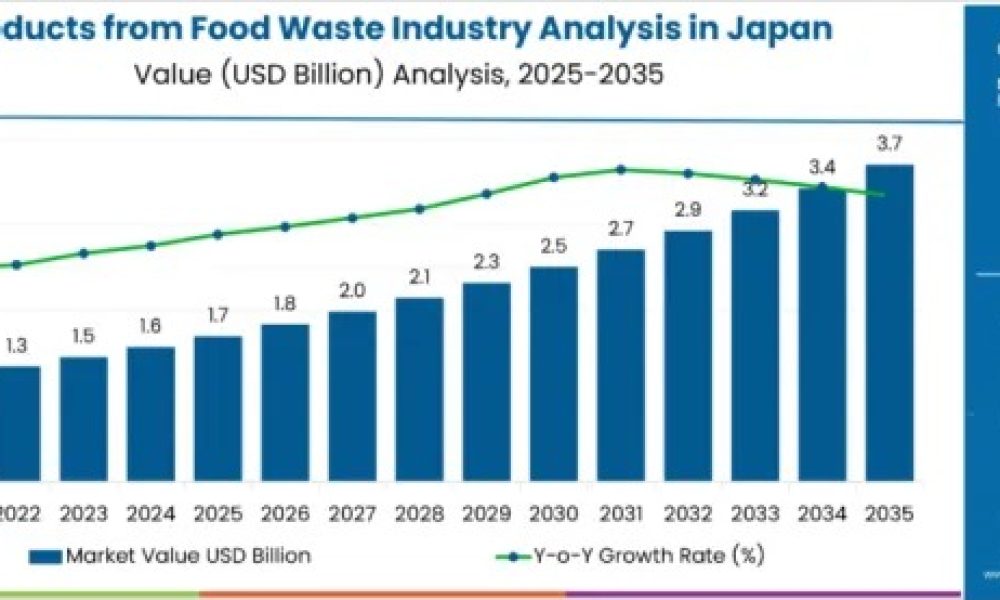
Sales of products derived from food waste in Japan are estimated at USD 1.7 billion in 2025 and are projected to reach USD 3.7 billion by 2035, expanding at a robust CAGR of 8.1% over the forecast period. This growth reflects a structural shift in Japan’s food and waste management ecosystem, driven by rising sustainability awareness, supportive government policies, and rapid technological progress in waste valorization.
Japan’s transition toward a circular economy is reshaping how food byproducts are perceived—from disposal challenges to valuable raw materials. Increasing pressure to reduce landfill volumes, coupled with national food loss reduction targets, is accelerating investments across food processing, energy recovery, agriculture, and bio-based materials. Businesses are responding by integrating waste-to-value models that deliver both environmental and economic returns.
Explore trends before investing – request a sample report today!
Quick Market Snapshot (Japan)
- Market size (2025): USD 1.7 billion
- Forecast value (2035): USD 3.7 billion
- CAGR (2025–2035): 8.1%
- Leading source (2025): Citrus fruits (48% share)
- Leading application (2025): Food processing (25% share)
- Fastest-growing regions: Tohoku and Kanto
Policy Support and Technology Drive Momentum
Demand growth is strongly linked to Japan’s waste reduction regulations, subsidies for recycling infrastructure, and municipal-level circular economy programs. Technological advancements—ranging from improved extraction efficiency to biochemical processing—are lowering operational costs and expanding commercial viability. While processing economics remain a consideration, innovation is steadily improving margins and scalability.
Regional specialization is emerging as a defining trend. Kanto leads in energy recovery, textile fibers, and large-scale recycling, supported by dense urban waste streams. Tohoku focuses on eco-friendly fertilizers, biogas, and biodegradable packaging, leveraging its agricultural base. Chubu is developing advanced food rescue programs and biochemical extraction, while Kinki emphasizes premium, small-batch applications aligned with its culinary heritage.
Citrus Fruits Dominate by Source
By source, citrus fruits account for 48% of market value in 2025, making them the backbone of Japan’s food waste valorization industry. High volumes of peels and pulp from juice processing, combined with mature extraction technologies, support strong output of pectin, essential oils, and natural additives.
Other sources are steadily gaining traction. Mango waste is being explored for fiber and antioxidant extraction, apple pomace supports animal feed and pectin demand, and vegetable waste such as carrot and beetroot residues is increasingly used for organic fertilizers and natural pigments. Together, these streams diversify supply and reduce dependency on single waste sources.
Food Processing Leads Applications
Food processing remains the largest application, accounting for 25% of total demand in 2025. Established infrastructure, stringent food safety regulations, and rising use of natural and functional ingredients are sustaining this dominance. Companies are incorporating waste-derived additives to meet clean-label and sustainability goals.
Animal feed is expanding as a cost-effective and environmentally responsible protein and fiber source. Beverage processing is gaining momentum through natural flavor extraction and fermentation-based innovations, while cosmetics and personal care brands are increasingly sourcing bioactive compounds from food waste to meet consumer demand for sustainable beauty. Nutraceuticals and dietary supplements remain niche but high-value segments.
Regional Growth Patterns Highlight Opportunity
From 2025 to 2035, Tohoku is forecast to lead with a 9.0% CAGR, supported by strong farm–processor linkages and government-backed waste-to-energy initiatives. Kanto follows at 8.5%, driven by urban consumption and advanced logistics. Chubu grows at 8.3%, leveraging manufacturing expertise and bioenergy projects. Kyushu & Okinawa post 8.0%, benefiting from tourism-linked applications, while Kinki grows at 7.5%, focused on premium and artisanal outputs.
Subscribe for Year-Round Insights → Stay ahead with quarterly and annual data updates
Competitive Landscape and Strategic Focus
Japan’s products from food waste market features a mix of environmental organizations, technology-focused processors, and financial enablers. Competitive advantage is increasingly defined by processing capacity, technology integration, and distribution reach rather than sheer product variety.
Key participants such as Biodiversity International Japan, Japan Food Ecology Center, and Mitsubishi UFJ Lease & Finance Group play complementary roles across sustainability programs, advanced processing, and financial infrastructure. Additional contributors—including TOYOKOH Inc., Tokyo Eco Recycle Co. Ltd., and Onkyo Ecosystems Co. Ltd.—strengthen equipment supply, recycling services, and ecosystem development. Collaboration with municipalities, retailers, and academic institutions continues to expand capacity and innovation.
As Japan deepens its commitment to circular economy principles, products derived from food waste are moving from experimental initiatives to mainstream industrial inputs. With strong policy backing, regional specialization, and growing corporate adoption, the sector is positioned to play a critical role in Japan’s sustainable growth strategy through 2035.
About Future Market Insights (FMI)
Future Market Insights, Inc. (FMI) is an ESOMAR-certified, ISO 9001:2015 market research and consulting organization, trusted by Fortune 500 clients and global enterprises. With operations in the U.S., UK, India, and Dubai, FMI provides data-backed insights and strategic intelligence across 30+ industries and 1,200 markets worldwide.



