
The global thermoformed containers market is entering a decade of stable and dependable growth as industries increasingly prioritize packaging solutions that balance functionality, cost efficiency, and visual appeal. Used extensively across food, beverage, healthcare, and consumer goods sectors, thermoformed containers have become a core element of modern packaging infrastructure.
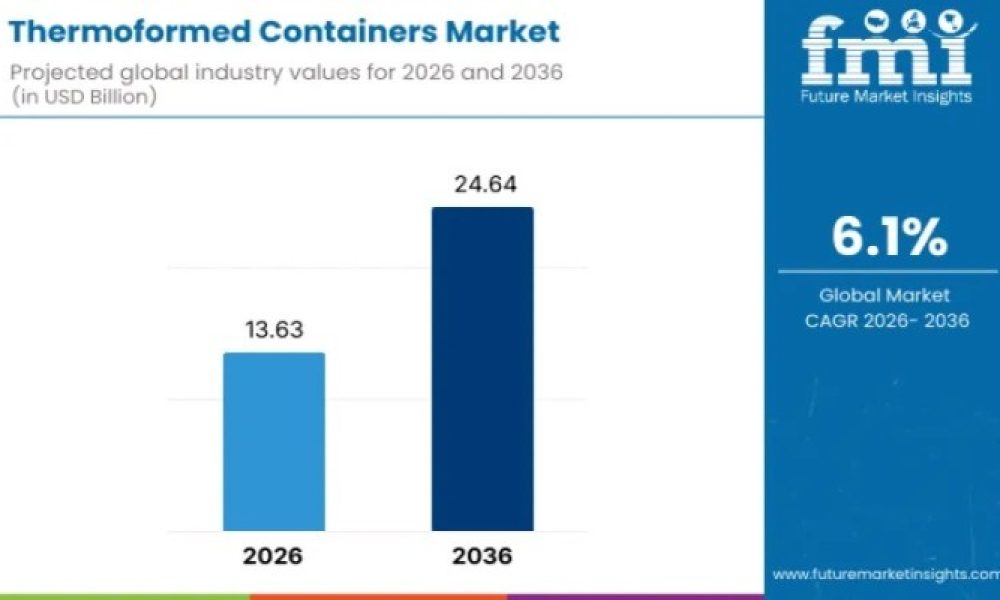
In 2026, the market is valued at USD 13.63 billion, supported by rising packaged food consumption, expanding foodservice networks, and the need for lightweight, durable packaging formats. As lifestyles continue to shift toward convenience and ready-to-consume products, thermoformed containers are expected to remain a preferred choice across global markets.
Request Your Sample Now – Unlock Growth Potential and Discover Key Market Opportunities!
Meaning and Industry Context
Thermoformed containers are rigid packaging products manufactured by heating plastic sheets and molding them into specific shapes using pressure or vacuum. These containers offer clarity, structural integrity, and design flexibility, making them suitable for high-volume applications that require both protection and presentation.
Key characteristics driving adoption include:
- Lightweight construction with strength and rigidity
- High transparency for product visibility
- Cost-effective mass production
- Compatibility with automated filling and sealing lines
Their versatility allows use across food trays, clamshells, blister packs, medical trays, and consumer product packaging.
Market Overview
Food packaging remains the backbone of thermoformed container demand, accounting for approximately 51% of total market usage in 2026. The surge in ready meals, fresh produce packaging, bakery products, and dairy items across urban households and organized retail channels underpins this dominance. Beyond food, healthcare and pharmaceutical packaging adds a stable demand layer through blister packs, diagnostic trays, and protective enclosures.
Market Snapshot:
- Market Value (2026): USD 13.63 billion
- Forecast Value (2036): USD 24.64 billion
- CAGR (2026–2036): 6.1%
- Leading Material: Polystyrene
- Key Regions: North America, Europe, Asia Pacific
Market Outlook (2026–2036)
By 2036, the thermoformed containers market is projected to reach USD 24.64 billion, reflecting consistent expansion rather than short-term spikes. Growth aligns closely with long-term shifts in consumption behavior, including demand for hygienic packaging, portion-controlled meals, and efficient food distribution systems. Expansion of modern retail, food delivery platforms, and institutional catering services continues to reinforce the role of thermoformed containers as a reliable, scalable packaging solution.
Growth Drivers
Market growth is driven by structural changes across foodservice and retail ecosystems rather than isolated trends.
Primary growth drivers include:
- Expansion of quick-service restaurants and takeaway food outlets
- Rising consumption of packaged and ready-to-eat meals
- Increased reliance on food delivery and cloud kitchens
- Strong demand for packaging that supports stacking, transport, and storage efficiency
Advances in thermoforming technology allow manufacturers to reduce material thickness without sacrificing performance, improving cost efficiency while maintaining container strength.
Demand Analysis
Demand for thermoformed containers continues to rise across both mature and emerging economies. In developed markets, growth is supported by replacement demand, operational optimization, and premium container designs. In emerging regions, expanding restaurant density, retail modernization, and urban population growth drive volume demand.
Regional demand highlights:
- Asia Pacific: Fastest-growing region led by China and India
- North America: Stable demand driven by foodservice and grocery delis
- Europe: Consistent adoption aligned with food safety and quality standards
Material and Application Trends
Why Polystyrene Leads by Material
Polystyrene accounts for nearly 46% of material demand in 2026, largely due to its deep integration into foodservice operations.
Key advantages include:
- Excellent heat retention and moisture resistance
- Lightweight yet rigid structure
- Fast forming cycles and production efficiency
- Predictable cost structure for high-volume usage
Despite growing interest in alternative materials, polystyrene continues to anchor large-scale food packaging applications where speed and reliability are critical.
Why Food Packaging Dominates Applications
Thermoformed containers play a central role in modern food consumption habits.
Food packaging advantages include:
- Support for freshness and portion control
- High clarity for shelf and display appeal
- Resistance to movement during delivery
- Compatibility with hot, cold, and ambient foods
Their dominance reflects the everyday reliance on rigid containers across quick-service meals, grocery prepared foods, and grab-and-go formats.
Regulatory and Operational Considerations
Regulatory pressure around food contact safety, recycling standards, and material compliance shapes market scalability. Manufacturers must invest in approved resins, testing systems, and certification processes. Capital investment requirements for thermoforming equipment, tooling, and automation further influence capacity expansion. Resin price volatility and logistics efficiency also play a role in shaping long-term production strategies.
Country-Level Demand Outlook
Growth varies by country based on foodservice density, retail maturity, and regulatory enforcement.
Country CAGR (2026–2036):
- China: 7.2%
- India: 6.9%
- United States: 6.5%
- Germany: 5.8%
- Japan: 5.5%
China and India lead volume expansion through rapid restaurant scaling and delivery-driven consumption, while the U.S., Germany, and Japan sustain growth through quality-focused and performance-driven packaging adoption.
Competitive Landscape
Competition in the thermoformed containers market remains robust, with global leaders leveraging scale, supply chain strength, and broad product portfolios. Major players dominate high-volume foodservice and retail packaging, while regional specialists compete through customization and application-specific solutions.
Key competitive factors include:
- Design adaptability and tooling speed
- Consistent quality and supply reliability
- Compliance with food safety and material standards
- Compatibility with automated food processing lines
Leading Market Players:
- Pactiv LLC
- Dart Container Corporation
- Amcor plc
- Berry Global Inc.
- Anchor Packaging LLC
- Genpak LLC
- Sonoco Products Company
- D&W Fine Pack LLC
- Placon Corporation
- Huhtamaki Group
Why FMI: https://www.futuremarketinsights.com/why-fmi
About Future Market Insights (FMI)
Future Market Insights, Inc. (FMI) is an ESOMAR-certified, ISO 9001:2015 market research and consulting organization, trusted by Fortune 500 clients and global enterprises. With operations in the U.S., UK, India, and Dubai, FMI provides data-backed insights and strategic intelligence across 30+ industries and 1200 markets worldwide.



