
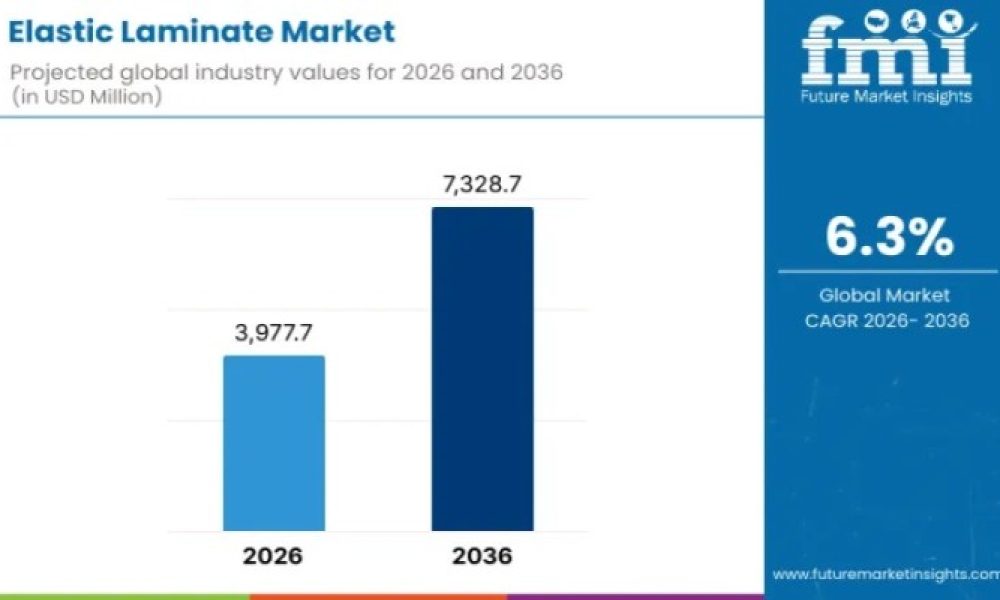
The global elastic laminate market is entering a decade of steady and resilient growth, underpinned by rising hygiene awareness, expanding medical applications, and continuous innovation in stretchable materials. Valued at USD 3,977.7 million in 2026, the market is projected to nearly double to USD 7,328.7 million by 2036, advancing at a compound annual growth rate (CAGR) of 6.3%.
This growth trajectory reflects how elastic laminates have become indispensable components in disposable hygiene, medical protective wear, and select apparel applications where comfort, fit, and flexibility are non-negotiable performance requirements.
Explore Opportunities – Get Your Sample of Our Industry Overview Now!
Hygiene and Healthcare Remain the Core Growth Engines
Elastic laminates are most widely used in baby diapers, adult incontinence products, and feminine hygiene items, which together account for approximately 67% of total global consumption. These products rely on elastic laminates to deliver snug fit, leakage protection, and long-wear comfort without adding bulk or compromising breathability. Demographic shifts including rising birth rates in developing regions and aging populations in developed economies continue to reinforce demand across infant and adult care categories.
Healthcare applications represent another important growth pillar. Elastic laminates are increasingly incorporated into surgical gowns, face masks, and protective medical apparel, where stretchability improves wearer mobility while maintaining barrier performance. The post-pandemic emphasis on infection control and disposable medical supplies has strengthened long-term demand for reliable elastic materials in healthcare settings.
Material Leadership Anchored by Polyethylene-Based Laminates
By material type, polyethylene-based elastic laminates dominate global demand with roughly 52% market share. Their leadership is driven by a combination of cost efficiency, reliable elastic recovery, and compatibility with high-speed hygiene manufacturing lines. Polyethylene laminates offer consistent bonding behavior and scalable performance, making them the preferred choice for mass-produced disposable products.
Key material insights include:
- Polyethylene leads due to widespread hygiene product usage
- Strong balance between elasticity and cost efficiency
- Seamless integration with high-speed converting equipment
- Limited substitutes offering similar scale and affordability
Other materials such as polypropylene, polyurethane, and polyester serve niche or premium applications where enhanced strength, softness, or specialized performance is required.
Asia Pacific Emerges as the Fastest-Growing Region
From a regional perspective, Asia Pacific stands out as the fastest-growing elastic laminate market, driven by population growth, urbanization, and rapid expansion of hygiene product penetration. China and India, in particular, are investing heavily in large-scale diaper and personal care manufacturing, supported by rising disposable incomes and government-backed sanitation and healthcare initiatives.
- China leads global growth with a CAGR of 7.2%, supported by advanced manufacturing hubs and increasing demand for premium hygiene products.
- India follows closely at 7.0% CAGR, where affordability-focused elastic laminates are enabling broader adoption across income groups.
Meanwhile, North America and Europe maintain steady growth supported by mature hygiene markets, premium product innovation, and strong demand for adult incontinence and medical disposables. The United States grows at 6.8% CAGR, while Germany (6.1%) and Japan (5.7%) emphasize engineering quality, material consistency, and skin-friendly performance.
Cost Pressures and Innovation Shape Market Dynamics
Despite positive demand fundamentals, the elastic laminate industry faces ongoing challenges related to raw material price volatility, particularly for polyethylene and specialty polymers. Margin pressure from cost-sensitive hygiene segments has pushed manufacturers to prioritize lightweight designs, material efficiency, and process optimization.
Innovation remains focused on:
- Improved breathability and softness
- Enhanced elastic recovery with reduced material use
- Compatibility with existing high-speed production lines
- Skin safety and comfort for extended wear applications
Long-term scalability will depend on manufacturers’ ability to balance performance improvements with cost control while maintaining consistent quality at large production volumes.
Competitive Landscape: Performance and Partnerships Matter
The competitive landscape is moderately consolidated, with 10–15 global and regional suppliers operating at scale. Leading players benefit from strong technical expertise and long-standing relationships with major hygiene and medical product manufacturers.
Key players shaping the market include:
- Tredegar Corporation, the market leader known for consistent elastic performance across hygiene and medical applications
- Schweitzer-Mauduit International and Berry Global Inc., offering broad product portfolios optimized for high-speed manufacturing
- Mitsui Chemicals Inc., Nitto Denko Corporation, and Mondi Group, competing through premium, breathable laminate solutions
- RKW Group, Covestro AG, Kraton Corporation, and Aplix SA, contributing polymer innovation and custom laminate development
Competition increasingly centers on material performance, design flexibility, and technical collaboration, rather than price alone.
Why FMI: https://www.futuremarketinsights.com/why-fmi
About Future Market Insights (FMI)
Future Market Insights, Inc. (FMI) is an ESOMAR-certified, ISO 9001:2015 market research and consulting organization, trusted by Fortune 500 clients and global enterprises. With operations in the U.S., UK, India, and Dubai, FMI provides data-backed insights and strategic intelligence across 30+ industries and 1200 markets worldwide.



