
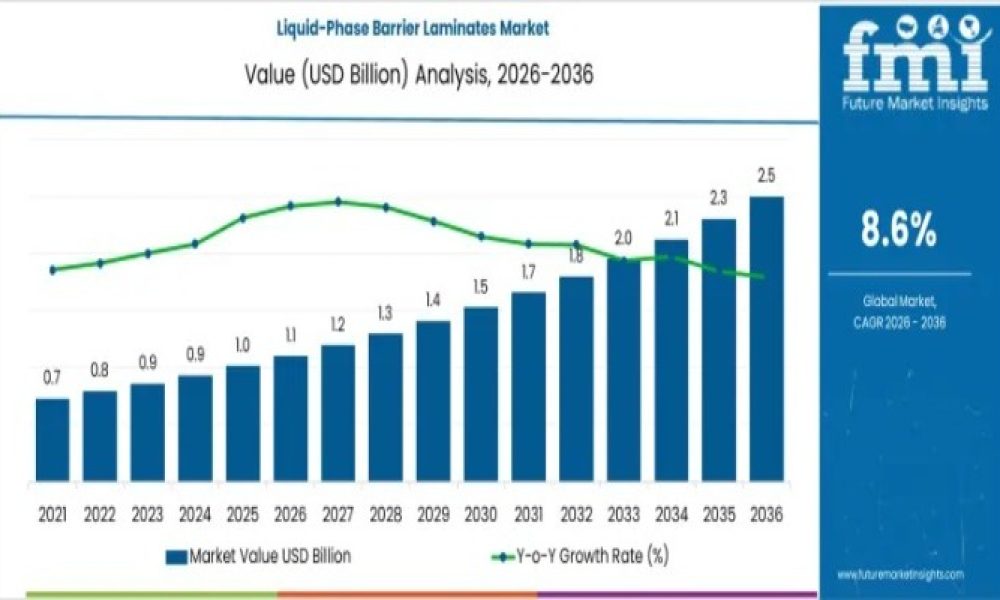
The global Liquid-Phase Barrier Laminates Market is entering a decade of accelerated expansion as packaging producers respond to rising demand for safer, longer-lasting, and contamination-resistant liquid packaging. Valued at USD 1.1 billion in 2026, the market is projected to reach USD 2.5 billion by 2036, advancing at a robust CAGR of 8.6%. This growth reflects the essential role that advanced barrier laminates now play across beverages, dairy, ready-to-drink (RTD) products, and premium liquid applications worldwide.
Once viewed primarily as a technical solution to leakage and seepage, liquid-phase barrier laminates have evolved into a strategic packaging material. Today, they sit at the intersection of food safety, shelf-life extension, high-speed filling compatibility, and emerging sustainability expectations. Established global manufacturers and ambitious new entrants alike are investing in material science, extrusion, and coating innovations to expand capacity and differentiate their offerings.
Unlock Growth Potential and Explore Market Opportunities With Our Comprehensive Industry Overview. Request Your Sample Now
Quick Stats: Liquid-Phase Barrier Laminates Market
- Market Value (2026): USD 1.1 billion
- Forecast Value (2036): USD 2.5 billion
- Forecast CAGR (2026–2036): 8.6%
- Leading Packaging Format: Carton & pouch laminates (45%)
- Key Growth Regions: India, China, USA, Brazil, Germany
- Major Players: Tetra Pak, Mondi, Greatview, UFlex, Klabin, Toyo Seikan, SIG, Amcor, Elopak, Xinjufeng
Market Growth Outlook Through 2036
From 2026 to 2031, the market expands from USD 1.1 billion to nearly USD 1.6 billion, marking an early adoption phase. Growth during this period is driven by pilot programs and selective adoption in food, beverage, pharmaceutical, and personal care packaging, where resistance to moisture, oxygen, and aroma migration is critical. North America and Europe account for nearly 60% of market value, as converters and brand owners validate laminate adhesion, seal integrity, and performance on high-speed filling lines.
Between 2031 and 2036, the market enters a late adoption phase, scaling from USD 1.6 billion to USD 2.5 billion. This stage is defined by broader commercialization, multi-region rollouts, and repeat procurement across full product portfolios. Regulatory mandates around food safety, hygiene, and shelf stability, combined with the integration of laminates into automated packaging systems, reinforce consistent demand. What begins as selective adoption matures into standardized use across global packaging operations.
What Is Shaping Demand for Liquid-Phase Barrier Laminates?
Initial demand for liquid-phase barrier laminates emerged from practical failures in early flexible packaging formats. Conventional films often allowed seepage, swelling, or oxygen ingress during transportation and storage, leading to spoilage, leakage claims, and brand risk. Multilayer laminates combining polymers, paper, and high-barrier layers were adopted to protect product integrity and maintain flavor and aroma profiles.
Looking ahead, demand is being reshaped by regulatory expectations and lifecycle performance requirements. As recyclability and circularity become procurement criteria, manufacturers are re-engineering barrier structures to deliver liquid hold-out while improving compatibility with recycling systems. Liquid-phase barrier laminates are no longer niche containment materials; they are becoming defined components of compliant, future-ready packaging portfolios.
Demand by End Use and Packaging Format
Key End Use Applications
- Beverages & liquid foods (40%) – requiring protection against oxygen and moisture
- Dairy and juice – managing spoilage risk and flavor preservation
- RTD beverages – maintaining aroma, carbonation, and shelf stability
- Premium liquids – demanding higher barrier consistency and quality assurance
Demand remains stable because barrier requirements are embedded into formulation, filling, and shelf-life validation processes. Once approved, laminate structures are rarely changed, limiting short-term volatility.
Packaging Formats Driving Adoption
- Carton & pouch laminates (45%) – compatible with high-speed filling lines
- Aseptic carton laminates – supporting long shelf life without refrigeration
- Pouches, sachets, and hybrid formats – addressing flexibility and portion control
Carton-based laminates dominate due to established infrastructure and scalability, while pouch formats grow where weight reduction and material efficiency are prioritized.
Regional Demand Highlights
- India (CAGR 11.8%) – Rapid growth driven by expanding packaged food and beverage sectors and modern packaging infrastructure
- China (10.8%) – Large-scale packaging operations and strong demand for extended shelf-life solutions
- USA (7.8%) – Stable adoption across beverages, dairy, pharmaceuticals, and industrial packaging
- Brazil (7.8%) – Growth supported by organized distribution and quality-focused packaging
- Germany (6.9%) – Mature market with strict food safety and hygiene standards
Competitive Landscape: Established Leaders and Emerging Innovators
Competition in the liquid-phase barrier laminates market is shaped less by raw material choice and more by compatibility with filling, sealing, and sterilization systems. Global leaders such as Tetra Pak, SIG, Elopak, and Greatview dominate due to laminate designs engineered specifically for proprietary or semi-proprietary filling platforms.
At the same time, companies like Mondi and Amcor expand flexible and carton-based laminate solutions for non-aseptic and alternative systems. UFlex and Xinjufeng play a critical role in cost-sensitive and export-oriented markets, supporting regional converters with scalable, process-compatible laminates. Toyo Seikan and Klabin contribute through container engineering and fiber-based components integrated into liquid packaging structures.
For both established players and new manufacturers, success depends on:
- Qualification within filling ecosystems
- Consistency across large production volumes
- Ability to support long approval and validation cycles
- Alignment with evolving sustainability and recyclability standards
Why FMI: https://www.futuremarketinsights.com/why-fmi
About Future Market Insights (FMI)
Future Market Insights, Inc. (FMI) is an ESOMAR-certified, ISO 9001:2015 market research and consulting organization, trusted by Fortune 500 clients and global enterprises. With operations in the U.S., UK, India, and Dubai, FMI provides data-backed insights and strategic intelligence across 30+ industries and 1200 markets worldwide.



