
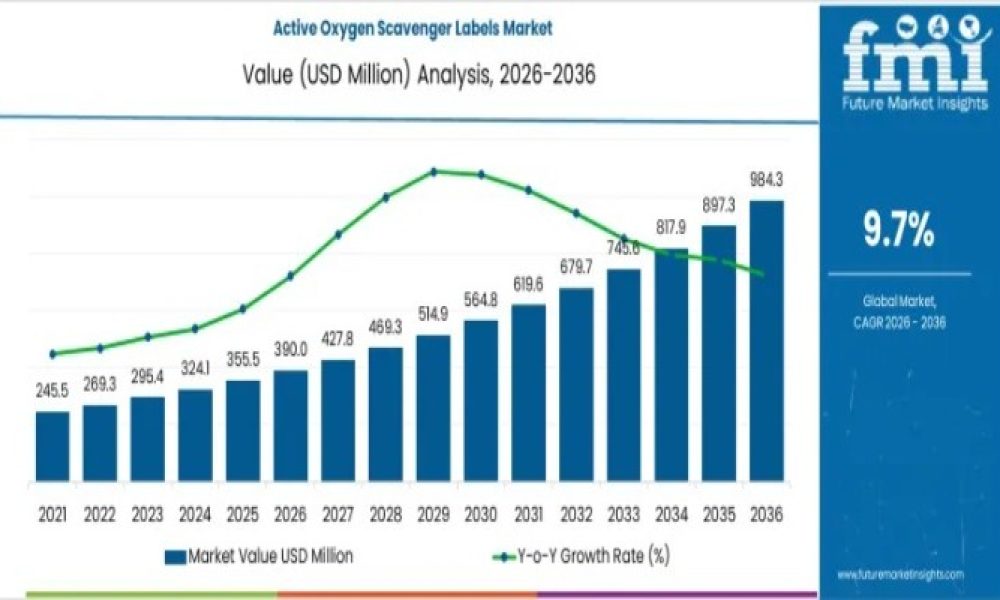
The global active oxygen scavenger labels market is entering a decade of accelerated expansion as packaging priorities shift from passive protection to active preservation. Valued at USD 390 million in 2026, the market is forecast to reach USD 984.3 million by 2036, growing at a strong compound annual growth rate (CAGR) of 9.7%. This growth reflects the rising need to extend shelf life, reduce spoilage, and maintain product integrity across oxygen-sensitive categories such as fresh food, meat, pharmaceuticals, and high-value consumer goods.
Active oxygen scavenger labels are increasingly recognized as a critical packaging innovation. Unlike traditional barrier materials that only limit oxygen ingress, these labels actively absorb residual oxygen inside sealed packages. This functionality significantly slows oxidation, microbial growth, and quality degradation—helping brands deliver fresher products while reducing waste across global supply chains.
Unlock Growth Potential and Explore Market Opportunities With Our Comprehensive Industry Overview. Request Your Sample Now
Quick Market Snapshot
- Market Value (2026): USD 390 million
- Forecast Value (2036): USD 984.3 million
- Forecast CAGR (2026–2036): 9.7%
- Top Label Type: Self-adhesive scavenger labels (45% share)
- Leading End-Use Segment: Fresh food & meat packaging (42% share)
- Key Growth Regions: Asia Pacific, North America, Europe, Latin America
Market Momentum Driven by Shelf-Life Extension Needs
The market’s upward trajectory is closely tied to changing consumer expectations and tightening regulatory standards. Shoppers increasingly demand fresher food with fewer preservatives, while regulators enforce stricter food safety and pharmaceutical stability requirements. Active oxygen scavenger labels meet both needs by preserving freshness without direct contact with the product or changes to packaging appearance.
Additionally, the expansion of global cold-chain logistics, cross-border food trade, and e-commerce delivery has intensified the need for packaging solutions that perform reliably over longer transit times and fluctuating temperature conditions. As a result, brand owners and converters are adopting oxygen scavenger labels to protect product quality from factory to final consumer.
Segment-Wise Market Performance
Fresh Food & Meat Packaging Leads Demand
Fresh food and meat packaging dominates the global market with a 42% share, reflecting the segment’s high sensitivity to oxygen exposure.
Key drivers include:
- Rising consumption of packaged fresh and processed meat
- Demand for longer shelf life without chemical preservatives
- Reduced spoilage and food waste across retail and export supply chains
- Growing emphasis on sustainability and freshness guarantees
Oxygen scavenger labels help maintain color, texture, flavor, and nutritional value—making them indispensable in meat, poultry, and fresh produce packaging.
Self-Adhesive Scavenger Labels Dominate by Type
Self-adhesive scavenger labels account for 45% of global demand, outperforming other formats due to their ease of use and adaptability.
Their dominance is supported by:
- Compatibility with plastic, glass, and metal packaging
- Simple integration into existing labeling processes
- Secure adhesion and consistent oxygen absorption
- Broad use across food, FMCG, and pharmaceutical packaging
Other formats such as sachet-integrated labels, label & patch inserts, and small oxygen absorber labels continue to expand the market’s product diversity, serving specialized packaging needs.
What Is Driving Demand Across Industries?
Key demand drivers shaping the market include:
- Rising demand for fresher, longer-lasting food products
- Growth in pharmaceutical and biologics packaging, where oxygen control ensures drug stability
- Expansion of global logistics and export-oriented food trade
- Shift toward active and smart packaging technologies
- Need to reduce spoilage-related losses and improve sustainability metrics
By actively removing residual oxygen, these labels help manufacturers balance performance, safety, and environmental responsibility.
Key Restraints Impacting Adoption
Despite strong growth, certain challenges remain:
- Higher costs compared to passive barrier films
- Integration complexities with existing packaging formats
- Regulatory approval variations across regions
- Need for clear ROI data for cost-sensitive product categories
However, continuous innovation in label chemistry and manufacturing efficiency is gradually reducing these barriers.
Trends Shaping the Future of the Market
Several trends are redefining the competitive landscape:
- Integration of oxygen scavenger labels with smart packaging features such as time-temperature indicators and RFID
- Development of metal-free, food-safe, and bio-based scavenger chemistries
- Improved performance at low residual oxygen levels
- Growing compatibility with recyclable and flexible packaging
- Increased adoption in e-commerce and direct-to-consumer cold-chain delivery
These advancements are aligning active packaging solutions with sustainability and circular economy goals.
Country-Wise Growth Outlook
- India: 12.4% CAGR, driven by expanding food, pharmaceutical, and consumer goods packaging
- China: 11.2% CAGR, supported by industrial growth and packaged goods demand
- USA: 8.4% CAGR, fueled by food safety regulations and sustainability initiatives
- Germany: 7.6% CAGR, driven by strict regulatory compliance and waste reduction goals
- Brazil: 8% CAGR, supported by food exports and rising consumer quality expectations
India leads global growth due to rapid packaging innovation, population growth, and alignment with international safety standards.
Competitive Landscape and Market Players
The market features a mix of global leaders and regional converters offering specialized solutions.
Key players include:
- Multisorb
- Avery Dennison
- BASF
- Mitsubishi Gas Chemical
- Yantai Jereh
- Flexituff
- Local and regional converters
Leading companies emphasize performance transparency through data-driven brochures, showcasing oxygen uptake rates, material compatibility, and application guidance. Regional converters play a vital role by offering customized solutions tailored to local regulatory and market needs.
Why FMI: https://www.futuremarketinsights.com/why-fmi
About Future Market Insights (FMI)
Future Market Insights, Inc. (FMI) is an ESOMAR-certified, ISO 9001:2015 market research and consulting organization, trusted by Fortune 500 clients and global enterprises. With operations in the U.S., UK, India, and Dubai, FMI provides data-backed insights and strategic intelligence across 30+ industries and 1200 markets worldwide.



