
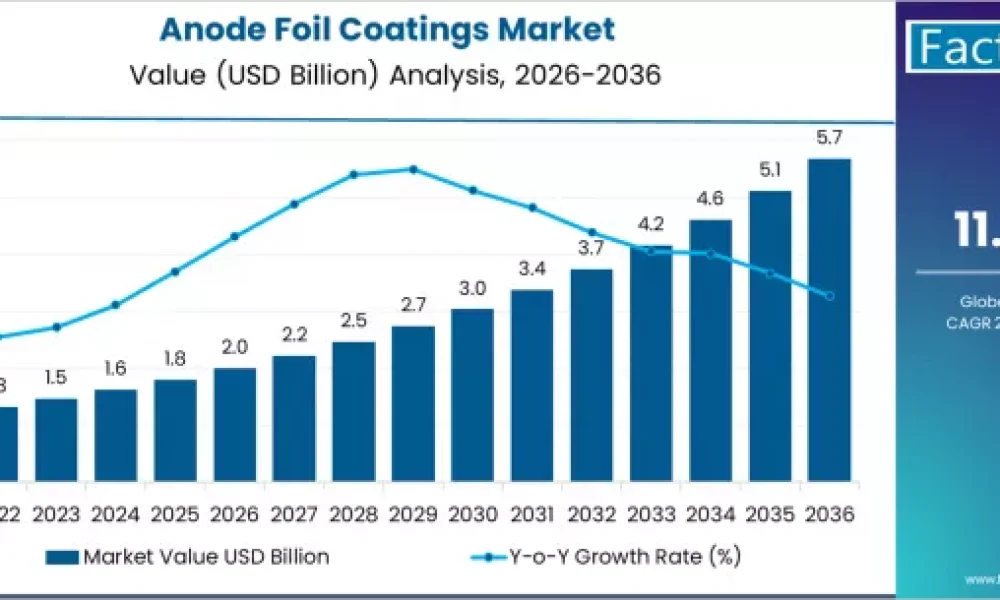
The global anode foil coatings market is expected to witness strong growth over the next decade, driven by accelerating demand for advanced battery technologies across electric vehicles, energy storage systems, and consumer electronics. In 2026, the market is valued at USD 2.0 billion and is projected to reach USD 5.7 billion by 2036, reflecting an absolute increase of USD 3.7 billion during the forecast period. This expansion represents a compound annual growth rate (CAGR) of approximately 11.0% between 2026 and 2036.
Anode foil coatings play a critical role in improving battery performance by enhancing electrical conductivity, adhesion between active materials and current collectors, corrosion resistance, and overall durability. As battery manufacturers push for higher energy density, longer cycle life, and improved safety, the adoption of advanced coating technologies for anode foils continues to rise.
Quick Market Snapshot (2026–2036)
Market Value (2026): USD 2.0 billion
Market Forecast Value (2036): USD 5.7 billion
Market Forecast CAGR: 11.0%
Leading Foil Type: Copper Foil
Primary End Use: Electric Vehicle Batteries
Key Growth Regions: Asia Pacific, Europe, North America
Key Demand Drivers: EV adoption, energy storage expansion, battery performance optimization
To Access the Complete Data Tables & in-depth Insights, Request a Discount on this report: https://www.factmr.com/connectus/sample?flag=S&rep_id=12914
Market Overview
Anode foil coatings are specialized surface treatments applied primarily to copper and aluminum foils used as current collectors in lithium-ion and other rechargeable batteries. These coatings improve interfacial stability between the foil and anode active materials, reduce internal resistance, and enhance overall battery efficiency. As battery architectures become more complex and performance requirements tighten, foil coating technologies have become a crucial component of next-generation battery design.
Copper foil dominates the anode foil coatings market due to its superior electrical conductivity and widespread use in lithium-ion batteries. Advanced coatings applied to copper foils help mitigate issues such as delamination, corrosion, and uneven current distribution, which are critical concerns in high-capacity battery applications.
Key Market Drivers
Rapid Growth of Electric Vehicles
The global transition toward electric mobility is one of the strongest drivers of the anode foil coatings market. Electric vehicles require high-performance batteries capable of delivering longer driving ranges, faster charging, and extended lifespans. Anode foil coatings contribute directly to these performance enhancements, making them essential for modern EV battery manufacturing.
Expansion of Energy Storage Systems
The increasing integration of renewable energy sources such as solar and wind has led to growing demand for grid-scale energy storage solutions. These systems rely on large battery installations that must maintain stable performance over long operational lifetimes. High-quality anode foil coatings enhance durability and reliability, supporting the expanding energy storage market.
Demand from Consumer Electronics
Portable electronics such as smartphones, laptops, and wearable devices continue to evolve toward thinner designs, higher energy densities, and faster charging capabilities. Anode foil coatings help meet these requirements by improving battery efficiency while maintaining compact form factors.
Technological Advancements in Battery Manufacturing
Ongoing innovations in battery chemistry and cell design are driving the need for advanced material solutions. Coating technologies that offer improved adhesion, conductivity, and compatibility with next-generation anode materials are gaining traction across battery manufacturing facilities.
Market Segmentation Analysis
By Foil Type
Copper Foil: Accounts for the largest market share due to excellent conductivity and compatibility with lithium-ion batteries.
Aluminum Foil: Used in specific battery configurations and emerging technologies.
Other Foil Materials: Includes specialty substrates designed for niche applications.
By Coating Function
Conductive Coatings: Enhance electron transport and reduce resistance.
Adhesion-Enhancing Coatings: Improve bonding between foil and active material layers.
Corrosion-Resistant Coatings: Protect foils from electrochemical degradation.
Multi-Functional Coatings: Combine multiple performance benefits in a single layer.
By End Use
Electric Vehicle Batteries: Largest and fastest-growing segment.
Energy Storage Systems: Includes grid-scale and industrial storage applications.
Consumer Electronics: Smartphones, laptops, and portable devices.
Industrial Batteries: Backup power and specialized applications.
Regional Demand Dynamics
Asia Pacific
Asia Pacific leads the global anode foil coatings market, supported by extensive battery manufacturing capacity, rapid EV adoption, and strong investments in energy storage technologies. Countries with established battery supply chains continue to drive regional dominance.
Europe
Europe is experiencing steady growth due to stringent emission regulations, aggressive electrification targets, and expanding EV production. Investments in sustainable energy storage infrastructure further support demand for advanced battery materials.
North America
North America is witnessing increasing adoption of electric vehicles and large-scale energy storage projects. Strong research and development activity in battery technology contributes to rising demand for high-performance anode foil coatings.
Competitive Landscape
The anode foil coatings market is moderately competitive, with participants focusing on material innovation, process optimization, and strategic collaborations with battery manufacturers. Companies are investing in research and development to create coatings that deliver higher efficiency, improved durability, and compatibility with evolving battery chemistries.
Manufacturers are also emphasizing scalable production techniques and cost-effective solutions to support mass adoption across automotive, energy, and electronics sectors.
Future Outlook
The anode foil coatings market is expected to maintain strong momentum through 2036 as global electrification efforts accelerate and battery technologies continue to advance. Innovations in multifunctional coatings, nanostructured materials, and interface engineering will play a pivotal role in shaping future market growth.
As electric vehicles, renewable energy storage, and high-performance electronics become increasingly integral to modern infrastructure, demand for advanced anode foil coatings will remain robust. Companies that prioritize performance optimization, manufacturing scalability, and alignment with next-generation battery requirements will be well positioned to capitalize on long-term opportunities in this evolving market.
Have specific requirements or need assistance on report pricing or have a limited budget? Please contact [email protected]
About Fact.MR:
Fact.MR is a global market research and consulting firm, trusted by Fortune 500 companies and emerging businesses for reliable insights and strategic intelligence. With a presence across the U.S., UK, India, and Dubai, we deliver data-driven research and tailored consulting solutions across 30+ industries and 1,000+ markets. Backed by deep expertise and advanced analytics, Fact.MR helps organizations uncover opportunities, reduce risks, and make informed decisions for sustainable growth



