
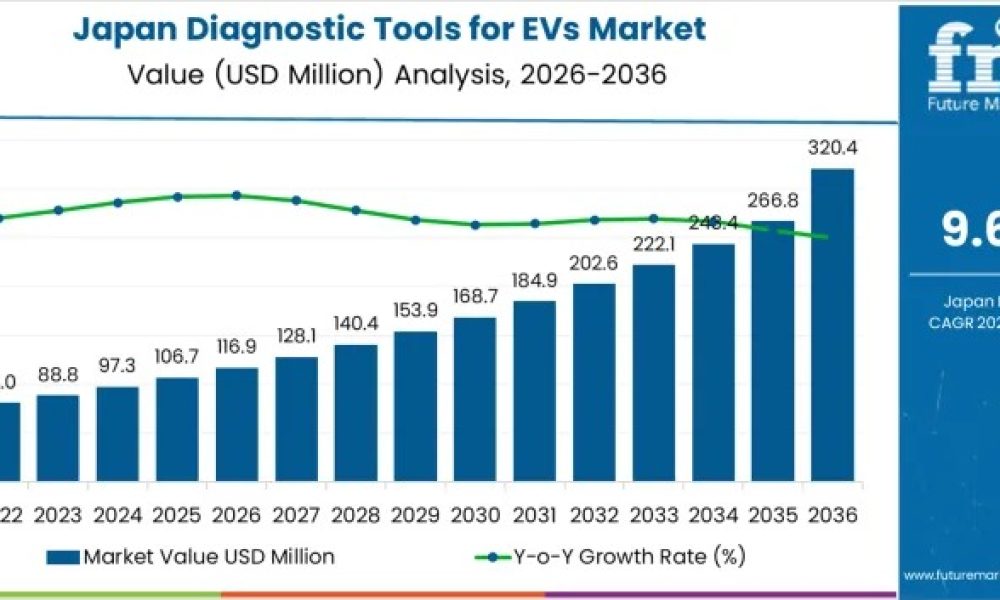
The demand for diagnostic tools for electric vehicles (EVs) in Japan is entering a phase of sustained acceleration, reflecting the country’s rapid transition toward software-defined, electrified mobility. The market is valued at USD 116.9 million in 2026 and is forecast to reach USD 320.4 million by 2036, expanding at a compound annual growth rate (CAGR) of 9.6% over the ten-year period.
This expansion underscores a structural shift within Japan’s automotive service ecosystem. As battery electric vehicles (BEVs) and electrified powertrains proliferate, traditional internal combustion engine (ICE) diagnostic systems are proving inadequate. EVs introduce high-voltage architectures, battery management systems, power electronics, and complex software layers—each requiring specialized diagnostic capabilities to ensure safety, performance, and regulatory compliance.
EV adoption transforms diagnostic requirements
Japan’s EV fleet growth is reshaping how vehicles are maintained, monitored, and repaired. Diagnostic tools are no longer limited to fault code reading; they now play a critical role in assessing battery degradation, inverter efficiency, thermal performance, and software integrity. Government incentives promoting EV adoption, combined with stringent environmental policies, continue to accelerate this transition.
Advanced diagnostic solutions enable workshops and service centers to deliver faster, more accurate fault detection while supporting predictive maintenance models. The growing reliance on over-the-air (OTA) updates, remote diagnostics, and cloud-connected vehicle platforms further elevates the importance of next-generation EV diagnostic tools across Japan’s automotive aftermarket.
Get access to comprehensive data tables and detailed market insights — request your sample report today!
Diagnostic hardware anchors market demand
By offering type, diagnostic hardware remains the leading segment, reflecting continued investment in physical diagnostic devices capable of handling high-voltage systems and real-time vehicle data acquisition. These tools are essential for interfacing directly with EV batteries, motors, and power control units, particularly in professional service environments.
Hardware demand is reinforced by the need for safety-certified equipment that can operate reliably within EV architectures. As EV designs diversify across manufacturers, compatibility and multi-platform functionality are becoming critical purchase criteria for service providers.
Professional diagnostic tools dominate tool-type segmentation
By tool type, professional diagnostic tools account for 24% of total demand, positioning them as the most influential segment in Japan’s EV diagnostic tools market. These tools are widely deployed across authorized service centers, independent garages, and fleet maintenance operations.
Professional systems provide deep diagnostic access, enabling technicians to:
- Analyze battery health, voltage imbalance, and state-of-charge accuracy
- Diagnose motor, inverter, and regenerative braking systems
- Validate software integrity and system communication across ECUs
As EV penetration increases, the reliance on advanced professional diagnostics is expected to intensify, reinforcing their dominant role in the market.
Safety systems drive application-level growth
From an application standpoint, automatic crash notification systems represent 24% of demand, reflecting Japan’s strong emphasis on vehicle safety and emergency response infrastructure. These systems rely on accurate diagnostics to ensure that sensors, communication modules, and control units function reliably during critical events.
Beyond crash notification, diagnostic tools support:
- Vehicle health alerts and roadside assistance systems
- Predictive maintenance and fault prevention
- Software calibration and system validation
The integration of safety, connectivity, and diagnostics positions EV diagnostic tools as essential components within Japan’s intelligent mobility ecosystem.
Regional growth highlights uneven but accelerating adoption
Regionally, demand growth reflects variations in EV adoption, infrastructure maturity, and industrial concentration:
- Kyushu & Okinawa (12.0% CAGR)
- Strong EV adoption supported by regional incentives
- Expanding industrial and commercial EV usage
- Rising demand for specialized service and diagnostic infrastructure
- Kanto (11.0% CAGR)
- Japan’s largest EV concentration, led by Tokyo
- High density of service centers and research institutions
- Strong regulatory and sustainability focus
- Kansai (9.7% CAGR)
- Automotive industry transition toward electrification
- Growing demand from urban sustainability initiatives
Chubu, Tohoku, and the rest of Japan show steady growth as EV adoption expands beyond major metropolitan areas, driving broader demand for diagnostic tools across regional service networks.
Technology innovation accelerates market momentum
Technological advancements are redefining the capabilities of EV diagnostic platforms. Cloud-connected diagnostics, machine-learning-enabled analytics, and remote monitoring systems are transforming reactive repairs into predictive service models. Diagnostic tools increasingly support real-time battery health tracking, performance optimization, and OTA software validation.
These innovations not only reduce vehicle downtime but also enable service providers to scale operations efficiently as EV volumes rise. As software becomes central to vehicle performance, diagnostic tools that can interpret complex datasets gain strategic importance.
Competitive landscape shaped by precision and integration
The competitive environment features a mix of global technology leaders and domestic automotive specialists. Bosch Automotive Service Solutions maintains a strong market position through comprehensive EV diagnostic platforms designed for multi-brand compatibility and high-voltage safety.
Other key players include:
- Snap-on Incorporated – premium, technician-focused diagnostic systems
- Launch Tech Co., Ltd. – cost-effective, versatile diagnostic solutions
- Autel Intelligent Technology Corp. – advanced battery diagnostics and OTA-enabled platforms
- Denso Corporation – OE-grade diagnostic equipment aligned with Japanese automakers
Competition centers on diagnostic depth, software integration, update frequency, and service ecosystem compatibility.
Market outlook: diagnostics become foundational to EV servicing
As Japan advances toward a fully electrified mobility future, EV diagnostic tools are evolving from optional workshop equipment into foundational infrastructure for vehicle lifecycle management. The market’s strong growth outlook reflects not only rising EV volumes but also the increasing complexity of vehicle systems that demand precision diagnostics.
With diagnostic accuracy directly impacting safety, reliability, and customer satisfaction, investment in advanced EV diagnostic tools is expected to remain a strategic priority across Japan’s automotive service landscape through 2036.
About Future Market Insights (FMI)
Future Market Insights, Inc. (FMI) is an ESOMAR-certified, ISO 9001:2015 market research and consulting organization, trusted by Fortune 500 clients and global enterprises. With operations in the U.S., UK, India, and Dubai, FMI provides data-backed insights and strategic intelligence across 30+ industries and 1200 markets worldwide.



