
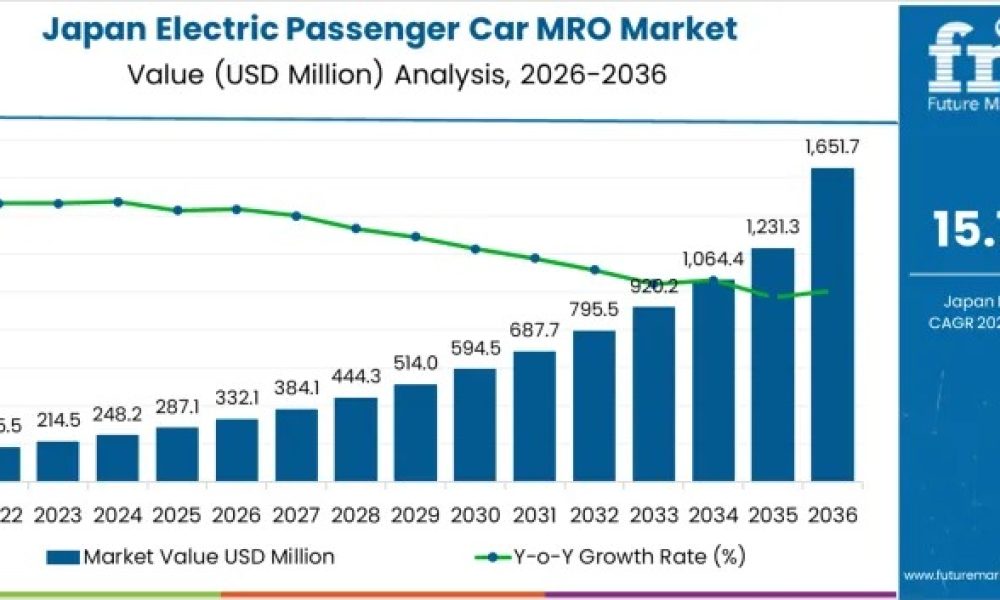
The demand for electric passenger car maintenance, repair, and overhaul (MRO) services in Japan is set to expand rapidly over the next decade, supported by accelerating electric vehicle (EV) adoption and rising service complexity. Market demand is projected to grow from USD 332.1 million in 2026 to USD 1,651.7 million by 2036, registering a robust CAGR of 15.7%.
As Japan advances toward decarbonized mobility, electric passenger cars are increasingly dependent on specialized MRO ecosystems capable of supporting batteries, electric drivetrains, power electronics, and software-driven vehicle systems.
Key Market Growth Drivers
The expansion of Japan’s electric passenger car MRO market is underpinned by multiple structural factors:
- Rapid increase in EV penetration, driven by government incentives and emissions-reduction targets
- Rising share of Battery Electric Vehicles (BEVs), which require specialized diagnostic and maintenance capabilities
- Higher technical complexity of EV architectures, including battery management systems and high-voltage components
- Growing reliance on professional service networks to ensure safety, performance, and vehicle longevity
As early-generation EVs age, demand for battery inspections, system diagnostics, and component refurbishment is increasing across both private and fleet ownership segments.
Get access to comprehensive data tables and detailed market insights — request your sample report today!
BEVs Lead Demand by Vehicle Type
Battery Electric Vehicles (BEVs) account for approximately 40% of total electric passenger car MRO demand in Japan, making them the dominant vehicle segment.
Key factors supporting BEV leadership include:
- Absence of internal combustion engines, shifting maintenance focus toward battery packs, motors, and electronics
- Higher dependency on specialized tools and certified technicians
- Increasing BEV sales volumes across urban and suburban regions
- Periodic servicing needs for battery health monitoring and software updates
As BEV adoption continues to rise, the segment will remain the primary contributor to MRO demand growth.
Franchise General Repairs Dominate Service Provider Landscape
Franchise general repair centers represent 45% of total market demand, reflecting their accessibility and established consumer trust.
Key advantages of franchise repair networks include:
- Extensive nationwide presence across urban and regional Japan
- Growing investments in EV-specific tools and technician training
- Ability to service multiple EV brands and powertrain types
- Cost-effective alternatives to OEM-authorized service centers
Their role is expected to strengthen further as EV ownership expands beyond metropolitan areas.
Regional Demand Outlook: Kyushu & Okinawa Lead Growth
Electric passenger car MRO demand is rising across all major Japanese regions, with notable variation in growth rates:
- Kyushu & Okinawa: 19.6% CAGR
- Strong government support for sustainable transport
- Rapid EV penetration in both urban and rural markets
- Kanto: 18.0% CAGR
- High EV concentration in Tokyo and surrounding cities
- Advanced automotive and charging infrastructure
- Kansai: 15.8% CAGR
- Sustainability initiatives in Osaka and Kyoto
- Strong automotive manufacturing presence
- Chubu: 14.0% CAGR
- Gradual EV transition in traditional automotive hubs
- Tohoku & Rest of Japan: 12.2%–11.6% CAGR
- Expanding EV adoption in smaller cities and rural regions
Regional growth reflects a broad-based national transition toward electric mobility.
Technology Trends Reshaping EV MRO Services
Technological innovation is redefining how MRO services are delivered in Japan’s EV ecosystem:
- Advanced diagnostics and predictive maintenance using vehicle data
- Over-the-air (OTA) software updates reducing physical service visits
- High-voltage safety training programs for technicians
- Battery health assessment tools enabling lifecycle optimization
- Mobile and remote servicing models improving customer convenience
These innovations are increasing service efficiency while raising the skill threshold for MRO providers.
Competitive Landscape: Technology and Service Reach Drive Leadership
The competitive environment is shaped by OEMs and global automotive technology providers expanding EV service capabilities.
Key players operating in Japan include:
- Tesla, Inc.
- Bosch Automotive Service
- Continental AG
- ZF Friedrichshafen AG
- Siemens AG
Market leadership is increasingly defined by diagnostic sophistication, service network coverage, and EV-specific expertise rather than traditional mechanical servicing capabilities.
Market Outlook
Japan’s electric passenger car MRO market is transitioning from early-stage development to a scalable, high-growth service industry. As EV fleets expand and mature, demand for specialized maintenance solutions will rise steadily, creating long-term opportunities for service providers, technology suppliers, and investors aligned with electric mobility infrastructure.
About Future Market Insights (FMI)
Future Market Insights, Inc. (FMI) is an ESOMAR-certified, ISO 9001:2015 market research and consulting organization, trusted by Fortune 500 clients and global enterprises. With operations in the U.S., UK, India, and Dubai, FMI provides data-backed insights and strategic intelligence across 30+ industries and 1200 markets worldwide.



