
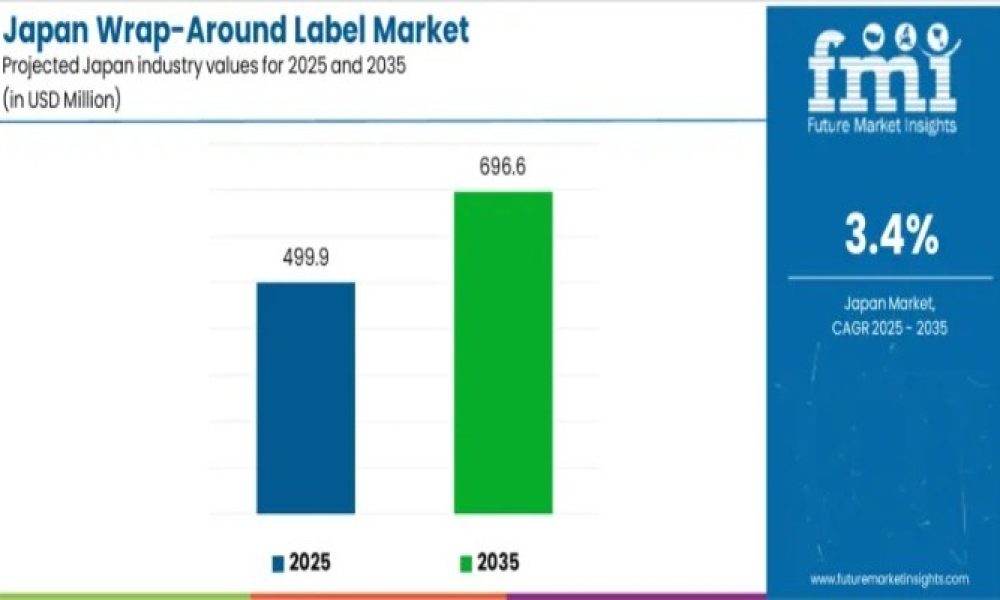
The demand for wrap-around labels in Japan is forecast to grow from USD 499.9 million in 2025 to USD 696.6 million by 2035, registering a CAGR of 3.4%. This consistent expansion reflects the stable nature of Japan’s consumer goods market and ongoing investments in packaging innovation. Growth will be driven by increased adoption across food and beverage packaging, expanding personal care product lines, and rising demand for recyclable and lightweight packaging formats.
Japan’s packaging industry continues to evolve as manufacturers balance efficiency, aesthetics, sustainability, and regulatory compliance. Within this landscape, wrap-around labels have emerged as a preferred labeling solution for cylindrical and curved packaging formats. Between 2025 and 2035, demand for wrap-around labels in Japan is projected to rise steadily, supported by strong consumption of packaged food, beverages, personal care, and household products.
Discover Growth Opportunities in the Market – Get Your Sample Report Now
Meaning and Industry Relevance
Wrap-around labels are labeling solutions designed to encircle the entire circumference of a container, offering 360-degree coverage. Commonly applied to bottles, jars, cans, and tubs, these labels maximize branding space while supporting high-speed automated application. In Japan, where packaging precision and visual appeal strongly influence purchasing decisions, wrap-around labels play a critical role in product differentiation and shelf visibility.
Market Overview
Wrap-around labels are widely favored due to their operational efficiency, cost-effectiveness at scale, and superior presentation capabilities. Japanese manufacturers prioritize packaging solutions that enhance automation compatibility while minimizing waste. Innovations in paper-based labels, adhesives, and printing technologies continue to improve durability, moisture resistance, and print clarity, further strengthening market adoption.
Quick Market Highlights
- Market Value (2025): USD 499.9 million
- Forecast Value (2035): USD 696.6 million
- CAGR (2025–2035): 3.4%
- Dominant Material: Paper (90%)
- Leading Product Type: Stretch labels (34.4%)
Growth Analysis
The five-year growth block analysis reveals a smooth upward trajectory. Early-stage growth from 2025 to 2027 reflects rising penetration in packaged food and beverage segments. From 2028 onward, growth accelerates as wrap-around labels become integral to branding strategies and export packaging. Increased reliance on automated labeling systems and private-label manufacturing further supports sustained expansion through 2035.
Demand Drivers
Several structural and consumer-driven factors are shaping demand for wrap-around labels in Japan:
- Rising consumption of bottled beverages and ready-to-drink products
- Growth in packaged food, cosmetics, and personal care segments
- Preference for high-speed, automated labeling solutions
- Need for full-body branding and regulatory information display
- Expansion of convenience products and e-commerce packaging
Wrap-around labels offer manufacturers an efficient solution that balances cost control with premium visual presentation.
Key Market Segments
The wrap-around label market in Japan is segmented by material and product type.
By Material
- Paper dominates with a 90% market share
- Plastic films and specialty materials serve niche durability needs
By Product Type
- Stretch labels lead with 34.4% share
- Shrink labels, cut-and-stack, roll-fed, and pressure-sensitive labels follow
Paper remains the preferred material due to its recyclability, print quality, and compatibility with sustainability goals.
Trends Shaping the Market
The Japanese wrap-around label market is influenced by several notable trends:
- Increasing use of wrap-around labels in beverage packaging
- Growing adoption of BOPP and advanced paper substrates
- Integration with high-speed automated labeling lines
- Demand for eco-friendly and recyclable labeling materials
- Focus on premium shelf appeal and export-ready packaging
As competition intensifies at retail level, brands continue to invest in label formats that enhance visibility and brand storytelling.
Regional Demand Outlook
Demand growth varies by region, reflecting industrial concentration and packaging activity levels.
Regional CAGR Forecast (2025–2035)
- Kyushu & Okinawa: 4.2%
- Kanto: 3.9%
- Kansai: 3.4%
- Chubu: 3.0%
- Tohoku: 2.6%
- Rest of Japan: 2.5%
Kyushu & Okinawa lead due to strong focus on packaging innovation and sustainability, while Kanto benefits from its dense consumer goods manufacturing base.
Competitive Landscape
The competitive environment for wrap-around labels in Japan is characterized by the presence of global packaging and material specialists. Competition centers on material quality, print performance, sustainability credentials, and compatibility with automated labeling systems.
Key Players
- Amcor Plc
- Huhtamaki Oyj
- Fuji Seal International Inc.
- Avery Dennison Corporation
- Klockner Pentaplast Group
Leading suppliers differentiate themselves through advanced material science, recyclable label substrates, high-performance adhesives, and compliance with Japan’s stringent packaging standards.
Why FMI: https://www.futuremarketinsights.com/why-fmi
About Future Market Insights (FMI)
Future Market Insights, Inc. (FMI) is an ESOMAR-certified, ISO 9001:2015 market research and consulting organization, trusted by Fortune 500 clients and global enterprises. With operations in the U.S., UK, India, and Dubai, FMI provides data-backed insights and strategic intelligence across 30+ industries and 1200 markets worldwide.



