
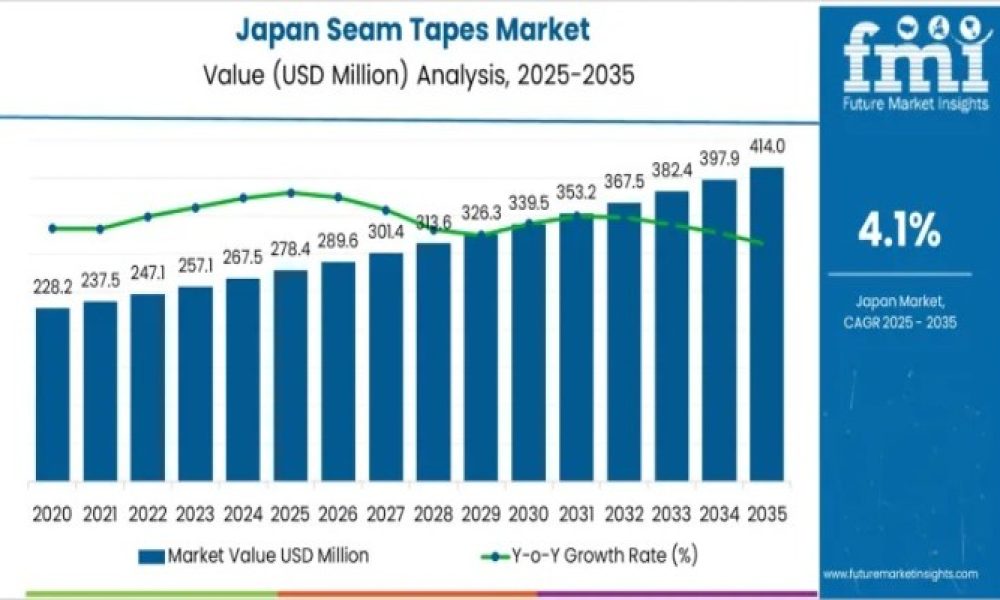
The seam tapes industry in Japan is entering a phase of steady, structurally driven growth as performance apparel, industrial protective clothing, and medical textiles continue to prioritize waterproof integrity and bonded fabric engineering. Valued at USD 278.4 million in 2025, the market is projected to reach USD 414.0 million by 2035, expanding at a CAGR of 4.1%. This growth reflects Japan’s long-standing emphasis on durability, weather resistance, and manufacturing precision rather than short-term fashion cycles.
Seam tapes play a critical role in ensuring waterproof and airtight seams across rainwear, sportswear, safety uniforms, and medical isolation garments. In Japan, where heavy rainfall, coastal humidity, and seasonal typhoons are a fact of life, seam sealing is viewed as a functional necessity. From industrial workwear to commuter outerwear, sealed seams are increasingly treated as a baseline quality requirement rather than a premium feature.
Unlock Growth Potential – Request Your Sample Now and Explore Market Opportunities!
Market Outlook: Function Over Fashion
Between 2025 and 2030, seam tape demand in Japan is expected to rise from USD 278.4 million to USD 326.3 million, generating nearly USD 47.9 million in incremental value. This phase of growth is anchored in outdoor apparel, rainwear, and industrial protective clothing, where replacement of stitched sealing with tape-based reinforcement continues. Domestic garment manufacturers remain focused on high tensile bonding strength, precise heat activation, and long-term wash durability to meet export-grade performance standards.
From 2030 to 2035, market expansion accelerates further, with demand increasing by USD 87.7 million to reach USD 414.0 million. During this period, seam tape usage broadens into medical disposables, firefighting gear, cleanroom suits, and technical accessories such as waterproof bags and footwear components. As multilayer laminates become more common, especially in safety-critical applications, seam tape value per meter is expected to rise, reinforcing revenue growth beyond pure volume gains.
Key Drivers Sustaining Demand
The demand for seam tapes in Japan is shaped by a combination of environmental exposure, regulatory standards, and manufacturing discipline:
- Waterproof Apparel & Outdoor Activity: Hiking, skiing, cycling, and fishing remain deeply embedded in Japanese lifestyles. Seam-taped construction is now standard across these segments.
- Workplace Safety Compliance: Construction, utilities, transportation, and municipal services require sealed seams in protective uniforms to meet safety and durability norms.
- Medical & Infection-Control Textiles: Hospitals and public institutions continue steady procurement of sealed gowns and isolation garments.
- Quality Expectations: Clean interior seam finishes and long service life are viewed as essential product attributes in the Japanese market.
Together, these factors ensure that seam tape demand remains resilient even during broader textile market fluctuations.
Material and Application Insights
By material, polyurethane seam tapes account for approximately 45% of total demand, reflecting their flexibility, strong adhesion, and compatibility with laminated and coated fabrics. Polyurethane performs reliably under repeated washing, flexing, and thermal stress, making it the preferred choice for sportswear, rainwear, medical garments, and industrial uniforms. Polyamide tapes continue to retain relevance in high-temperature industrial applications, while polyolefin-based solutions are gradually gaining traction in select niches.
By application, waterproofing leads with a 25.5% market share, driven by outdoor apparel, rainwear, and industrial protective clothing. Seam sealing is mandatory for moisture protection in these segments, directly impacting brand reputation and product warranties. Demand is supported by predictable manufacturing calendars and institutional uniform replacement cycles rather than seasonal fashion volatility.
Regional Growth Patterns
Seam tape demand is not evenly distributed across Japan. Growth is closely tied to regional manufacturing clusters and climatic conditions:
- Kyushu & Okinawa (5.1% CAGR): The fastest-growing region, supported by export-oriented garment manufacturing, marine apparel, and high humidity conditions that sustain replacement demand.
- Kanto (4.7% CAGR): Driven by technical textile innovation, premium sportswear production, and dense concentration of brand headquarters and high-capacity factories.
- Kansai (4.1% CAGR): Supported by mid-scale apparel manufacturing, footwear production, and steady domestic brand orders.
- Chubu (3.6% CAGR): Growth remains value-focused, with demand from automotive textiles and industrial workwear.
- Tohoku and Rest of Japan (3.0–3.2% CAGR): Slower expansion due to smaller manufacturing bases, but stable demand persists through school uniforms and municipal safety gear.
Competitive Landscape and Supply Dynamics
Japan’s seam tapes market is characterized by a mix of strong domestic suppliers and specialized international players. Toray Industries Inc. plays a central role through polymer-based tape materials integrated into advanced waterproof fabric systems. Sealon Co., Ltd. and Himel Corp. support consistent demand with heat-activated seam sealing and adhesive bonding solutions tailored for Japanese garment production standards.
Global players such as 3M Company and Bemis Associates Inc. participate through imported high-performance seam sealing solutions, particularly in premium outdoor gear and medical protective clothing. Product selection across the market is governed by peel strength, heat activation range, flexibility, and resistance to hydrolysis under prolonged use.
Why FMI: https://www.futuremarketinsights.com/why-fmi
About Future Market Insights (FMI)
Future Market Insights, Inc. (FMI) is an ESOMAR-certified, ISO 9001:2015 market research and consulting organization, trusted by Fortune 500 clients and global enterprises. With operations in the U.S., UK, India, and Dubai, FMI provides data-backed insights and strategic intelligence across 30+ industries and 1200 markets worldwide.



