
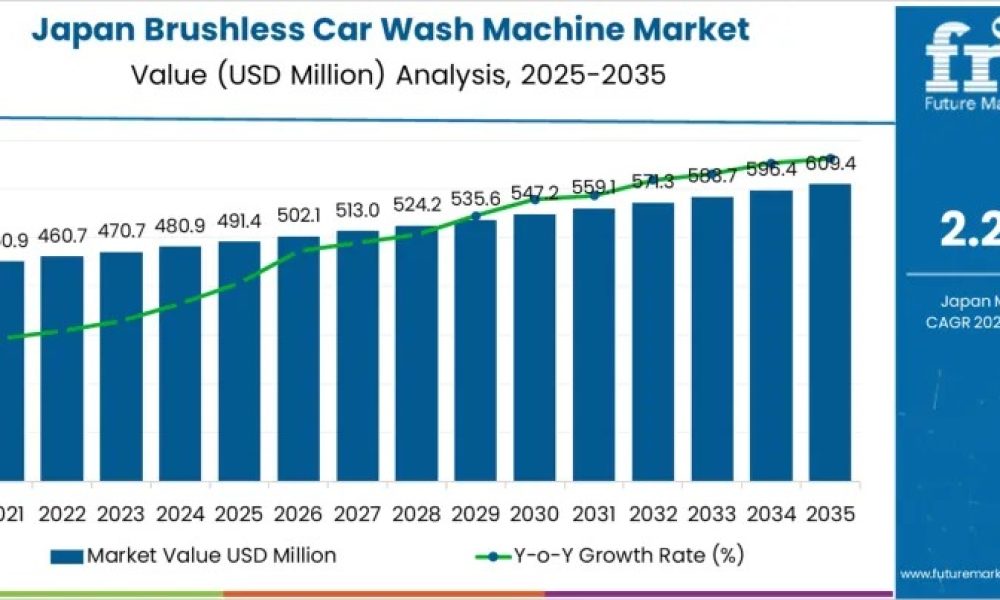
The brushless car wash machine market in Japan is evolving as a steady, infrastructure-driven industry shaped by urban density, automation priorities, and a strong cultural emphasis on vehicle surface protection. Valued at USD 491.4 million in 2025, demand is projected to reach USD 609.4 million by 2035, expanding at a CAGR of 2.2% over the forecast period. While growth remains moderate, it is notably resilient, supported by predictable replacement cycles, gradual technology upgrades, and expanding commercial fleet utilization.
Unlike consumer discretionary equipment markets, brushless car wash machines in Japan are embedded within service station networks, fleet depots, and urban mobility infrastructure. Demand is therefore driven less by rapid site proliferation and more by equipment renewal, performance optimization, and regulatory alignment, creating a low-volatility growth profile through 2035.
Market Trajectory: Replacement-Led Growth with Back-Weighted Value Expansion
Between 2025 and 2030, demand for brushless car wash machines rises from USD 491.4 million to USD 535.6 million, adding USD 44.2 million in incremental value. This phase is defined by the replacement of aging friction-based and early-generation tunnel systems, many of which were installed during earlier retail fuel network expansion cycles. Operators increasingly favor touchless systems for their faster wash cycles, reduced mechanical wear, and lower labor dependency—critical advantages in Japan’s labor-constrained service economy.
Get access to comprehensive data tables and detailed market insights – request your sample report today!
From 2030 to 2035, market expansion accelerates modestly but meaningfully, with value increasing by USD 73.8 million to reach USD 609.4 million. This back-weighted growth reflects higher value per installation rather than a sharp rise in the number of sites. Investments increasingly focus on water recycling efficiency, reduced chemical consumption, energy optimization, and system uptime, as operators seek to lower total cost of ownership while meeting environmental and municipal discharge standards.
Urban Constraints and Paint Protection Drive Touchless Preference
Japan’s urban structure plays a decisive role in shaping brushless car wash demand. High population density, limited private washing space, and residential restrictions on water usage make home car washing impractical across many metropolitan areas. As a result, service stations and express wash formats dominate installations, offering compact, automated solutions that integrate seamlessly into constrained forecourt layouts.
Consumer preference has steadily shifted toward non-contact wash technology, driven by heightened awareness of paint preservation. Modern vehicles with thinner clear coats, dark finishes, and aftermarket ceramic coatings are particularly vulnerable to micro-scratches caused by mechanical brushes. Brushless systems, which rely on high-pressure water jets and chemical foams, are increasingly perceived not merely as cleaning equipment but as paint protection systems. This perception underpins consistent usage frequency and supports subscription-based wash programs that encourage repeat visits.
Application Structure: Passenger Vehicles Lead, Fleets Stabilize Demand
By application, passenger vehicles account for approximately 30% of total brushless car wash machine demand in Japan, making them the single largest segment. Daily urban exposure to road dust, rain residue, and airborne pollutants increases the need for frequent exterior cleaning, while time efficiency remains a critical factor for private owners. Brushless systems align well with these needs, offering quick turnaround without surface abrasion risk.
Commercial fleets—including logistics vehicles, taxis, rental cars, and municipal fleets—provide a stable and recurring demand base. Fleet operators favor brushless systems for their consistency, reduced risk of cosmetic damage, and compatibility with multi-year service contracts. As fleet utilization intensity rises, particularly in urban delivery and mobility services, automated wash infrastructure becomes an essential operational asset rather than a discretionary upgrade.
Exterior Washing Dominates Installation Economics
By wash type, exterior washing represents around 80% of total brushless car wash machine usage in Japan. Exterior cleanliness directly affects vehicle appearance, corrosion prevention, and resale value—factors that carry strong weight in both consumer and commercial decision-making. Brushless exterior systems also support high throughput, enabling service stations and automated tunnels to process vehicles quickly with minimal staffing.
Interior cleaning remains more labor-intensive and less suited to full automation, limiting its scale within brushless installations. Regulatory inspections, used-vehicle resale preparation, and fleet branding requirements further reinforce the priority placed on exterior wash capability.
Technology Shift: From Fixed Equipment to Intelligent Wash Platforms
After 2030, technology differentiation becomes a more prominent growth driver. Operators increasingly prioritize system reliability, remote diagnostics, and predictive maintenance, particularly at high-utilization sites. Advanced brushless machines now integrate vehicle profiling sensors that adjust spray angles and pressure based on body geometry, improving wash consistency across compact cars, SUVs, and commercial vans.
Water management is another critical focus. Closed-loop recycled water systems and optimized chemical dosing help operators comply with tightening environmental standards while reducing operating costs. Energy efficiency per wash cycle becomes a key procurement metric as electricity prices and sustainability reporting gain importance. These enhancements elevate brushless car wash machines from fixed assets to digitally enabled service platforms, supporting higher lifetime value.
Regional Growth: Moderate but Broad-Based
Regionally, growth remains balanced, led by Kyushu & Okinawa (2.7% CAGR), where service station modernization, tourism-driven rental activity, and coastal climate conditions increase wash frequency. Kanto (2.5%) follows, supported by dense vehicle circulation, premium car ownership, and large-scale fleet servicing. Kansai (2.2%) reflects steady replacement demand tied to suburban fueling stations and used-car dealerships, while Chubu (1.9%) is shaped by industrial logistics activity and depot-based installations. Tohoku (1.7%) and the rest of Japan (1.6%) show slower but stable growth, constrained by lower vehicle density and cautious capital spending.
Competitive Landscape: Reliability, Efficiency, and Diagnostics in Focus
The Japanese brushless car wash machine market features a mix of global technology leaders, including WashTec AG, PDQ Manufacturing Inc., Istobal S.A., Autec Car Wash Systems, and Ryko Solutions Inc. Competitive focus centers on wash consistency, drying efficiency, water and chemical optimization, and remote monitoring capabilities. Suppliers increasingly differentiate through modular designs suited to limited urban space and systems engineered for high uptime under continuous operation.
Outlook: Infrastructure-Anchored Growth with Rising Quality Expectations
Japan’s brushless car wash machine market is characterized by incremental, infrastructure-anchored growth rather than rapid expansion. Stable vehicle ownership, predictable replacement cycles, and rising expectations around paint protection, water efficiency, and automation ensure sustained demand through 2035. As operators shift from basic cleaning toward optimized, intelligent vehicle care, brushless systems are set to remain a core component of Japan’s automated mobility service ecosystem.
Why Choose FMI: Empowering Decisions that Drive Real-World Outcomes: https://www.futuremarketinsights.com/why-fmi
About Future Market Insights (FMI)
Future Market Insights, Inc. (FMI) is an ESOMAR-certified, ISO 9001:2015 market research and consulting organization, trusted by Fortune 500 clients and global enterprises. With operations in the U.S., UK, India, and Dubai, FMI provides data-backed insights and strategic intelligence across 30+ industries and 1200 markets worldwide.



