
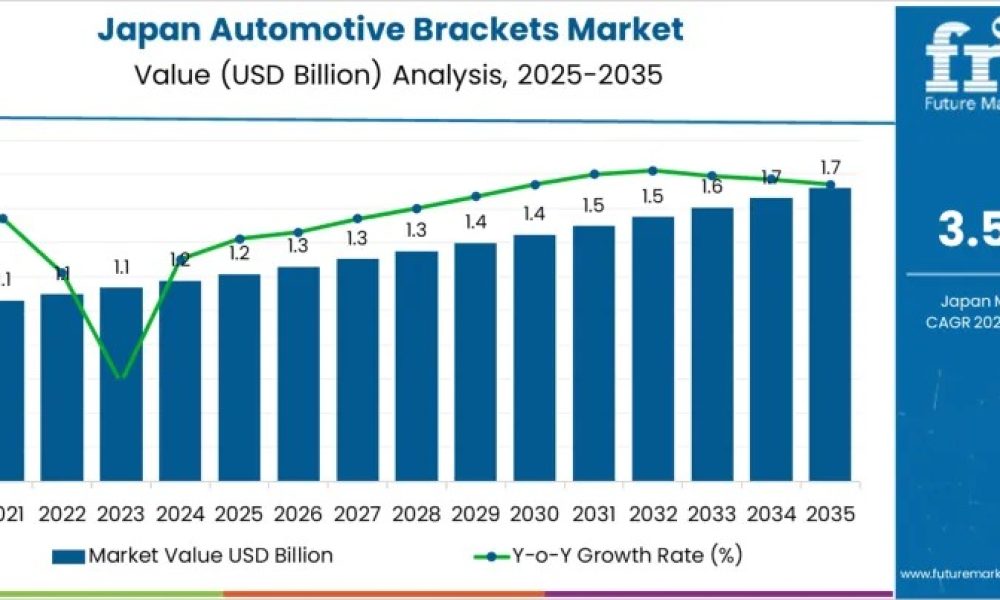
The automotive brackets market in Japan is set to expand steadily over the next decade, underpinned by structural changes in vehicle architecture, rising electrification, and increasing regulatory emphasis on safety and efficiency. Industry analysis indicates that demand for automotive brackets in Japan is valued at USD 1.2 billion in 2025 and is forecast to reach USD 1.7 billion by 2035, growing at a compound annual growth rate (CAGR) of 3.5%.
This sustained growth reflects the essential role automotive brackets play in modern vehicle manufacturing. As vehicles become more complex—integrating advanced powertrains, electronics, and safety systems—brackets have evolved from basic mounting components into precision-engineered structural elements that directly influence performance, durability, and noise, vibration, and harshness (NVH) characteristics.
Vehicle Complexity and Safety Regulations Drive Core Demand
From 2025 to 2030, the Japanese automotive brackets market is expected to witness a steady rise in demand, supported by continued production of passenger vehicles and commercial vehicles. Automotive brackets are indispensable for securing key systems such as engines, exhaust assemblies, radiators, suspension units, and body-to-frame connections. Increasingly stringent safety and emissions regulations are compelling automakers to adopt more robust and precisely engineered mounting solutions, directly translating into higher bracket demand.
Japan’s auto parts ecosystem, known for its strict quality and precision standards, further reinforces market stability. Bracket suppliers are required to deliver components that meet exacting tolerances while offering corrosion resistance, durability, and long service life—particularly critical for applications exposed to heat, vibration, and environmental stress.
Get access to comprehensive data tables and detailed market insights – request your sample report today!
Electrification and Lightweighting Accelerate Innovation
The shift toward electric and hybrid vehicles represents one of the most important long-term demand drivers for automotive brackets in Japan. While traditional internal combustion engine (ICE) platforms continue to dominate volumes, electrification introduces new mounting requirements for battery packs, electric motors, power electronics, and advanced cooling systems.
From 2030 to 2035, market growth is expected to remain steady as electrification deepens and advanced materials gain wider adoption. Aluminum, high-strength steel, and emerging composite materials are increasingly used to reduce vehicle weight while maintaining structural integrity. Lightweight brackets contribute directly to improved fuel efficiency, extended EV range, and compliance with Japan’s CO₂ reduction targets.
New EV-specific design specifications are also driving innovation in bracket manufacturing. Suppliers are developing specialized geometries and modular designs that support high-voltage components while meeting crash safety and thermal management requirements. As a result, brackets are becoming more integrated into the overall vehicle safety and performance system rather than remaining stand-alone components.
Passive Elastomeric Brackets Lead the Market
By product type, passive elastomeric brackets account for approximately 45% of total demand, making them the leading segment in Japan. These brackets are widely adopted for their superior vibration and noise-damping capabilities, particularly in engine and suspension applications. Elastomeric materials provide flexibility and resilience under high stress, making them well-suited for components exposed to continuous vibration and thermal cycles.
Their cost-effectiveness, durability, and ease of integration into mass-production environments further strengthen their position. As Japanese automakers continue to prioritize ride comfort, cabin quietness, and refined driving performance, passive elastomeric brackets are expected to remain the preferred solution across both traditional and electrified vehicle platforms.
Engine Applications Remain a Key Demand Anchor
From an application perspective, engine-related uses account for around 30% of automotive bracket demand in Japan. Brackets used in engine systems must withstand extreme operating conditions, including high temperatures, mechanical loads, and constant vibration. They play a critical role in securing engine blocks, exhaust systems, and cooling assemblies, ensuring alignment and long-term reliability.
Even as electric vehicles gain momentum, engine and powertrain applications will continue to anchor demand through hybrid vehicles and the large installed base of ICE-powered cars and commercial vehicles. Additionally, EV powertrains require their own specialized brackets, offsetting the gradual decline in traditional engine-mount applications.
Regional Growth Led by Manufacturing Hubs
Regionally, demand growth reflects the geographic distribution of Japan’s automotive manufacturing and supplier base:
- Kyushu & Okinawa lead the market with a CAGR of 4.4%, supported by strong vehicle assembly activity and expanding auto-parts manufacturing capabilities.
- Kanto follows closely at 4.1% CAGR, driven by its concentration of OEMs, Tier 1 suppliers, and a robust aftermarket ecosystem.
- Kinki is projected to grow at 3.6%, reflecting moderate but consistent manufacturing and technology adoption.
- Chubu, anchored by Aichi Prefecture’s automotive cluster, is expected to grow at 3.1%, supported by commercial vehicle and hybrid production.
- Tohoku and the Rest of Japan show slower but stable growth between 2.6% and 2.7%, driven largely by maintenance, replacement demand, and smaller-scale manufacturing.
This regional spread highlights that automotive bracket demand is not limited to a single hub but is supported by nationwide production and aftermarket activity.
Tailor Your Solution: Request Customization for Your Unique Needs!
Competitive Landscape Focuses on Precision and Materials Expertise
The Japanese automotive brackets market is shaped by a mix of domestic manufacturers and global suppliers, including Allena Group, Toyo Tires, MISUMI Corporation, Cooper-Standard Holdings Inc., and Hangzhou Ekko Auto Parts Co., Ltd. Competition centers on precision engineering, material innovation, and the ability to meet evolving OEM requirements across both ICE and EV platforms.
Suppliers that can deliver lightweight, corrosion-resistant, and modular bracket solutions—while maintaining cost efficiency—are best positioned to capture long-term growth as vehicle architectures continue to evolve.
Outlook: Stable, Long-Term Growth Through 2035
Overall, Japan’s automotive brackets market presents a low-volatility, structurally driven growth outlook through 2035. Supported by steady vehicle production, rising electrification, and continuous innovation in materials and design, automotive brackets will remain a critical component category within Japan’s auto parts industry.
As automakers pursue lighter, safer, and more technologically advanced vehicles, demand for high-performance brackets is set to grow in parallel—positioning the market as a resilient and strategically important segment of Japan’s automotive value chain.
Why Choose FMI: Empowering Decisions that Drive Real-World Outcomes: https://www.futuremarketinsights.com/why-fmi
About Future Market Insights (FMI)
Future Market Insights, Inc. (FMI) is an ESOMAR-certified, ISO 9001:2015 market research and consulting organization, trusted by Fortune 500 clients and global enterprises. With operations in the U.S., UK, India, and Dubai, FMI provides data-backed insights and strategic intelligence across 30+ industries and 1200 markets worldwide.



