
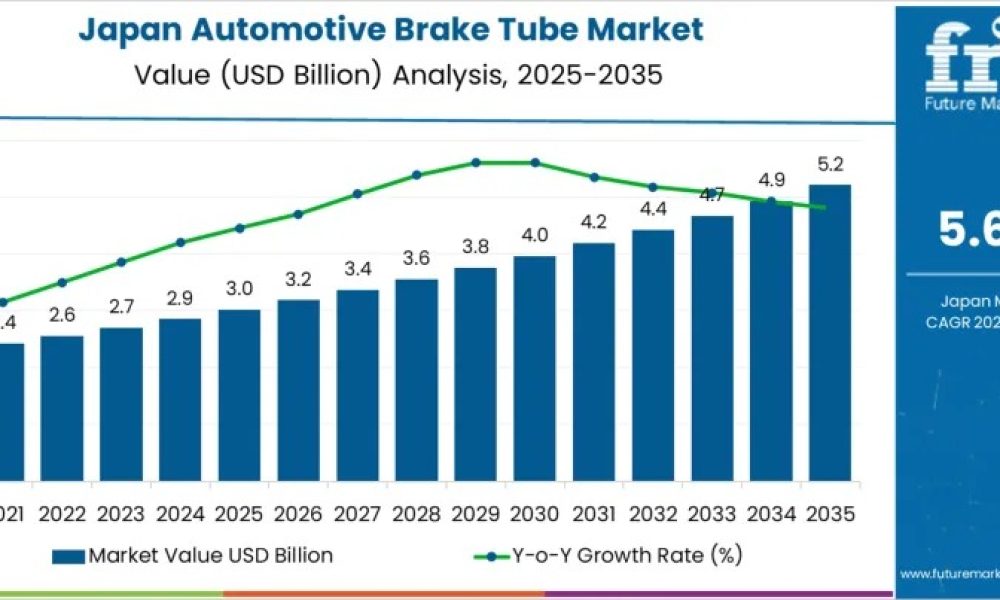
The automotive brake tube market in Japan is transitioning from recovery-led growth to a structurally supported expansion phase, underpinned by stringent safety regulations, predictable replacement cycles, and rising specification intensity across vehicle platforms. Market demand, valued at USD 3.0 billion in 2025, is projected to reach USD 5.2 billion by 2035, advancing at a CAGR of 5.6% over the forecast period.
Unlike discretionary automotive components, brake tubes represent a non-negotiable safety-critical input. Their demand profile in Japan is therefore anchored to regulation, inspection compliance, and long-term fleet maintenance rather than short-term vehicle sales volatility. This structural characteristic keeps downside risk limited while allowing steady value accretion through material upgrades and tighter tolerances.
Market Evolution: From Recovery to Specification-Led Expansion
Between 2020 and 2025, brake tube demand rose from USD 2.3 billion to USD 3.0 billion, with annual absolute additions constrained to USD 0.1–0.2 billion. This period was marked by controlled growth tied to the recovery of light vehicle production, stable aftermarket replacement, and incremental safety upgrades. The low volatility index during this phase reflects predictable OEM ordering patterns and disciplined inventory management across domestic supply chains.
From 2025 onward, the market enters a controlled expansion phase. Demand is forecast to increase by USD 2.2 billion through 2035, with annual increments gradually widening to USD 0.3 billion after 2030. Importantly, this widening reflects structural demand reinforcement, not instability. Drivers include tightening braking performance standards, wider adoption of advanced braking systems, and gradual electrification of vehicle platforms that require higher precision and corrosion resistance in hydraulic lines.
Get access to comprehensive data tables and detailed market insights – request your sample report today!
Passenger Vehicles Anchor Demand Stability
By application, passenger vehicles account for 62% of total brake tube demand, making them the dominant consumption segment. Japan’s large installed base of private vehicles, combined with dense urban traffic conditions, leads to frequent braking cycles that accelerate fatigue and corrosion exposure in hydraulic lines. Strict inspection regimes, particularly under the shaken system, reinforce preventive replacement behavior, sustaining aftermarket volumes even as new vehicle ownership growth remains modest.
Commercial vehicles—spanning light commercial fleets, buses, and municipal vehicles—form the remaining share. Their demand is driven by high mileage utilization and mandatory safety compliance, particularly in logistics, public transport, and regional freight operations. Together, these segments create a balanced OEM–aftermarket demand mix that stabilizes market growth across economic cycles.
Stainless Steel Emerges as the Dominant Product Type
By product type, stainless steel brake tubes command 55% of total demand, establishing clear leadership in the Japanese market. This dominance reflects Japan’s emphasis on long service life, corrosion resistance, and regulatory compliance, particularly in regions exposed to road salt, humidity, and temperature variation.
Stainless steel offers superior resistance to corrosion-induced leakage and burst failures, enabling automakers to meet pressure tolerance and fatigue strength requirements with lower long-term risk. From a manufacturing perspective, stainless steel forming, bending, and flaring processes are well standardized within Japan’s component ecosystem, supporting tight dimensional tolerances required by modern braking systems.
While rubber brake tubes remain relevant in specific low-pressure applications, the long-term trend favors metal tubing with extended corrosion warranties, predictable performance under thermal cycling, and lower lifetime replacement frequency—advantages that align with fleet economics and regulatory scrutiny.
Electrification Reinforces Precision Requirements Rather Than Reducing Demand
Contrary to early assumptions, the rise of hybrid and battery electric vehicles is not reducing brake tube demand in Japan. Although regenerative braking lowers friction brake usage, hydraulic systems remain essential for safety redundancy. Electrified platforms introduce new underbody layouts, higher system pressures, and tighter packaging constraints, increasing the need for thinner-wall, high-strength, precision-formed tubing.
OEMs increasingly prioritize internal cleanliness, vibration resistance, and dimensional accuracy to ensure compatibility with advanced electronic brake control systems. This shift favors suppliers capable of delivering higher-value, lower-volume, precision-engineered brake tube assemblies, reinforcing value growth even if unit volumes expand modestly.
Regional Growth Reflects Manufacturing Density and Climate Exposure
Regionally, growth rates vary in line with vehicle production density, climate, and service intensity:
- Kyushu & Okinawa (7.0% CAGR) lead growth, supported by coastal corrosion exposure, expanding vehicle production, and strong export logistics infrastructure.
- Kanto (6.5%) benefits from dense vehicle ownership, major assembly operations, and high aftermarket service intensity.
- Kinki (5.7%) reflects balanced passenger and commercial demand anchored by manufacturing clusters around Osaka.
- Chubu (5.0%) remains stable due to its concentration of OEM assembly hubs and tier-one suppliers.
- Tohoku (4.4%) and the Rest of Japan (4.2%) show slower but predictable growth tied to lower vehicle density and distributor-led supply models.
Across all regions, corrosion exposure and inspection rigor play a decisive role in replacement cycles.
Tailor Your Solution: Request Customization for Your Unique Needs!
Competitive Landscape: Precision, Automation, and OEM Integration
The competitive environment is shaped by a mix of domestic specialists and global component groups, including Parker Hannifin Corporation, Sumitomo Riko Company Limited, Eaton Corporation, Nichirin Co., Ltd., and TI Fluid Systems. Domestic suppliers benefit from long-standing OEM relationships and deep integration into quality assurance programs, while global players contribute advanced materials, automation, and standardized system architectures.
Strategic priorities across the supplier base include automation of forming and inspection, non-destructive testing, traceability to raw material sources, and joint development with OEMs. Investments increasingly target weight reduction without durability loss, enhanced coating technologies, and modular pre-bent assemblies that reduce assembly time at vehicle plants.
Outlook: Low-Volatility Growth with Rising Value Density
Japan’s automotive brake tube market is defined less by rapid expansion and more by predictable, regulation-driven growth with rising specification intensity. Stable replacement demand, electrification-compatible design requirements, and persistent corrosion challenges ensure long-term relevance for high-quality brake tubing. For suppliers aligned with precision manufacturing, material innovation, and OEM collaboration, the market offers low volatility, strong planning visibility, and sustained value growth through 2035.
Why Choose FMI: Empowering Decisions that Drive Real-World Outcomes: https://www.futuremarketinsights.com/why-fmi
About Future Market Insights (FMI)
Future Market Insights, Inc. (FMI) is an ESOMAR-certified, ISO 9001:2015 market research and consulting organization, trusted by Fortune 500 clients and global enterprises. With operations in the U.S., UK, India, and Dubai, FMI provides data-backed insights and strategic intelligence across 30+ industries and 1200 markets worldwide.



