
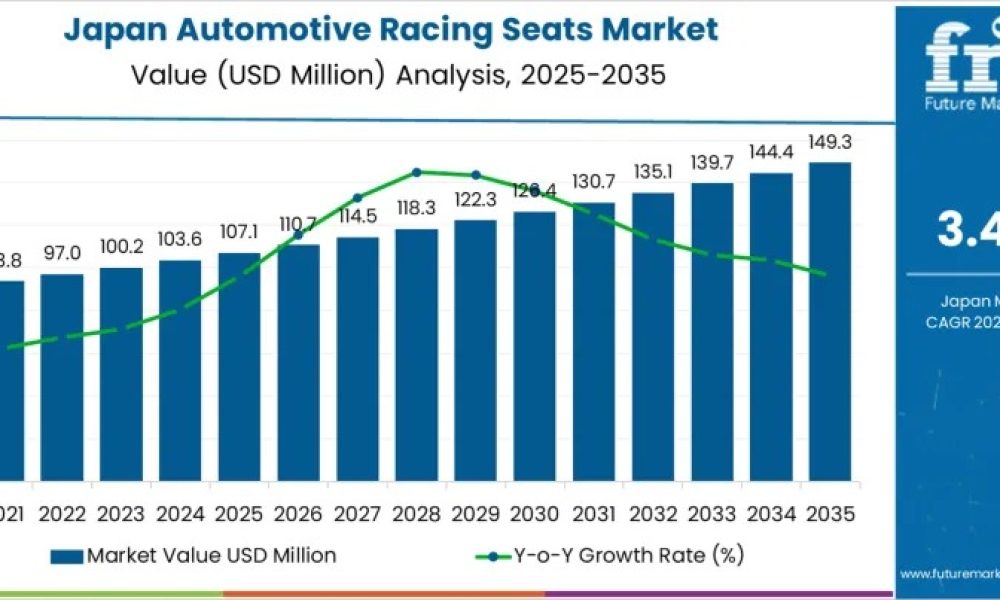
The demand for automotive racing seats in Japan is projected to grow from USD 107.1 million in 2025 to USD 149.3 million by 2035, representing a CAGR of 3.4%. The market is primarily driven by motorsport participation, performance-vehicle customization, and aftermarket replacement installations in sports cars, tuner models, and enthusiast-owned vehicles.
Racing seats enhance driver support, cockpit safety, and vehicle performance, particularly during high-G maneuvers, while lightweight constructions contribute to vehicle weight reduction and handling precision. Increasing adoption of carbon-fiber seats, valued for their high torsional rigidity and strength-to-weight ratio, remains a key growth driver.
Market Growth Dynamics (2025–2035)
- 2025–2030: Demand grows steadily as interest in tuning culture, circuit driving, and amateur racing supports periodic spikes in sales.
- 2030–2035: Growth continues at a controlled pace, moderated by economic fluctuations, discretionary spending, and regulatory requirements for street-legal installations.
The market remains niche and cyclical, driven largely by enthusiast consumption rather than mass-market structural demand, with professional motorsport offering a consistent baseline volume.
Get access to comprehensive data tables and detailed market insights – request your sample report today!
Material and Application Insights
Carbon Fiber Leads Demand – Accounting for 65% of the market, carbon fiber is preferred for:
- Reduced weight for improved handling
- High torsional rigidity for cornering stability
- Compatibility with multi-point harnesses and motorsport regulations
Natural Fiber Seats represent 35%, targeting cost-conscious enthusiasts and sustainable material adoption, particularly in mid-range tuning applications.
High-Performance Vehicles Dominate – Approximately 70% of sales are for GT cars, rally builds, and track vehicles, supporting driver posture, control, and safety harness integration. The remaining 30% is driven by eco-performance or styling-focused vehicles, reflecting consumer demand for sporty aesthetics without extensive chassis modification.
Regional Market Insights
- Kyushu & Okinawa: 4.2% CAGR, strong local tuning culture, motorsport engagement, and premium seating upgrades for sport-compact models.
- Kanto: 3.9% CAGR, driven by dense enthusiast communities, urban tuning hubs, and access to aftermarket suppliers and circuit facilities.
- Kansai: 3.4% CAGR, supported by Osaka and Kobe performance garages, track-day participation, and mixed-purpose seating demand.
- Chubu: 3.0% CAGR, influenced by proximity to automotive production clusters and tuning communities.
- Tohoku: 2.6% CAGR, steady demand for practical performance upgrades suited to long-distance and seasonal driving.
- Rest of Japan: 2.5% CAGR, emerging demand from dispersed tuning communities and incremental vehicle interior upgrades.
Key Market Drivers
- Motorsport Participation – Grassroots racing, drifting, gymkhana, and amateur track days drive demand for FIA-compliant, reinforced seats.
- Performance Vehicle Customization – Lightweight seats improve handling, driver feedback, and cockpit aesthetics.
- Technological Innovation – Modular designs compatible with modern seat rails, airbags, and electronic safety systems.
- Simulator and Esports Applications – Growing demand for high-rigidity seats in home simulators and driving arcades.
Market Restraints
- Premium pricing limits adoption to dedicated enthusiasts.
- Regulatory compliance for street-legal installations, including airbag and seatbelt integration, adds complexity.
- Fixed-back designs are less practical for daily commuting in compact Japanese vehicles.
Tailor Your Solution: Request Customization for Your Unique Needs!
Competitive Landscape
Leading suppliers in Japan include:
- Bride Co., Ltd. – 32% market share, recognized for controlled shell-strength and FIA-compliant designs.
- RECARO Japan – FIA-rated seats offering consistent ergonomics and harness compatibility.
- BRIDE/Stradia sub-brands – Specialized seating for both track-day and street-legal applications.
- Sparco Japan – Track-day and drift-focused reinforced seats.
- OMP Japan – Flexible cockpit configurations supporting motorsport and hobbyist installations.
Competition centers on shell rigidity, impact-load tolerance, weight optimization, regulatory compliance, and installation precision, with demand concentrated in enthusiast and motorsport segments.
Market Outlook Through 2035
The Japan automotive racing seats market is expected to maintain steady growth, supported by a combination of enthusiast-driven aftermarket adoption, professional motorsport requirements, and evolving performance vehicle designs. Carbon fiber seats and lightweight, modular constructions will continue to dominate, while innovation in ergonomics and safety compliance ensures consistent demand across track, street, and simulator applications.
Why Choose FMI: Empowering Decisions that Drive Real-World Outcomes: https://www.futuremarketinsights.com/why-fmi
About Future Market Insights (FMI)
Future Market Insights, Inc. (FMI) is an ESOMAR-certified, ISO 9001:2015 market research and consulting organization, trusted by Fortune 500 clients and global enterprises. With operations in the U.S., UK, India, and Dubai, FMI provides data-backed insights and strategic intelligence across 30+ industries and 1200 markets worldwide.



