
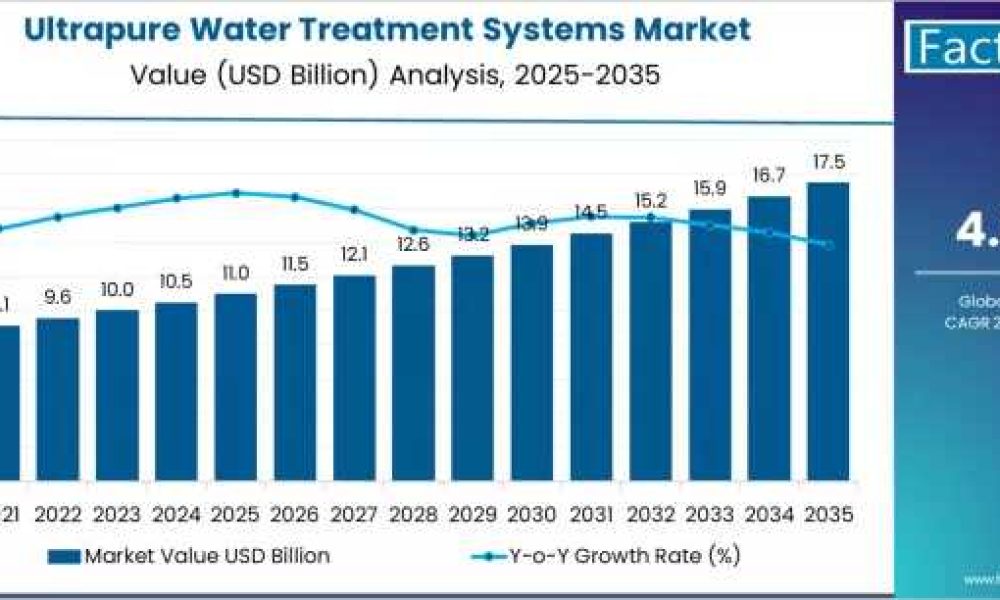
The U.S. ultrapure water treatment systems market was valued at approximately USD 2,299.4 million in 2024. The market is forecast to grow steadily, reaching around USD 3,552.3 million by 2033, representing a compound annual growth rate (CAGR) of ~4.8% from 2025 to 2033. Extrapolating trends beyond 2033, the market is expected to reach approximately USD 3.9–4.0 billion by 2035, assuming continued adoption and investment across key industries.
Between 2025 and 2035, the U.S. ultrapure water treatment systems market is poised for steady, mid‑single-digit growth.
Key Growth Drivers
1. Expansion of Semiconductor & Electronics Industry
The increasing complexity of semiconductor manufacturing, including smaller geometries and advanced nodes, demands extremely high‑purity water for wafer cleaning, rinsing, and etching. Even trace contaminants can degrade yield and device reliability. Semiconductor fabs, particularly new facilities incentivized by domestic initiatives, are investing heavily in multi‑stage ultrapure water (UPW) infrastructure.
The semiconductor segment is currently the largest end‑use, accounting for around 42.8% of market share in 2024, and is expected to continue being a major growth driver.
2. Growth in Pharmaceuticals, Biotechnology & Life‑Sciences Manufacturing
The pharmaceutical and biotechnology sectors are another strong pillar of demand. Ultrapure water is essential for drug formulation, cleaning, sterilization, lab processes, and biologics manufacturing, where water quality impacts product safety and regulatory compliance.
Rising investments in biotech, increased R&D, growth in biologics, and expansion of clean‑room manufacturing facilities support ongoing growth. The pharma/biotech “ingredient” water segment is projected to grow at a CAGR of ~6.1% from 2025 to 2033.
To access the complete data tables and in-depth insights, request a Discount On The Report here: https://www.factmr.com/connectus/sample?flag=S&rep_id=12421
3. Technological Evolution & Preference for Advanced, Sustainable Purification Methods
Reverse Osmosis (RO) remains the largest technology segment in 2024, accounting for ~44.4% share. However, Electrode Deionization (EDI) is the fastest-growing technology segment, as it enables continuous, chemical‑free water purification.
The shift toward EDI and other advanced purification technologies reflects both regulatory pressure for purity and industry demand for more efficient, low-waste systems.
4. Regulatory & Quality Compliance
Stringent quality standards in semiconductor fabrication, pharmaceuticals, biotechnology, and power generation require water with extremely low levels of dissolved solids, organics, ions, and particulates. The regulatory environment in the U.S., reinforced by industry standards, incentivizes firms to invest in validated ultrapure water systems, supporting adoption and expansion.
Segment‑level Outlook & Trends
| Segment Type | 2024 Baseline / Dominant Segment | Forecast Trend (2025–2033) | Implication for 2025–2035 |
|---|---|---|---|
| End‑use | Semiconductor (~42.8%) | Semiconductor growth (~5.5% CAGR), Pharmaceuticals rising strongly | Stable growth from dual demand |
| Application | Cleaning (~50.2%) | Ingredient (pharma/biotech) fastest growing (~6.1% CAGR) | Demand shifting from cleaning to broader applications |
| Technology | RO largest share (~44.4%) | EDI fastest growth; shift toward advanced purification | Uptake of EDI could increase average system value |
Implication (2025–2035): The U.S. market will diversify beyond cleaning and semiconductor uses toward pharma/biotech applications and advanced system adoption, smoothing growth trajectories.
Risks, Challenges & Market Restraints
Several factors could affect growth:
High CapEx and Operating Costs: Advanced systems have high installation costs and ongoing maintenance, including membrane replacement and energy consumption.
Market Saturation in Mature Segments: Older facilities may only require incremental upgrades, limiting new installations.
Regulatory & Compliance Risk: Changes in environmental regulations could require retrofitting or investment in water‑reuse systems.
Competition from Alternative Water Solutions: Water reuse and recycling may reduce demand for traditional systems.
Volatility in End‑Use Industries: Semiconductor and pharma demand can be cyclical and influenced by economic factors.
Strategic Implications & Opportunities (2025–2035)
Diversified Client Base
Suppliers should increasingly target pharmaceuticals, biotechnology, and life-sciences segments where water demand is growing fastest.
Technology Upgrades
Investment in EDI and other advanced, automated systems can capture higher-growth market segments and meet sustainability goals.
Water Reuse & Sustainability
Integrating water reuse and recycling with ultrapure water systems provides a differentiator and aligns with environmental and regulatory requirements.
Retrofitting & Upgrades
As regulations evolve and water quality standards tighten, existing plants will need retrofitting with upgraded UPW systems, offering steady opportunities.
Forecast Scenarios for 2035
| Scenario | Description & Assumptions | Estimated U.S. Market Size by 2035 |
|---|---|---|
| Base Case | Steady 4.8% CAGR through 2033; slight slowdown afterward | ~USD 4.0 billion |
| Growth Acceleration | Rapid EDI adoption, biotech growth, regulatory push | ~USD 4.4–4.6 billion |
| Conservative | Economic slowdown, slower fab growth, shift to water reuse | ~USD 3.8–3.9 billion |
Even in a conservative scenario, the market remains substantially larger than 2024 levels.
Key Trends to Watch (Beyond 2025)
EDI & chemical-free systems: Faster adoption driven by sustainability and regulatory requirements.
Diversification into pharma/biotech: Growing biologics manufacturing will increase demand for ingredient water.
Environmental compliance & water reuse: Water scarcity and discharge regulations will encourage hybrid solutions.
Domestic semiconductor growth: New fabs will boost demand for large-scale UPW systems.
Retrofitting & replacement: Older systems will be upgraded with modular, automated solutions.
Conclusion
The U.S. ultrapure water treatment systems market is on track for steady growth through 2025–2035, supported by expanding semiconductor manufacturing, rising pharmaceutical & biotech activity, and adoption of advanced purification technologies.
Challenges include high costs, maintenance requirements, and competition from water reuse solutions. However, the diversified demand base and regulatory imperatives provide a robust growth foundation. Opportunities exist in new installations, upgrades, retrofits, and technology-driven sustainability solutions.
Have a specific Requirements and Need Assistant on Report Pricing or Limited Budget please contact us – [email protected]
To View Related Report :
Water Soluble Packaging Market https://www.factmr.com/report/water-soluble-packaging-market
Waterjet Cutting Machine Industry Analysis in the United Kingdom https://www.factmr.com/report/united-kingdom-waterjet-cutting-machine-industry-analysis
Water Desalination Equipment Market https://www.factmr.com/report/water-desalination-equipment-market
Water Electrolysis Machine Market https://www.factmr.com/report/5248/water-electrolysis-machine-market



