
The U.S. electric power sector is undergoing a shift toward renewables, with large-scale retirement of conventional thermal plants and modernization of grid infrastructure.
Inverter-based resources (wind, solar) lack natural inertia, making synchronous condensers increasingly critical for reactive power support, voltage regulation, and grid stability.
SCs provide a scalable, proven solution to maintain reliability in high-renewable grids.
Market Forecast:
| Metric | Value/Trend |
|---|---|
| CAGR (2025–2035) | 7–8% |
| U.S. Market Size (2034 est.) | USD 158 million |
| Key Drivers | Renewable integration, grid modernization, reactive power & voltage support, retirement of conventional plants |
Quick Stats for Synchronous Condenser Market
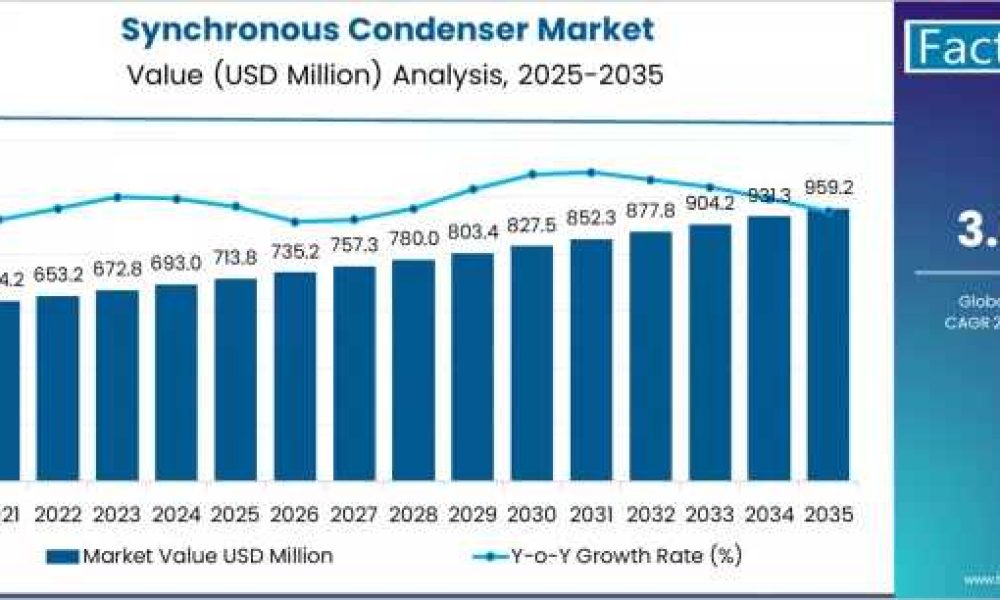
- Synchronous Condenser Market Value (2025): USD 713.8 million
- Synchronous Condenser Market Forecast Value (2035): USD 959.2 million
- Synchronous Condenser Market Forecast CAGR: 3.0%
- Leading Product Type in Synchronous Condenser Market: Refurbished Synchronous Condenser (57.8%)
- Key Growth Regions in Synchronous Condenser Market: North America, Europe, and Asia Pacific
- Top Players in Synchronous Condenser Market: ABB, Siemens Energy, IDEAL ELECTRIC POWER CO., Ansaldo Energia S.p.A., GE Vernova Inc.
To access the complete data tables and in-depth insights, request a Discount On The Report here: https://www.factmr.com/connectus/sample?flag=S&rep_id=12417
Key Growth Drivers
Renewable Energy Integration & Grid Stability
Increased renewable penetration → greater voltage fluctuations, reactive power imbalance, reduced inertia.
SCs provide dynamic reactive support and “rotational inertia,” maintaining frequency stability.
Retirement or underutilization of conventional plants → loss of inherent inertia, increasing reliance on SCs.
Grid Modernization & Transmission Upgrades
Aging infrastructure requires transmission upgrades, HVDC links, and advanced reactive-power devices.
Regulatory incentives and policies for grid resilience and renewable integration promote SC adoption over SVCs or capacitor banks.
Technological Advancements & Diversified Use Cases
Improvements: higher efficiency, better control, predictive maintenance, enhanced cooling.
Industrial adoption: large facilities needing reactive power and stable power quality.
Retrofit of older synchronous machines as condensers → cost-effective deployment pathway.
Browse Full Report : https://www.factmr.com/report/synchronous-condenser-market
Market Challenges
| Challenge | Implication |
|---|---|
| High capital cost | Limits adoption for smaller utilities; competing alternatives may be preferred. |
| Competition from alternative tech | STATCOMs, advanced inverter-based systems, battery storage can substitute some SC functions. |
| Integration complexity | Older grids may need extensive engineering or upgrades to accommodate SCs. |
| Regulatory uncertainty | Growth depends on supportive policies, grid-code requirements, and utility spending. |
Emerging Opportunities & Trends
Retrofit & Repurposing: Converting idle generators into SCs reduces CAPEX and leverages existing assets.
Smart Grid Integration: IoT-enabled SCs allow remote monitoring, predictive maintenance, and dynamic control.
Hybrid Systems: Combining SCs with batteries and inverter-based renewables improves resilience.
Eco-Friendly Designs: Emphasis on low-emission, efficient cooling systems aligns with environmental standards.
Regional & Utility-Level Implications
Deployment concentrated in high-renewable states (wind, solar) and regions planning HVDC or interconnection expansion.
Utilities retiring coal/thermal plants or retrofitting idle generators → early adopters.
Transmission operators upgrading long-distance corridors → prefer SCs for voltage stability and inertia injection.
Strategic Recommendations
| Stakeholder | Action Points |
|---|---|
| Manufacturers & Suppliers | Develop modular, cost-effective SC units; integrate smart features and predictive maintenance; invest in eco-friendly designs. |
| Utilities & Grid Operators | Evaluate legacy plants for SC conversion; plan SC deployment alongside renewables; explore hybrid solutions. |
| Investors & Financiers | Track grid modernization and renewable pipelines; SC market offers stable medium-term growth. |
| Policymakers & Regulators | Support reactive power and inertia standards; provide incentives and favorable depreciation models. |
Conclusion
The U.S. SC market is expected to grow steadily through 2035 with CAGR of 7–8%, driven by renewable expansion, grid modernization, and retirement of conventional plants.
SCs are strategically critical for maintaining grid stability, voltage regulation, and system inertia in a high-renewable power system.
Early adopters—utilities, manufacturers, and investors—stand to benefit as SCs become integral to the modernized, resilient U.S. grid.
Have a specific Requirements and Need Assistant on Report Pricing or Limited Budget please contact us – [email protected]
To View Related Report :
Permanent Magnet Synchronous Motors Market https://www.factmr.com/report/5358/permanent-magnet-synchronous-motors-market
About Fact.MR
Fact.MR is a global market research and consulting firm, trusted by Fortune 500 companies and emerging businesses for reliable insights and strategic intelligence. With a presence across the U.S., UK, India, and Dubai, we deliver data-driven research and tailored consulting solutions across 30+ industries and 1,000+ markets. Backed by deep expertise and advanced analytics, Fact.MR helps organizations uncover opportunities, reduce risks, and make informed decisions for sustainable growth.



