
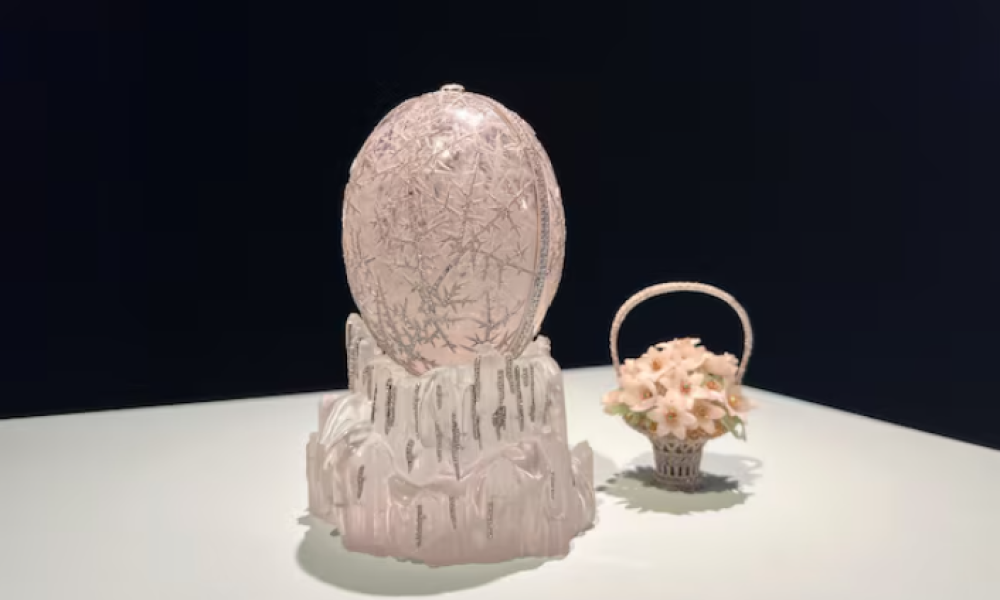
The forthcoming auction of the Faberge Imperial Winter Egg is poised to test the limits of the ultra-high-end collectible market, with an estimated price exceeding $26 million. This valuation places the relic not merely as a historical artifact, but as a critical, high-performing asset in the world of patrimonial wealth. Commissioned by Tsar Nicholas II in 1913, the egg is more than a masterpiece of jewelcraft; it represents one of the final, magnificent gestures of the Romanov dynasty just before its collapse.
Analysis of the Winter Egg’s pedigree and previous sales history suggests that the current estimate is grounded in a proven trajectory of appreciation. When the Winter Egg last appeared at auction in 2002, it fetched $9.6 million, setting a world record for a Faberge item at the time. Its reappearance now, two decades later with an estimate nearly three times that amount, underscores the consistent and aggressive growth in value attributed to the highest-quality Imperial Faberge pieces. The sale, managed by Christie’s, is a bellwether for the collectible luxury goods sector, particularly for items with impeccable historical provenance.
Imperial Provenance as a Market Driver
The market for objects connected to the Imperial House of Romanov exhibits extraordinary resilience, largely due to the fixed supply and the profound historical narrative embedded in each item. Tsar Nicholas II gifted the Winter Egg to his mother, Maria Feodorovna, as a traditional Easter present. This specific history, combined with the technical brilliance of Peter Carl Faberge’s workshop, elevates the Winter Egg beyond mere ornamentation. Faberge’s reputation was built on his exclusive role as the court jeweler, a position that mandated both unparalleled artistic innovation and absolute quality in execution.
The Winter Egg, in particular, is frequently cited by experts as the pinnacle of Faberge’s Imperial creations. It is crafted from carved rock crystal, giving the illusion of a frozen surface. This transparent, icy exterior is dramatically offset by elaborate rose-cut diamond-set platinum snowflakes, an astounding demonstration of early 20th-century Russian goldsmithing. The interior, which would have contained a surprise, carries an engraved frost pattern and originally housed an intricate bouquet of flowers. The object’s base is carved to resemble melting ice, a subtle and technically demanding detail that speaks to the artistry of its design. The convergence of historical significance, rarity, and technical mastery justifies its position at the apex of the collectible art market.
Shifting Valuation Dynamics for Russian Masterworks
The current valuation reflects not only inflation but a structural shift in how these masterworks are viewed globally. The 2007 sale of the Rothschild Faberge Egg for $18.5 million established a new price tier for these objects, confirming that the market treats the Imperial Eggs as a unique asset class distinct from general antique jewelry or fine art. This class is characterized by a limited pool of collectors, often including institutions, museums, and private individuals seeking diversification into tangible, portable wealth that carries a narrative.
The strategy by Christie’s to anchor its Classic Week around this singular offering emphasizes the economic weight of historical luxury. The decision to list the estimate “on request, in excess of 20 million pounds” injects a layer of strategic ambiguity that is often reserved for pieces expected to command record-breaking figures. It is an acknowledgment that the intrinsic value may be less important than the psychological threshold a determined buyer is willing to cross for ownership of an irreplaceable cultural artifact. This approach maximizes competitive bidding among those vying for an item that embodies both extraordinary beauty and terminal political history.
The Winter Egg’s prominence within Christie’s auction calendar, coinciding with sales like the Old Masters Evening Sale featuring Dutch artist Gerrit Dou’s “The Flute Player,” signals its status as a primary financial draw. Its sale is not merely an exchange of goods, but a performance in the global luxury goods market, where historical provenance translates directly into exponential financial appreciation. This continued upward trajectory reaffirms the enduring investment appeal of artifacts intrinsically linked to legendary, powerful figures and empires. The outcome of the December 2 auction will provide a clear metric for the current health and confidence of the world’s most elite collecting community.



