
As environmental concerns intensify and public demand for clean water continues to rise, the U.S. microplastics removal technologies market is entering a decade of strong expansion. Microplastics—tiny plastic particles found in oceans, rivers, drinking water, and wastewater—have become a critical environmental and public-health challenge. From 2025 to 2035, the United States is expected to witness significant investment in advanced filtration, biological, and electrochemical technologies to combat microplastic contamination across municipal, industrial, and environmental applications.
Market Size and Forecast Outlook
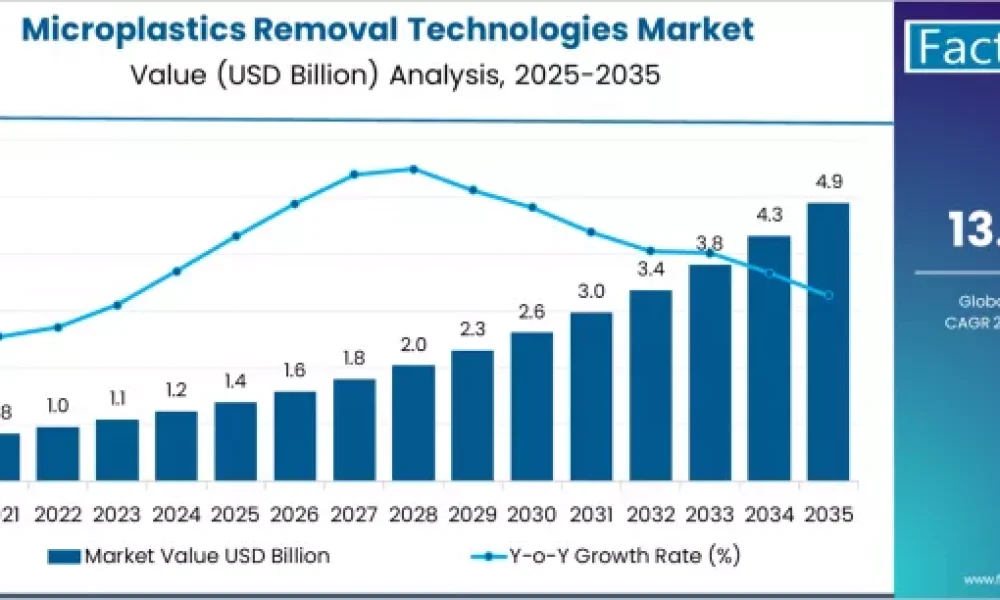
The global microplastics removal technologies market is projected to expand rapidly over the next decade, and the U.S. will play a major role in this growth. The market is expected to rise from approximately USD 1.4 billion in 2025 to USD 4.9 billion by 2035, representing a CAGR of more than 13.3%. Growing regulatory pressure, infrastructure modernization, and increased awareness of microplastic risks are accelerating adoption across water-treatment ecosystems. In the U.S., municipalities, industries, and environmental agencies are increasingly investing in advanced treatment systems designed to meet stricter water-quality standards and support long-term sustainability goals.
To access the complete data tables and in-depth insights, request a Discount On The Report here: https://www.factmr.com/connectus/sample?flag=S&rep_id=11840
Key Growth Drivers
Regulatory pressure: Federal and state authorities are continuously tightening water-quality guidelines and introducing monitoring frameworks for microplastics, compelling utilities and industries to upgrade treatment infrastructure.
Growing public awareness: Scientific research and media reporting have amplified concern over microplastics in drinking water and aquatic ecosystems, driving stronger demand for high-performance removal technologies.
Municipal infrastructure upgrades: Aging U.S. water-treatment systems are undergoing modernization, with cities prioritizing advanced filtration systems such as membrane bioreactors (MBRs), ultrafiltration modules, and hybrid treatment solutions.
Technological advancements: Innovations in filtration, biological degradation, and electrochemical processes are enabling more precise, cost-efficient, and scalable microplastics removal. These technologies support both large-scale municipal systems and decentralized industrial applications.
Expanding industrial and environmental applications: Beyond municipal drinking water and wastewater, industries such as textiles, chemicals, food processing, and manufacturing are implementing microplastic treatment systems to comply with discharge regulations. Coastal and marine environmental protection programs are also contributing to market expansion.
Market Segmentation: Technology and Application Trends
By Technology Type:
- Filtration systems remain the leading segment, representing the largest share of the market. Membrane bioreactors account for a significant portion of filtration demand due to their high removal efficiency and growing adoption in municipal and industrial wastewater treatment.
- Biological methods are emerging as the fastest-growing category, driven by interest in eco-friendly and cost-efficient solutions capable of degrading microplastics over time.
- Chemical and electrochemical treatment technologies are gaining traction in industrial and environmental applications where conventional filtration is insufficient.
By Application:
- Municipal water treatment will dominate demand through 2035, as cities upgrade both wastewater and drinking-water systems with advanced microplastics removal technologies.
- Industrial wastewater treatment is expected to grow steadily as industries adopt stricter sustainability and compliance strategies.
- Agricultural runoff management is emerging as an important segment as microplastics from soil and fertilizers increasingly enter water streams.
- Marine and environmental protection applications are forecast to expand rapidly due to coastal cleanup initiatives and conservation efforts.
Strategic Implications for Stakeholders
For technology providers: The next decade offers substantial opportunities to expand portfolios in filtration, biological, and hybrid treatment systems. Companies that offer scalable, cost-effective, and regulatory-ready solutions will be positioned for strong growth.
For municipalities and environmental agencies: Proactive upgrades in water-treatment facilities will be essential to meet tightening standards. Integrating multi-stage treatment systems—combining filtration, biological, and electrochemical processes—will help ensure high-efficiency microplastics removal.
For investors and policymakers: The strong forecasted CAGR reflects a high-growth, environmentally aligned market. Supporting infrastructure upgrades, R&D investment, and public-private partnerships can yield long-term economic and ecological benefits.
Outlook Summary
Between 2025 and 2035, the U.S. microplastics removal technologies market will experience robust expansion driven by environmental regulation, technological innovation, and significant infrastructure modernization. Filtration systems will remain central to market growth, while biological and hybrid technologies gain momentum. With rising public concern and tightening compliance standards, the sector offers solid opportunities for technology providers, investors, and policymakers committed to advancing water quality and environmental protection.
Have a specific Requirements and Need Assistant on Report Pricing or Limited Budget please contact us – [email protected]
About Fact.MR
Fact.MR is a global market research and consulting firm, trusted by Fortune 500 companies and emerging businesses for reliable insights and strategic intelligence. With a presence across the U.S., UK, India, and Dubai, we deliver data-driven research and tailored consulting solutions across 30+ industries and 1,000+ markets. Backed by deep expertise and advanced analytics, Fact.MR helps organizations uncover opportunities, reduce risks, and make informed decisions for sustainable growth.



