
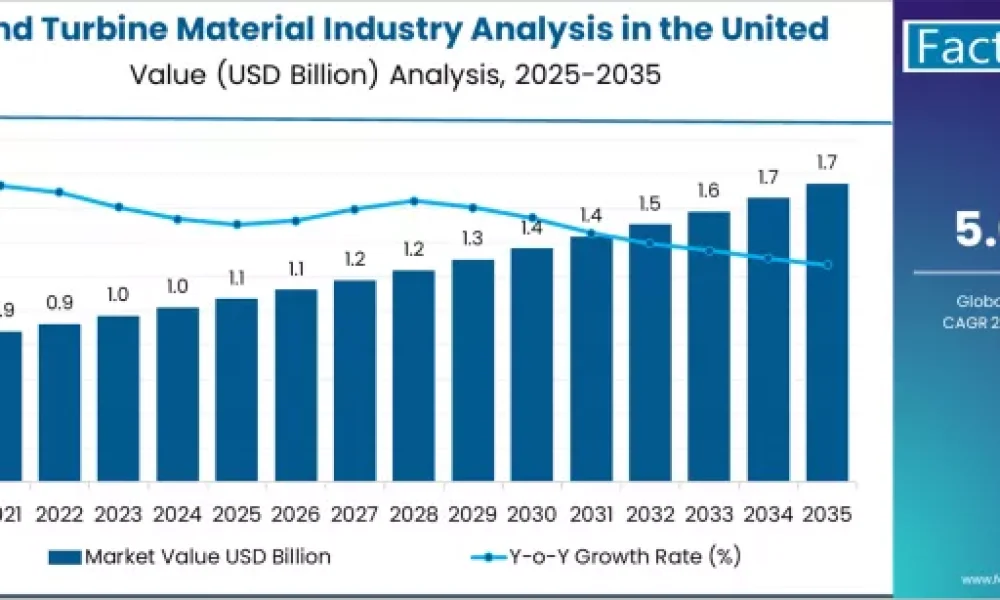
The U.K. wind turbine material industry is set for steady growth from 2025 to 2035, driven by the country’s ambitious renewable energy goals, expansion of offshore and onshore wind farms, and advancements in high-performance turbine materials. Wind turbine components—including blades, towers, nacelles, and specialized materials such as composites and steel—play a critical role in ensuring structural integrity, maximizing energy output, and supporting sustainable power generation. This report highlights market size, growth drivers, technological trends, regional dynamics, and strategic implications for stakeholders.
Market Size and Growth
The U.K. wind turbine material market is projected to grow from approximately USD 1.07 billion in 2025 to USD 1.74 billion by 2035, reflecting a compound annual growth rate (CAGR) of 5%. Blade materials will remain the largest application segment, accounting for 44% of demand, while composite materials (glass/carbon fiber with resin) will dominate the material segment with 49% share. This growth trajectory underscores the increasing reliance on advanced materials to enhance turbine performance and support renewable energy infrastructure.
To access the complete data tables and in-depth insights, request a Discount On The Report here: https://www.factmr.com/connectus/sample?flag=S&rep_id=11794
Key Growth Drivers
Expansion of renewable energy projects: The U.K.’s commitment to offshore wind power and sustainable energy transition is creating strong demand for high-performance turbine materials.
Technological innovation in materials: Advanced composites, specialized steel alloys, and other materials enhance durability, lightweight construction, and energy generation efficiency, enabling turbines to meet stringent performance standards.
Government policies and energy transition initiatives: Supportive regulations and investment incentives for renewable energy infrastructure encourage the adoption of superior turbine materials.
Sustainability and circular economy integration: Manufacturers are increasingly using eco-friendly materials and implementing sustainable production practices, reducing environmental impact while maintaining performance.
Regional Insights
England is the largest market for wind turbine materials, driven by extensive offshore wind farms and industrial hubs. Scotland, Wales, and Northern Ireland offer growing opportunities, particularly in emerging offshore wind projects. The blades segment dominates due to its critical aerodynamic performance, while composite materials are essential for strength, flexibility, and lightweight design. Key players operating in the U.K. market include Owens Corning, Hexcel, Toray, Siemens Gamesa Materials, LM Wind Power, and Jushi Group, which compete through material innovation, performance assurance, and sustainable manufacturing processes.
Technology Trends and Competition
The U.K. market is highly competitive, with innovation centered on:
- Next-generation composite materials for enhanced energy efficiency.
- Lightweight, durable blades optimized for offshore and onshore performance.
- Integration of sustainability principles and circular economy approaches in production.
- Standardization and certification to meet regulatory compliance and operational safety.
These trends enable manufacturers and energy developers to improve energy output, reduce environmental impact, and optimize lifecycle performance of wind turbines.
Challenges
Despite positive growth, challenges include high production costs for advanced materials, complex certification requirements, and supply chain constraints for specialized composites. Balancing cost, performance, and sustainability remains critical for stakeholders.
Strategic Implications
For manufacturers and distributors: Focus on R&D in high-performance materials, expand composite production capabilities, and align with renewable energy standards.
For energy developers: Prioritize turbine materials that enhance efficiency, durability, and compliance with environmental regulations.
For investors: The U.K. wind turbine material market offers robust growth opportunities, supported by renewable energy expansion, technological innovation, and government-backed infrastructure investments.
Outlook Summary
From 2025 to 2035, the U.K. wind turbine material industry is expected to grow steadily, with blades and composites remaining central to market demand. Expansion of offshore and onshore wind farms, adoption of advanced material technologies, and integration of sustainability practices will drive growth. While challenges such as cost and certification requirements persist, the sector presents compelling opportunities for manufacturers, energy developers, and investors aiming to enhance turbine efficiency, reliability, and sustainable energy generation in the U.K.
Have a specific Requirements and Need Assistant on Report Pricing or Limited Budget please contact us – [email protected]
About Fact.MR
Fact.MR is a global market research and consulting firm, trusted by Fortune 500 companies and emerging businesses for reliable insights and strategic intelligence. With a presence across the U.S., UK, India, and Dubai, we deliver data-driven research and tailored consulting solutions across 30+ industries and 1,000+ markets. Backed by deep expertise and advanced analytics, Fact.MR helps organizations uncover opportunities, reduce risks, and make informed decisions for sustainable growth.



