
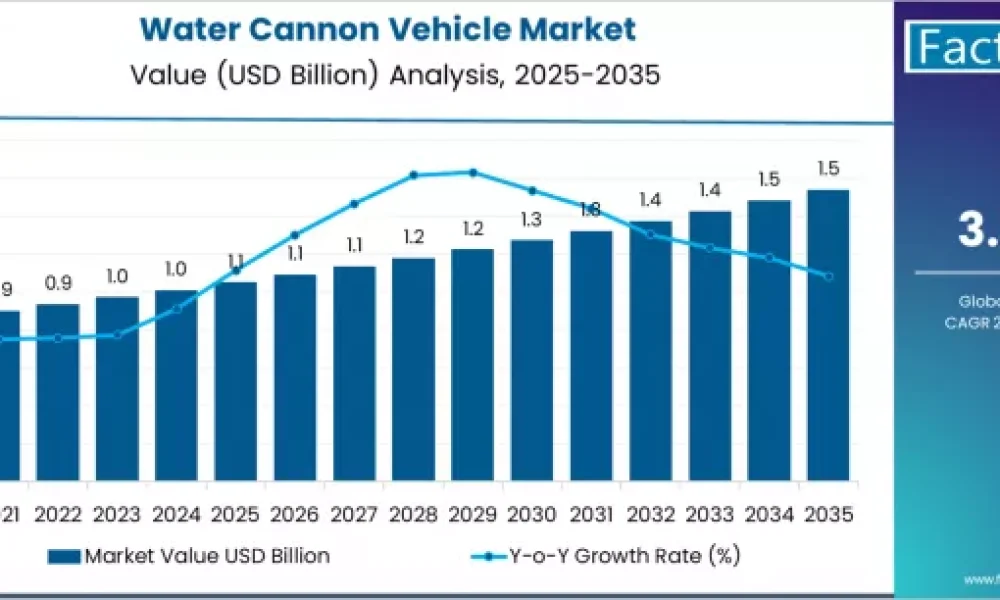
Fact.MR, a global market intelligence provider, today announced its latest findings on the U.S. Water Cannon Vehicle Market Forecast 2025–2035, projecting the market to expand from USD 1.05 billion in 2025 to USD 1.54 billion by 2035, reflecting a steady CAGR of 3.9% over the next decade.
The report notes that U.S. agencies across law enforcement, municipal fire departments, industrial safety units, and airport emergency response teams are accelerating investments in high-capacity, remote-operated, multi-role water cannon vehicles.
“Water cannon vehicles are evolving into critical assets for public safety and industrial resilience,” said Dr. Sonia Patel, Lead Infrastructure Analyst at Fact.MR. “Their operational versatility—spanning firefighting, riot control, emergency cooling, and industrial hazard suppression—makes them increasingly indispensable to U.S. response systems.”
Market Overview
The U.S. market for water cannon vehicles is projected to grow by nearly USD 489 million between 2025 and 2035. Demand continues to rise as urban areas expand, public safety budgets increase, and emergency response agencies seek more robust and technologically advanced equipment.
Across major U.S. metropolitan regions, fleet modernization is moving to the forefront of public safety planning. Fact.MR’s analysis indicates that water cannon vehicles are now viewed as force multipliers due to their:
- Ability to deliver large water volumes over extended distances
- Remote-operational safety
- Multi-terrain performance
- Adaptability across emergency scenarios
For access to full forecasts, regional breakouts, company share analysis, and emerging trend assessments, you can purchase the complete report here https://www.factmr.com/connectus/sample?flag=S&rep_id=11259
Key Growth Drivers
1. Rising Demand for Multipurpose Response Vehicles
U.S. cities and counties are increasingly adopting multi-role emergency vehicles to reduce procurement costs and boost operational flexibility. Water cannon vehicles, once used primarily for riot control, are now deployed in:
- Structural firefighting
- Airport crash response
- Refinery and industrial hazard mitigation
- Wildfire suppression in urban-wildland interface zones
2. Airport Infrastructure Expansion
U.S. airports continue to invest in advanced Aircraft Rescue and Firefighting (ARFF) capabilities. High-capacity water cannon vehicles with rapid discharge systems and thermal imaging features are becoming standard components of airport-wide safety upgrades.
3. Industrial Safety Regulations
Upward revisions in OSHA and NFPA safety standards have increased industrial investment in large-volume suppression vehicles, especially in sectors such as oil & gas refining, chemical manufacturing, steel plants, and warehousing hubs.
4. Public Order & Emergency Management
While politically sensitive, the demand for controlled, non-lethal crowd management systems continues to grow among federal, state, and municipal law enforcement—particularly as cities invest in equipment that provides capability without escalating risk.
Market Segmentation Insights
By Application
Fact.MR identifies four primary application pillars in the U.S. market:
Firefighting (Municipal & Industrial)
The largest application segment, representing 44% of U.S. demand, driven by cities upgrading aging equipment with high-capacity, remote-operated systems that enhance firefighter safety.
Airport Rescue & Firefighting
Growing air traffic and federal compliance requirements ensure continued adoption of modern water cannon vehicles equipped with fast-deployment foam systems and long-range discharge nozzles.
Riot Control & Public Safety
Law enforcement agencies continue to invest in non-lethal response technology, with water cannon vehicles offering precise, controllable crowd-dispersal capability.
Special Industrial & Mining Applications
Heavy industries are adopting specialized water cannon trucks for high-temperature cooling, fire hazard prevention, and emergency spill response.
Vehicle Design & Technology Trends
Dominance of 6×4 and 6×6 Chassis Configurations
These configurations represent roughly 44% of U.S. market share, valued for their optimal balance of mobility, payload capacity, and durability across varied terrains.
Shift Toward High-Capacity Water Tanks
Vehicles with >10,000-liter tanks are gaining ground in airports and industrial sites, while 5,000–8,000-liter units remain standard for municipal operations.
Adoption of Advanced Control Systems
The U.S. market shows a clear shift toward:
- Electro-hydraulic remote control
- CAN/PLC-based integrated command systems
- Telematics-enabled diagnostics
- Automated nozzle targeting
This wave of digitalization improves operator safety, reduces response time, and minimizes human error during high-risk missions.
Regional Outlook
Northeast U.S.
Demand driven by urban density, aging infrastructure, and emergency readiness upgrades.
Midwest
Strong adoption by industrial hubs, steel manufacturing regions, and petrochemical corridors.
South & Southeast
Growing investment in airport safety and hurricane-related emergency response capabilities.
Western States
A surge in wildland–urban interface emergencies has increased procurement of multi-purpose water cannon and high-discharge suppression vehicles.
Market Challenges
Despite promising growth, the U.S. market faces several industry-wide constraints:
- High upfront procurement costs, especially for advanced remote-control units
- Maintenance complexity, with hydraulic and PLC systems requiring specialized technicians
- Training demands, as operators must be proficient in vehicle handling and remote targeting
- Public scrutiny, particularly regarding use in crowd control scenarios
However, Fact.MR notes that federal funding programs and municipal grants are helping mitigate these barriers.
Competitive Landscape
Major international and domestic manufacturers continue to dominate the U.S. market through innovation, strong service networks, and multi-role product lines. Competition is intensifying around:
- Energy-efficient engines
- Smart control systems
- Modular platform design
- Extended maintenance contracts
- Rapid-response airport and industrial solutions
Companies investing in remote automation, predictive diagnostics, and multi-purpose functionality are expected to gain a competitive advantage over the next decade.
Forecast Highlights: 2025–2035
- Market valuation expected to rise from USD 1.05 billion to USD 1.54 billion
- 46.6% total growth across the decade
- Strongest demand from firefighting and industrial hazard control
- Ongoing airport expansion to intensify procurement
- Adoption of AI-assisted remote operation expected to accelerate post-2030
Related Report :
Waterjet Cutting Machine Industry Analysis in the United Kingdom
Water Desalination Equipment Market
About Fact.MR
Fact.MR is a global market research and consulting firm, trusted by Fortune 500 companies and emerging businesses for reliable insights and strategic intelligence. With a presence across the U.S., UK, India, and Dubai, we deliver data-driven research and tailored consulting solutions across 30+ industries and 1,000+ markets. Backed by deep expertise and advanced analytics, Fact.MR helps organizations uncover opportunities, reduce risks, and make informed decisions for sustainable growth.



