
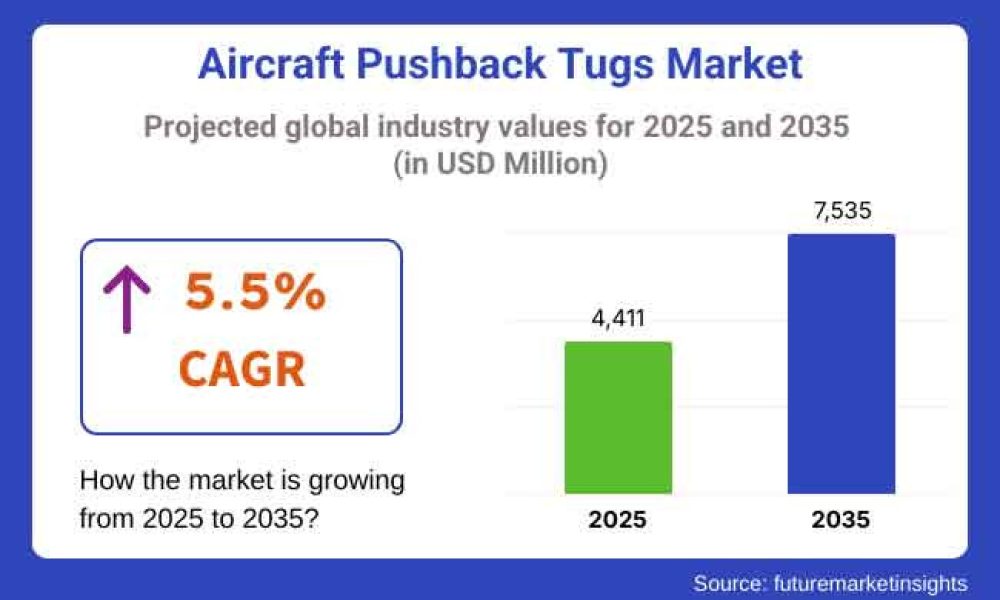
The global Aircraft Pushback Tugs Market is set for robust expansion, rising from USD 4,411 million in 2025 to nearly USD 7,535 million by 2035, according to new industry insights. A steady 5.5% CAGR is being driven by the recovery in global aviation, rapid modernization of ground support equipment (GSE), and the accelerating shift toward electric and autonomous tow systems.
Pushback tugs serve as critical airport assets, enabling safe and efficient aircraft gate departure and repositioning. As commercial airlines, cargo operators, and airport authorities push for improved operational efficiency and lower emissions, demand for next-generation electric, towbarless, and semi-autonomous tug systems continues to surge.
Aviation Electrification and Automation Drive Market Growth
Airports worldwide are focusing on zero-emission ground operations, boosting investment in electric propulsion systems, remote-controlled tugs, and autonomous piloting technology. Modern towbarless tugs—designed for faster turnaround, improved maneuverability, and reduced nose-gear stress—are becoming the preferred choice for high-density air terminals across the Middle East, Europe, and North America.
Innovations such as AI-guided routing, real-time diagnostics, and autonomous pushback systems (including solutions under development by Taxibot and Eagle) are reshaping the aircraft ground-handling landscape. These smart technologies reduce human error and operational downtime while supporting the broader global sustainability agenda.
Subscribe for Year-Round Insights → Stay ahead with quarterly and annual data updates
https://www.futuremarketinsights.com/reports/sample/rep-gb-8561
Regional Insights: Strong Progress Across Key Aviation Hubs
North America
North America will continue to dominate market share, supported by the region’s dense commercial aviation network and early adoption of zero-emission GSE. Major airports in the USA and Canada have rolled out electric and semi-autonomous tugs, supported by FAA-backed green GSE programs and investments in smart fleet management systems. GPS-enabled dispatch optimization and predictive diagnostics are already in widespread use.
Europe
Europe’s growth is driven by strict environmental regulations and rising labor costs. Airports in the UK, France, and Germany are rapidly phasing out diesel tugs in favor of hybrid and electric models. EU-funded decarbonisation programs such as Fit for 55 are pushing airports—including Frankfurt and Heathrow—to adopt green GSE at an accelerated pace.
Asia-Pacific
Asia-Pacific remains the fastest-growing region thanks to massive aviation expansion in India, China, and Southeast Asia. Large-scale airport construction, airline fleet modernization, and increasing air traffic volumes are fueling demand for semi-automatic and fully electric tugs. Future-proof infrastructure strategies at new greenfield airports are further boosting market adoption.
Challenges & Opportunities
Key Challenges
- High upfront cost of electric and autonomous tug systems
- Incompatibility of legacy airports with charging infrastructure
- Skill upgrades and training needed for operators of next-gen equipment
Major Opportunities
- Growing shift toward all-electric airport GSE fleets by 2030
- Expansion of autonomous pushback technologies in major hubs
- Integration of telematics, fleet optimization, and AI-based maintenance platforms to reduce ownership costs
2020–2024 vs. 2025–2035: A Market Transforming Toward Autonomy
Between 2020 and 2024, airport modernization slowed due to the COVID-19 pandemic. Since 2022, aviation rebound has revived GSE investment, including trials of hybrid, electric, and remote-controlled tugs at Tier-1 airports.
From 2025 to 2035, the market will transition toward:
- Fully electric pushback fleets
- Driverless autonomous towing operations
- Digital twin-based fleet optimization
- Solar-charged stations and battery-swapping systems
Pushback tugs are expected to evolve from purely mechanical equipment to networked mobility nodes integrated with airport operations control centers.
Personalize Your Experience: Ask for Customization to Meet Your Requirements!
https://www.futuremarketinsights.com/customization-available/rep-gb-8561
Country-Level Growth Outlook (2025–2035)
- USA: 5.7% CAGR — investments in semi-autonomous and electric tugs at major hubs like LAX and JFK
- UK: 5.4% CAGR — Jet Zero strategy accelerating electrification, Heathrow piloting autonomous tugs
- EU: 5.8% CAGR — Fit for 55 mandates driving 100% GSE electrification
- Japan: 5.6% CAGR — early adoption of autonomous towing at Haneda and Kansai
- South Korea: 5.3% CAGR — zero-emission GSE deployment supported by 5G fleet communication systems
Towbarless and Electric Tugs Lead Product Evolution
Towbarless tugs will command 57% of the market in 2025, owing to faster pushback, reduced aircraft stress, and compatibility across wide and narrow-body aircraft.
Electric pushback tugs, supported by sustainability regulations and lower operating costs, will account for 49% of the 2025 market, especially in noise-sensitive terminal environments and hangars.
Competitive Landscape
The market is moderately consolidated with leading players including:
- TLD Group (15–18%)
- JBT Corporation (12–15%)
- Textron GSE (10–13%)
- TREPEL Airport Equipment (8–11%)
- Kalmar Motor AB (6–9%)
These companies are prioritizing electric, hybrid, and autonomous innovations, expanding production capacity, and entering strategic partnerships with airlines and airport operators.
Have a specific Requirements and Need Assistant on Report Pricing or Limited Budget please contact us –[email protected]
About Future Market Insights (FMI)
Future Market Insights, Inc. (FMI) is an ESOMAR-certified, ISO 9001:2015 market research and consulting organization, trusted by Fortune 500 clients and global enterprises. With operations in the U.S., UK, India, and Dubai, FMI provides data-backed insights and strategic intelligence across 30+ industries and 1200 markets worldwide.



