
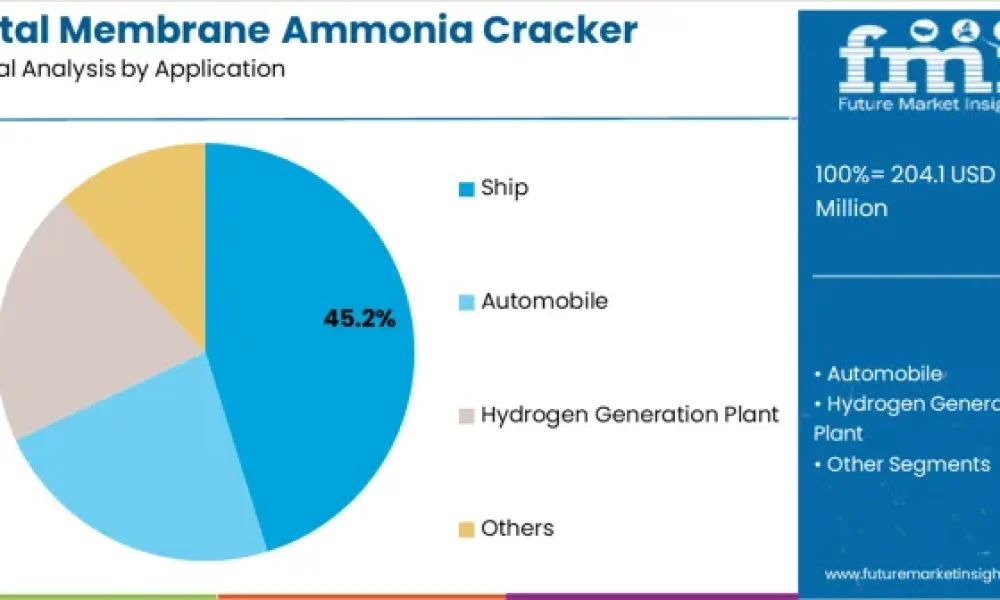
The global Metal Membrane Ammonia Cracker Market is entering a period of unprecedented expansion as industries worldwide pivot toward low-carbon hydrogen pathways. According to the latest assessment by Future Market Insights (FMI), the market will surge from USD 204.1 million in 2025 to USD 1,350.9 million by 2035, delivering an extraordinary CAGR of 20.8% — one of the highest across the clean-energy equipment landscape.
This acceleration reflects the rising adoption of ammonia as a hydrogen carrier, its expanding role in industrial sustainability strategies, and the transformative shift in global maritime, automotive, and energy sectors toward cleaner alternatives.
Hydrogen Demand, Green Policies, and Infrastructure Scale-Up Fuel Rapid Market Growth
Metal membrane ammonia crackers are gaining global attention as industries seek secure, flexible, and cost-efficient access to hydrogen. Ammonia’s ability to be stored and transported using existing logistics systems positions it as a highly scalable hydrogen vector.
Subscribe for Year-Round Insights → Stay ahead with quarterly and annual data updates: https://www.futuremarketinsights.com/reports/sample/rep-gb-26967
FMI identifies three primary demand drivers:
- Decarbonization of Maritime Transport
Shipping companies are increasingly adopting ammonia-to-hydrogen conversion to meet International Maritime Organization (IMO) decarbonization mandates. Shipboard crackers ensure uninterrupted hydrogen supply for fuel-cell propulsion and auxiliary systems.
- Government Hydrogen Roadmaps
APAC and Europe lead global hydrogen policy commitments. Major investments in ammonia infrastructure and hydrogen-ready ports are creating fertile ground for membrane cracker deployment.
- Industrial Transition Toward Low-Carbon Processing
Chemical, petrochemical, steel, and refining facilities are adopting ammonia-based hydrogen supply chains to reduce emissions, enhance energy security, and modernize legacy operations.
Pd-Ag Membrane Technology Dominates with 76% Market Share
Among membrane types, Pd-Ag (Palladium-Silver) membranes will capture 76% of the global share in 2025, making them the industry’s gold standard. Their high hydrogen selectivity, resistance to high-temperature degradation, and strong performance in dynamic marine and industrial environments make them the preferred choice for large-scale systems.
Continuous R&D advancements in alloy stability, membrane durability, and cost optimization further strengthen the segment’s leadership over other membrane types, including Pd-Cu, ceramic, and polymer variants.
Ship Applications Lead with 45.2% Share in 2025
Maritime adoption remains the strongest demand catalyst, with ship applications projected to hold 45.2% of global market share in 2025. Onboard cracker systems are becoming essential for:
- Hydrogen-powered propulsion
- Emission-free auxiliary power
- Compliance with carbon pricing and environmental regulations
- Fuel flexibility across global ports
Compact, modular membrane cracker designs optimized for marine engine rooms are accelerating adoption among commercial and cargo fleets.
Market Captures 23.1% Combined Share Across Parent Industries
FMI estimates that metal membrane ammonia crackers account for:
- 4.5% of the ammonia production market
- 6.7% of the hydrogen production market
- 5.2% of chemical process equipment
- 3.9% of industrial gas equipment
- 2.8% of renewable energy equipment
This 23.1% consolidated share underscores the technology’s rapidly expanding influence across industrial ecosystems transitioning to greener operations.
Need tailored insights? Request report customization to match your specific business objectives: https://www.futuremarketinsights.com/customization-available/rep-gb-26967
Global Regional Outlook: APAC Leads, Europe Accelerates, USA Innovates, Saudi Arabia Invests
APAC (China, Japan, South Korea, India)
APAC remains the world’s most dynamic growth hub, supported by multibillion-dollar hydrogen infrastructure programs.
- China: CAGR 28.1%, driven by massive maritime pilots and port modernization
- India: CAGR 26.0%, with adoption rising across refining and industrial manufacturing
- Japan and South Korea focus on precision membrane systems and shipboard integration
Europe (Germany, UK, France, Nordics)
Europe continues to lead in hydrogen standards and maritime decarbonization:
- Germany: CAGR 23.9%, strengthened by cutting-edge membrane research
- UK: CAGR 17.7%, backed by strong maritime integration programs
- EU-wide funding boosts adoption across shipping routes, ports, and industrial clusters
United States
The U.S. market grows at 19.8% CAGR, supported by Department of Energy funding, industrial hydrogen pilots, and deployments across ports such as Houston, Long Beach, and New York.
Saudi Arabia & Middle East
Saudi Arabia is emerging as a strategic expansion point as it develops clean ammonia hubs under national hydrogen programs. Crackers are being integrated into export infrastructure and industrial decarbonization initiatives.
USD 1.1–1.2 Billion Opportunity Pathway Through 2035
FMI’s revenue opportunity analysis identifies USD 1.1–1.2 billion in incremental growth driven by:
- Pd-Ag systems for maritime decarbonization (USD 280–300M)
- Pd-Cu for automotive fuel-cell use (USD 230–250M)
- Modular systems for hydrogen plants in India & Brazil (USD 200–220M)
- Distributed systems in USA & UK (USD 160–180M)
- Low-cost membrane innovation (USD 120–140M)
- Localized manufacturing in APAC (USD 110–120M)
The combination of membrane innovation, transport-sector decarbonization, and distributed hydrogen generation forms the backbone of long-term market potential.
Key Market Challenges
While growth remains robust, FMI notes challenges including:
- High palladium alloy costs
- Limited global membrane manufacturing capacity
- Complex integration with existing hydrogen infrastructure
- Regulatory uncertainty in marine ammonia handling
- Competition from direct-ammonia fuel technologies in niche applications
Despite these factors, industry momentum indicates sustained multi-sector adoption.
Country-Level Highlights
- China: Over USD 15B hydrogen project funding catalyzes rapid deployment.
- India: Strong industrial hydrogen demand under national clean energy missions.
- Germany: Leading R&D hub improving system efficiency by >15%.
- Brazil: Growing industrial adoption across petrochemical and shipping sectors.
- Japan: 82% reliance on Pd-Ag technology for high-precision systems.
- South Korea: Ship applications lead with 48% share.
About Future Market Insights (FMI)
Future Market Insights, Inc. (FMI) is an ESOMAR-certified, ISO 9001:2015 market research and consulting organization, trusted by Fortune 500 clients and global enterprises. With operations in the U.S., UK, India, and Dubai, FMI provides data-backed insights and strategic intelligence across 30+ industries and 1200 markets worldwide.
Why Choose FMI: Empowering Decisions that Drive Real-World Outcomes: https://www.futuremarketinsights.com/why-fmi



